Materials discovery has always been slow. Synthesizing and characterizing a single novel crystal can take weeks. High-throughput computational screening helps, but someone still must choose which structures to simulate, interpret density functional theory outputs, and decide what merits lab validation. The global push toward solid-state batteries, green hydrogen catalysts, and semiconductor materials intensifies pressure on R&D timelines that manual screening cannot meet at scale. MatBrain, published in Nature Machine Intelligence, automates that decision loop. The system uses a 14-billion-parameter executive model (Mat-T1) to orchestrate specialized tools through the Mat-MCP toolkit, while a 30-billion-parameter analytical model (Mat-R1) evaluates structural candidates. In benchmark runs, MatBrain screened 30,000 structures in 48 hours and flagged 38 promising materials, compressing timelines that typically span months.
This guide explains what MatBrain does, why tool orchestration beats raw LLM prompting for science, how human-active-time metrics change R&D economics, and where the approach hits limits. Teams exploring AI research agents or AI automation for lab workflows will find a concrete matbrain materials ai agent case study in crystallography.
MatBrain in Practice: An Agent That Runs the Screening Loop
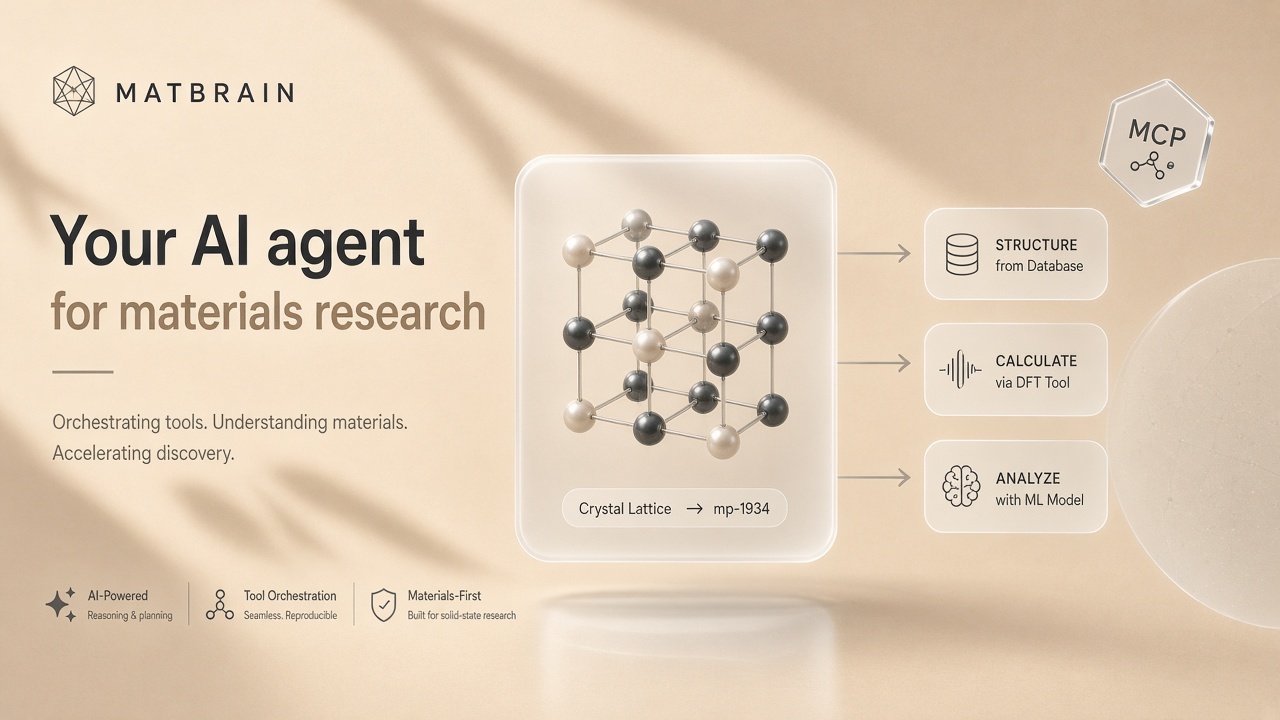
MatBrain is an autonomous materials research agent that plans, executes, and iterates crystal structure screening workflows by calling domain-specific computational tools rather than hallucinating material properties from language alone. The agent receives a research objective (for example, identify stable perovskite candidates with target band gaps), queries crystal structure databases, runs stability and property predictions, ranks results, and proposes follow-up simulations based on intermediate outputs.
The architecture splits responsibilities. Mat-T1, the 14B executive model, handles planning, tool selection, and workflow state. Mat-R1, the 30B analytical model, performs deeper structural reasoning on candidate materials flagged by the executive layer. Mat-MCP (Model Context Protocol toolkit) exposes materials science functions as callable tools: structure retrieval, DFT pre-screening, symmetry analysis, and literature cross reference. MatBrain was trained with DAPO reinforcement learning to improve multi-step tool use over time.
| Component | Size / type | Function |
|---|---|---|
| Mat-T1 | 14B executive LLM | Plans workflows, selects tools, manages iteration |
| Mat-R1 | 30B analytical LLM | Deep evaluation of structural candidates |
| Mat-MCP | Tool toolkit | Exposes materials databases and simulation APIs |
| DAPO RL | Training method | Optimizes multi-step tool orchestration policies |
Why Tool Orchestration Outperforms a Frontier Model Alone
Raw large language models lack grounded access to crystal databases and physics simulators; MatBrain achieves roughly 100x acceleration and 95% hardware reduction versus frontier API models by delegating computation to specialized tools instead of internalizing every materials science capability. Ask GPT-4 class models to predict formation energies without tools and you get plausible-sounding numbers with no guarantee of physical validity. MatBrain calls validated pipelines and reads their outputs.
The economic comparison is instructive. Running MatBrain on modest GPU infrastructure delivered screening throughput that previously required expensive frontier model API calls or large human teams. The 95% hardware reduction figure from the paper reflects switching from monolithic frontier inference to a smaller executive model plus deterministic scientific software. For R&D budget owners, that shifts spend from per-token API fees to amortized on-premise or cluster compute for simulation backends.
Benchmark Results at a Glance
In the reported evaluation, MatBrain processed 30,000 crystal structures within 48 hours and identified 38 candidates warranting further investigation. Manual workflows covering equivalent breadth typically require months of graduate student and postdoctoral time interleaved with queue waits on shared supercomputers. The agent does not eliminate human judgment at the synthesis stage; it front-loads computational triage so humans spend time on the most promising 0.1% of the search space.
How DAPO Reinforcement Learning Shaped MatBrain Policies
DAPO (Decoupled Clip and Dynamic Sampling Policy Optimization) reinforcement learning trained MatBrain to prefer tool sequences that produced validated structural candidates over sequences that wasted simulation budget on chemically implausible compositions. RL for scientific agents differs from chatbot RLHF: rewards come from downstream simulation scores and database match quality, not human preference ratings on prose fluency. MatBrain policies learned to call expensive DFT pre-screening only after cheaper symmetry and stability filters eliminated obvious non-starters, mirroring how experienced materials scientists triage manually.
Human-Active-Time: The Metric R&D Leaders Should Track
Human-active-time measures how many hours a qualified researcher must personally intervene in a discovery workflow, and MatBrain reduces this metric by automating routine tool calls, data aggregation, and ranking decisions that previously consumed calendar time even when compute ran overnight. Traditional timelines conflate wall-clock duration (including idle simulation queues) with researcher attention. An agent that runs 48-hour screening cycles with hourly check-ins changes staffing models.
For materials R&D teams, the implication is headcount reallocation rather than headcount elimination. Specialists shift from clicking through simulation GUIs to defining search objectives, validating agent proposals, and designing synthesis experiments for agent-shortlisted candidates. Labs that measure success by structures screened per FTE per quarter will see step-function improvements before they see patent filings.
Implications for Corporate and Academic R&D
MatBrain-style agents lower the barrier for mid-size materials companies and university labs to run high-throughput virtual screening without building bespoke orchestration code from scratch. Battery electrolytes, catalysts, semiconductors, and thermoelectric materials all share a similar discovery funnel: hypothesize composition, check stability, estimate target property, synthesize winners. Agent frameworks generalize across these verticals when the Mat-MCP tool surface expands.
Competition dynamics shift too. A team with MatBrain plus existing synthesis capacity can explore chemical spaces that larger incumbents previously monopolized through brute-force hiring. IP strategy may move earlier: if agents can scan 30,000 structures in two days, the race is won by who defines the best search objective and validates fastest in the lab, not who has the biggest manual screening team.
How MatBrain Compares to Other Agentic Science Systems
MatBrain joins a growing class of agentic science platforms that combine LLM planning with domain tools, alongside chemistry agents, protein design pipelines, and autonomous lab robotics systems, but distinguishes itself through materials-specific Mat-MCP tooling and dual-model executive-analytical architecture. Chemistry-focused agents like Coscientist and similar systems optimize reaction planning. Protein agents target AlphaFold-era structure prediction and binder design. MatBrain occupies crystallography and solid-state materials, where the bottleneck is screening vast composition spaces rather than designing single molecules.
The dual-model split (14B executive, 30B analytical) reflects a broader pattern in efficient agent design: small models handle frequent tool routing decisions while larger models engage only for high-stakes evaluation. This mirrors enterprise AI architectures that route simple queries to distilled models and complex reasoning to frontier endpoints. MatBrain proves the pattern in scientific discovery, not just customer support chatbots.
Deployment Considerations for R&D Organizations
Organizations deploying MatBrain-style agents need integration with existing materials informatics infrastructure, including structure databases, simulation queues, and electronic lab notebooks for handoff to synthesis teams. The agent is only as useful as the tools Mat-MCP exposes. Labs running proprietary DFT workflows must wrap those workflows as MCP-compatible functions before the agent can invoke them. Open materials databases like the Materials Project and COD provide natural starting points.
Change management matters as much as technical integration. Postdoctoral researchers accustomed to manual screening may view agent automation as threatening until they see human-active-time reductions on their own projects. Pilot programs that let one research group define objectives, run MatBrain screening, and present results at group meeting build internal champions faster than top-down mandates from R&D leadership.
Where MatBrain Stops: Limits and Open Questions
MatBrain validates computational screening acceleration but does not autonomously synthesize materials, characterize samples in physical labs, or replace safety review for hazardous precursors. The 38 promising structures still require experimental confirmation. DFT and machine-learned interatomic potentials carry known error modes for strongly correlated systems, metastable phases, and defect-rich environments.
Tool coverage defines the agent's ceiling. Mat-MCP must expose each new simulation modality before MatBrain can use it. Reinforcement learning policies trained on one materials class may transfer poorly to another without retraining. Governance questions mirror other autonomous lab systems: who signs off when an agent proposes a mercury-containing or pyrophoric synthesis route? Human oversight remains mandatory at decision gates with safety and budget consequences.
National laboratory systems investing in energy materials may adopt MatBrain-style agents to accelerate battery cathode and solid electrolyte discovery under DOE and equivalent international programs. The 30,000-structure throughput in 48 hours aligns with quarterly milestone reporting cycles common in government-funded materials science. Principal investigators can demonstrate progress with agent-generated candidate lists rather than incremental manual screening logs.
Venture-backed materials startups competing on speed to prototype should evaluate whether building custom agent orchestration or licensing MatBrain-derived frameworks delivers faster time to value. The Nature Machine Intelligence publication provides academic credibility for grant applications and partnership discussions with established chemical companies exploring AI-accelerated R&D joint ventures.
Frequently Asked Questions
What is MatBrain?
MatBrain is an autonomous materials research agent published in Nature Machine Intelligence. It uses Mat-T1 (14B executive model) and Mat-R1 (30B analytical model) with the Mat-MCP tool toolkit to screen crystal structures and rank candidates for further study.
How fast is MatBrain compared to manual screening?
MatBrain screened 30,000 structures in 48 hours and identified 38 promising candidates, representing roughly 100x acceleration over comparable manual workflows that span months.
What is Mat-MCP?
Mat-MCP is a Model Context Protocol toolkit that exposes materials science databases and simulation tools as callable functions for the MatBrain agent. It grounds LLM planning in validated computational pipelines.
Does MatBrain need frontier GPU clusters?
The published system achieved results with roughly 95% less hardware than frontier model API approaches, using a 14B executive model plus external simulation tools rather than monolithic trillion-parameter inference.
What is DAPO reinforcement learning?
DAPO is the reinforcement learning method used to train MatBrain's multi-step tool orchestration policy, rewarding successful screening trajectories and penalizing failed or inefficient tool sequences.
Will MatBrain replace materials scientists?
No. MatBrain automates computational triage. Synthesis, characterization, safety review, and creative hypothesis formation remain human responsibilities. The agent changes how scientists spend time, not whether they are needed.
Where was MatBrain published?
MatBrain was published in Nature Machine Intelligence. The paper documents the dual-model architecture (Mat-T1 executive and Mat-R1 analytical), Mat-MCP tool integration, DAPO reinforcement learning training, and benchmark results including 30,000 structures screened in 48 hours with 38 promising candidates identified.
What happened to the 38 promising candidates?
The 38 structures flagged by MatBrain represent computational shortlists warranting experimental synthesis and characterization. The published study focused on screening throughput and agent accuracy; follow-up synthesis results will determine how many computational predictions survive contact with physical materials science.
Is Mat-MCP based on the Model Context Protocol?
Yes. Mat-MCP follows the Model Context Protocol standard for exposing tools to LLM agents, allowing MatBrain to call materials science databases and simulation functions through a standardized interface that other agent frameworks can adopt for cross-domain scientific automation.