A child presents with seizures, developmental delay, and subtle craniofacial features. Exome sequencing returns thousands of variants of uncertain significance. The family has already visited eight specialists over six years. This diagnostic odyssey is typical: a 2024 EURORDIS Rare Barometer survey of 6,507 patients across 41 European countries found an average time to diagnosis of 4.7 years, with 25% waiting more than five years after first symptoms. AI rare disease diagnosis genomic pipelines combine phenotype encoding, variant prioritization, facial gestalt scoring, and cross-institutional matching to surface plausible causal genes faster than manual chart review alone. None of these systems replace a clinical geneticist; they compress search space so human experts focus on the most informative hypotheses.
Hospital informatics teams evaluating decision-support software should understand federated data exchange, consent models, and how gestalt scores interact with Human Phenotype Ontology (HPO) terms. Clinicians exploring AI chatbot assistants for patient education should pair them with validated genomic prioritization tools, not unconstrained large language model guesses. More research explainers on medical AI appear on the EliteAI.tools blog index.
What AI Rare Disease Diagnosis Genomic Means in Plain Language
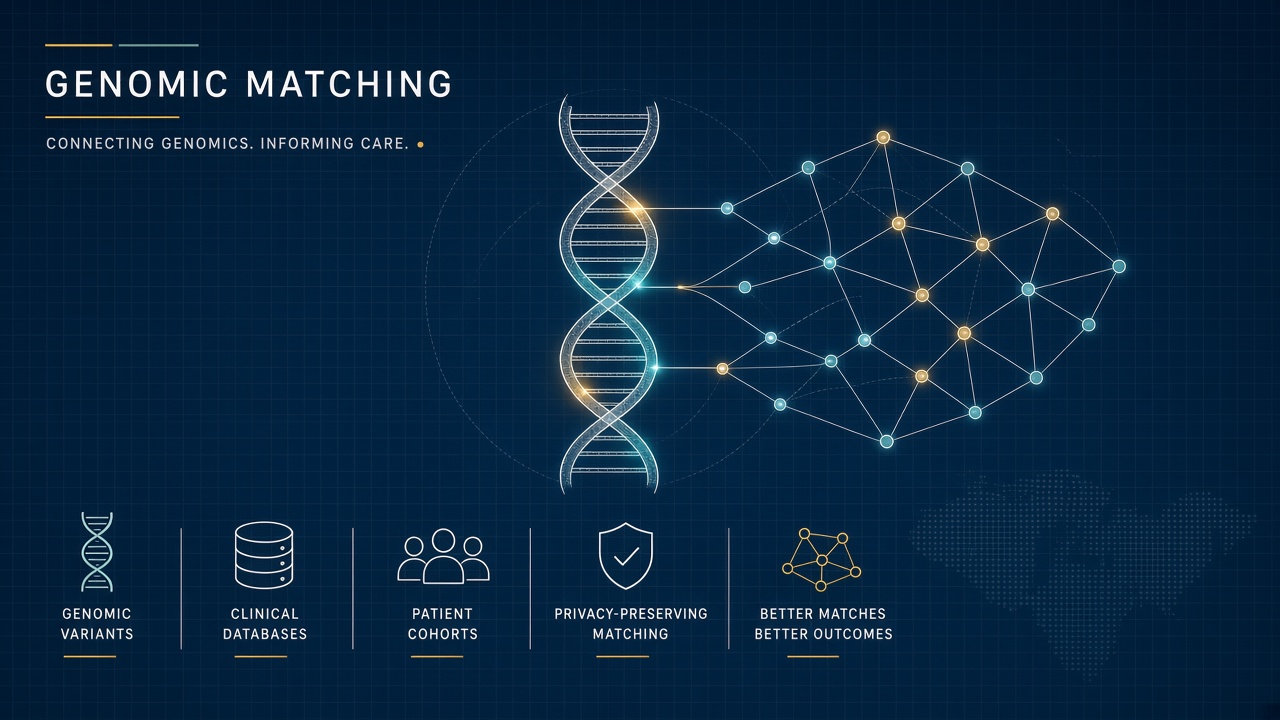
AI rare disease diagnosis genomic refers to computational workflows that rank candidate disease genes and match undiagnosed patients across databases using structured phenotypes, sequencing variants, and sometimes facial photographs, so clinicians can prioritize confirmatory testing. Rare Mendelian disorders often affect fewer than one in 50,000 people, which means a single hospital may never see two patients with the same novel gene. Matching networks solve the sample-size problem by connecting clinicians who share overlapping genotypes and phenotypes without centralizing all raw genomic data.
The workflow sits downstream of exome or genome sequencing. Variant callers identify millions of differences from a reference genome; annotators label each variant with population frequency, predicted pathogenicity, and gene function. AI layers add phenotype-aware re-ranking: genes whose associated disorders match the patient's HPO terms rise in the list. When two patients share a rare variant in the same gene and similar phenotypes, confidence increases that the gene is truly causal.
| Data layer | Standard format | AI role |
|---|---|---|
| Clinical phenotype | HPO terms, PhenoPackets (GA4GH) | Phen2Gene gene prioritization |
| Facial gestalt | Patient photographs (consented) | DeepGestalt, GestaltMatcher similarity |
| Genomic variants | VCF, HGVS notation | CADD, REVEL, ACMG classification |
| Cross-site matching | Matchmaker Exchange API | Federated genotype-phenotype queries |
The diagnostic odyssey in numbers
Up to 50% of rare disease patients may remain undiagnosed even in advanced expert centers that routinely apply genome sequencing, because single-center case volume is too small to implicate novel genes. Misdiagnosis is common: 73% of respondents in the EURORDIS survey reported at least one incorrect diagnosis during their journey. Women wait an average of 5.4 years versus 3.7 years for men, reflecting systemic bias in symptom recognition. AI matching does not fix inequity by itself, but faster gene discovery can reduce repeated invasive testing and psychological harm from prolonged uncertainty.
How the Underlying AI Pipeline Works
Modern rare disease AI stacks chain phenotype-driven gene ranking, variant pathogenicity scoring, optional facial gestalt embedding, and federated patient matching into a single interpretable report for the clinical team. Each module outputs ranked lists with confidence metadata; integrators like the PEDIA workflow (prioritization of exome data by image analysis) combine gestalt scores with CADD variant impact and HPO-based CADA phenotype scores.
Phenotype-driven gene prioritization with Phen2Gene
Phen2Gene, developed at the Wang Genomics Lab and published in NAR Genomics and Bioinformatics (2020, doi:10.1093/nargab/lqaa032), ranks candidate genes from HPO term lists in a median 0.94 seconds using the precomputed HPO2Gene Knowledgebase. Unlike binary HPO-gene annotations, each HPO term links to a weighted ranked gene list with confidence scores derived from gene-disease databases and gene-gene interaction networks. Clinicians submit semicolon-separated HPO IDs via REST API or PhenoPacket JSON; the tool returns a JSON-ranked gene list suitable for merging with variant filters. Phen2Gene is variant-agnostic, so it can prioritize genes even when structural variants or repeat expansions are not yet called by standard pipelines.
Facial gestalt scoring and PEDIA integration
Face2Gene's DeepGestalt neural network classifies hundreds of established syndromes from patient photographs, reporting top-ten suggestions rather than single-label diagnoses. GestaltMatcher extends DeepGestalt by embedding patients in a clinical face phenotype space where distance reflects syndromic similarity, enabling matches for ultrarare disorders absent from training sets. A 2024 Nature Genetics study of 1,577 ultrarare disorder patients in Germany integrated GestaltMatcher gestalt scores into PEDIA variant interpretation for 224 consented cases. In 94 molecularly solved cases, gestalt scores improved gene ranking in 81 instances (86%), lifting the causal gene when facial dysmorphism was a feature and solved comparator cases existed in the GestaltMatcher database.
Genomic variant prioritization layers
After sequencing, variant prioritization tools score each change for predicted deleteriousness. Combined Annotation Dependent Depletion (CADD) integrates multiple annotations into a single pathogenicity score. REVEL and MetaRNN add missense-specific predictors. American College of Medical Genetics and Genomics (ACMG) criteria provide rule-based classification for reportable variants. AI re-rankers merge these scores with phenotype gene lists: a variant in a gene ranked first by Phen2Gene and second by gestalt similarity receives higher composite priority than a high CADD score in an unrelated gene. Laboratories tune thresholds to balance sensitivity against false positives in trio exome analysis.
Matchmaker Exchange and federated matching
Matchmaker Exchange, launched in 2013 and described in Human Mutation (2015, doi:10.1002/humu.22858), connects six major nodes (DECIPHER, GeneMatcher, PhenomeCentral, seqr, MyGene2, IRUD Exchange) through standardized APIs. Clinicians submit candidate genes and phenotypes; the exchange queries peer databases for patients with overlapping profiles without pooling all raw genomes in one warehouse. A single additional case with a deleterious variant in the same gene and overlapping phenotype can provide sufficient evidence to implicate a novel disease gene. The network spans more than 150,000 cases from over 11,000 contributors in 88 countries, making it the backbone of international rare disease gene discovery.
| Component | Input | Output |
|---|---|---|
| Phen2Gene | HPO terms or PhenoPacket | Ranked gene list with scores |
| DeepGestalt / GestaltMatcher | Facial photograph | Syndrome similarity rankings |
| CADD / REVEL | VCF variant | Pathogenicity score |
| Matchmaker Exchange | Gene + phenotype query | Matched patient contacts |
Typical clinical workflow steps
- Curate HPO terms from history, exam, and imaging; avoid over-specific terms that exclude plausible genes.
- Run exome or genome sequencing with trio analysis when parents are available.
- Apply Phen2Gene or equivalent to generate a phenotype-weighted gene shortlist.
- Intersect shortlist with filtered variants (gnomAD frequency, inheritance model).
- Optionally upload facial photograph for GestaltMatcher gestalt score if dysmorphism is present and consent allows.
- Merge scores in an integrator such as PEDIA; review top candidates with ACMG criteria.
- Submit unsolved high-confidence variants to Matchmaker Exchange or GeneMatcher.
- Confirm diagnosis with functional studies, segregation analysis, or literature review before reporting.
Real Deployments and Published Evidence
National rare disease frameworks in Germany, the United Kingdom, and the United States integrate next-generation phenotyping into clinical genomics pipelines, with peer-reviewed outcome data from multi-year cohort studies. The 2024 Nature Genetics German ultrarare cohort demonstrates operational integration of GestaltMatcher and PEDIA at scale, not only bench validation. Face2Gene reports use in roughly two thousand clinics globally, though independent accuracy varies by ancestry and syndrome prevalence.
A 2024 Journal of Medical Internet Research comparative study evaluated DeepGestalt, GestaltMatcher, and D-Score on clinical photographs, concluding that algorithms can support clinicians with limited syndromology experience when used with caution. Phen2Gene remains widely deployed via web server and REST API in research and clinical laboratories that need sub-second turnaround during multidisciplinary conferences. Matchmaker Exchange has enabled discovery of hundreds of novel disease genes since 2013, with each match often triggered by a single additional patient.
Undiagnosed Diseases Network programs in the United States and analogous networks in Canada, Japan, and Australia combine deep phenotyping, RNA sequencing, and matching platforms. Yield improves when facial AI, HPO depth, and MME queries run in parallel rather than sequentially, because each modality captures orthogonal evidence. Pediatric consent and photograph storage require GDPR-compliant data processing agreements when cloud facial analysis vendors process identifiable images.
What published benchmarks actually measure
Top-ten accuracy metrics dominate facial AI papers: the correct syndrome appears somewhere in the first ten suggestions. Top-one accuracy is substantially lower and more clinically relevant for automated reporting. Phen2Gene benchmarks on 197 literature cases and 85 de-identified hospital cases show competitive ranking against Phenolyzer and other tools, but performance drops when HPO terms are incomplete or entered by nonspecialists. Genomic matching success depends on another site having already uploaded a similar case, creating a cold-start problem for truly novel phenotypes.
Large language models and phenotype extraction
Some clinics experiment with large language models to extract HPO terms from clinical notes before feeding Phen2Gene. Doc2Hpo and similar tools map free text to ontology concepts with useful but imperfect recall. Missed negation ("no seizures") or vague wording ("developmental concerns") propagates errors into gene rankings. Human curator review of HPO terms before prioritization remains standard practice in accredited laboratories. LLM chat interfaces should not replace structured phenotype capture in production diagnostic pipelines without validation studies measuring term-level precision and recall against geneticist-curated gold standards.
RNA sequencing and functional assays increasingly follow exome-negative cases. When DNA sequencing is inconclusive, transcriptome analysis can detect aberrant splicing or monoallelic expression. AI matching networks focus on DNA variant sharing today, but PhenoPackets and GA4GH standards evolve to encode multi-omic evidence so future MME queries can match on expression signatures as well as genotypes.
Limits, Risks, and Ethical Guardrails
AI genomic matching can reinforce training-set bias, mishandle population diversity in facial gestalt models, and create false confidence when composite scores align by chance across weak signals. DeepGestalt training skews toward syndromes with many contributed photographs, often from European and North American cohorts. Underrepresented ancestries see lower top-ten accuracy in independent evaluations. GestaltMatcher helps ultrarare cases only when phenotypically similar solved patients exist in its database.
- Consent and privacy: Facial photographs and genomic data require explicit consent for AI analysis and cross-border sharing.
- Incidental findings: Broad sequencing reveals secondary variants unrelated to the presenting phenotype.
- Automation bias: Clinicians may anchor on AI top suggestions and under-search plausible alternatives.
- Re-identification risk: Rare genotype-phenotype combinations can identify families in federated databases.
- Regulatory ambiguity: Some prioritization tools are research-use-only; clinical reporting requires laboratory-developed test validation.
Ethical deployment follows ACMG reporting guidelines, IRB oversight for novel matching protocols, and transparent patient communication that AI suggestions are hypothesis-generating. Equity initiatives should expand diverse photograph contributions to gestalt databases and fund MME nodes in low-resource regions so matching networks are not dominated by wealthy-country cases.
Who Should Use This and Who Should Wait
Clinical genetics laboratories, undiagnosed disease programs, and academic rare disease centers should integrate validated phenotype-gene tools and MME membership into standard exome interpretation workflows. Primary care physicians should refer complex cases to genetics rather than relying on consumer facial apps. Health systems without secure genomic infrastructure should build consent and storage before uploading patient data to third-party APIs.
| Stakeholder | Recommendation | Guardrail |
|---|---|---|
| Clinical genetics lab | Deploy Phen2Gene + MME integration | Validate against local case series |
| Undiagnosed disease clinic | Add PEDIA-style gestalt scoring | Separate photograph consent |
| Primary care | Refer early; avoid DIY genomic apps | No diagnosis from AI alone |
| Patients and families | Join registries (MME nodes, MyGene2) | Understand data sharing scope |
Frequently Asked Questions
Can AI diagnose a rare disease without a geneticist?
No. AI ranks hypotheses and matches patients; ACMG-qualified professionals interpret variants and issue clinical reports. Top-ten facial suggestions and gene lists require confirmatory testing and phenotypic correlation.
How does Phen2Gene differ from Matchmaker Exchange?
Phen2Gene ranks genes from HPO terms alone in seconds; Matchmaker Exchange searches other institutions for patients with overlapping genotypes and phenotypes. They complement each other in the same workflow.
When does GestaltMatcher help ultrarare cases?
GestaltMatcher helps when facial dysmorphism is present and phenotypically similar molecularly solved cases exist in its database. Disorders without distinctive facies or without database comparators gain little from gestalt scoring.
What accuracy should clinicians expect?
Accuracy varies by ancestry, HPO completeness, and syndrome prevalence; published facial AI studies emphasize top-ten rather than top-one performance. Genomic matching success rates depend on network participation and case upload quality.
Are these tools FDA-cleared medical devices?
Many prioritization and matching platforms are laboratory-developed tests or research tools regulated under CLIA and local laboratory law rather than as standalone SaMD. Verify regulatory status before clinical reporting in your jurisdiction.
What consent is needed for facial genomic matching?
Separate consents typically cover clinical photography, genomic sequencing, and cross-institutional sharing via Matchmaker Exchange nodes. GDPR and state privacy laws may restrict cloud processing of children's photographs.
Can AI shorten the five-year diagnostic odyssey?
Integrated phenotype-genotype-matching workflows have shortened time-to-gene in cohort studies when cases are referred early to expert centers. Systemic delays from misdiagnosis, insurance authorization, and geographic access require policy fixes beyond software.
Insurance, reimbursement, and access
Exome and genome sequencing coverage varies by payer and country. When sequencing is denied, Phen2Gene can still suggest candidate genes for targeted single-gene or panel testing, lowering cost but lengthening the pathway if the true diagnosis sits outside the shortlist. Centers of expertise that bundle sequencing, phenotyping, and MME membership shorten odysseys by 1.1 years on average in EURORDIS survey data compared with patients never referred. Health systems should treat genomic matching infrastructure as part of rare disease program funding, not an optional research addon, because network effects compound as more cases upload.
Conclusion
AI rare disease diagnosis genomic pipelines weave Phen2Gene phenotype ranking, CADD and ACMG variant interpretation, GestaltMatcher facial gestalt scoring, and Matchmaker Exchange federated matching into workflows that address the sample-size limits of rare Mendelian genetics. Published evidence from German national cohorts and long-running matching networks shows measurable gains in gene prioritization when modalities combine, though accuracy varies and bias persists in facial models. The 4.7-year average diagnostic odyssey will not disappear from software alone, but genomic matching networks give clinicians and families a structured path from undiagnosed to molecularly confirmed when another patient's data completes the puzzle.