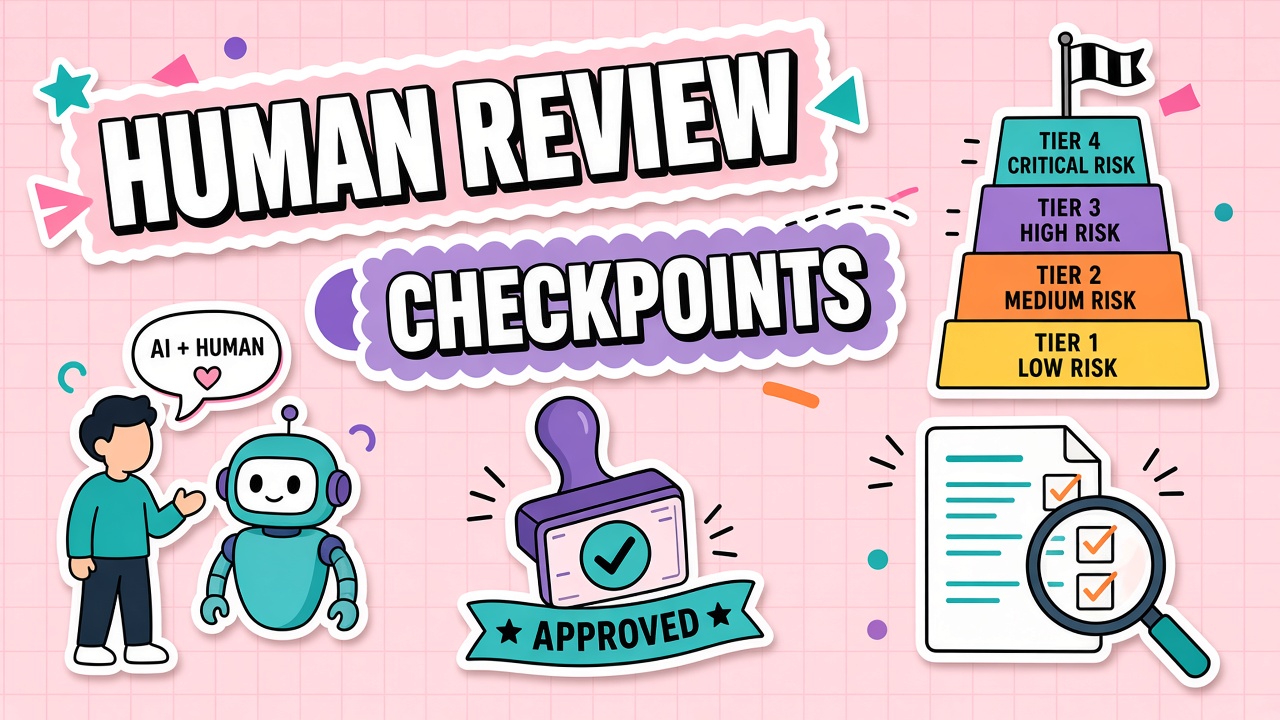
AI accelerates drafts. Humans remain accountable for decisions that affect customers, money, compliance, and reputation. Teams that skip checkpoints ship fast until the first costly error. Teams that review everything ship slowly and train reviewers to rubber-stamp outputs they do not read.
Human review in AI workflows works when checkpoints match risk tier and workflow stage. This guide maps where to insert approvals, what reviewers need in the evidence pack, and how to escalate failures without killing useful speed. Pair governance with AI writing tools and AI productivity tools that support draft, comment, and approve states in your existing systems.
Risk Tiers for AI-Assisted Work
Risk tiers classify work by blast radius if AI output is wrong. Assign tiers before choosing checkpoint patterns. Static tier labels plus dynamic signals (amount, sentiment, data sensitivity) catch edge cases.
| Tier | Example work | Review pattern |
|---|---|---|
| Low | Internal summaries, brainstorm lists | Audit log; spot sampling |
| Medium | Customer emails, CRM updates, published drafts | Pre-send or pre-publish approval |
| High | Payments, contract language, regulated filings | Mandatory approval; dual review if required |
| Critical | Safety, legal holds, irreversible deletes | Human-only execution; AI may suggest only |
Checkpoint Placement by Workflow Stage
Place checkpoints before irreversible actions, at multi-step plan milestones, and when confidence or novelty scores fall below threshold. Avoid reviewing only after customer impact; rollback is expensive.
- Before external send: Email, social, support replies, press statements
- Before destructive write: Database overwrites, record deletion, production config
- Before financial action: Refunds, credits, pricing changes
- At plan milestones: Multi-step agent plans pause between segments for high-tier work
- On anomaly: Policy check failure, unusual amount, negative sentiment escalation
Most workflows need two to three checkpoints, not ten. If reviewers approve ninety-five percent without edits, tiering is probably too heavy. If errors reach customers, tiering is too light or rubrics are unclear.
Reviewer Skills and Rubrics
Reviewers need domain judgment, not prompt engineering mastery. Provide a five-point rubric: factual accuracy, completeness, tone, policy compliance, residual risk. Reviewers edit or reject with short notes models can learn from only when you capture feedback in the prompt library.
Route specialist cases to finance, legal, or security queues instead of forcing generalists to guess. Time-box approvals with safe default: block the action if nobody responds within the SLA unless emergency override is documented.
Escalation When AI Output Fails Review
Failed review triggers one of four paths: revise with annotated feedback and rerun, human rewrite from AI outline, escalate to senior reviewer, or abort and fall back to manual process. Log failure mode to improve prompts or retire the workflow tier from automation.
Balancing Speed and Accuracy
Use exception-only review for stable low-tier workflows after thirty days of strong first-pass acceptance. Keep full review on tier jumps, new prompt versions, and new data sources. Staged actions (suggest, draft, send) let speed and safety coexist.
Evidence Pack Checklist for Reviewers
Every approval queue item should include: proposed action in plain language, affected record or customer, sources the model used, policy checks run, expected effect, downside if wrong, approve/reject/edit options, and expiry time with fallback owner. Reviewers should not hunt through chat logs for context.
Sampling low-tier workflows
After stable first-pass acceptance, review a random five to ten percent sample weekly instead of every output. Increase sample rate when models update, prompts change, or error reports spike. Sampling catches drift without permanent bottlenecks.
Audit trail requirements
Log reviewer identity, timestamp, policy version, inputs hash or reference, decision, and execution result. Retain logs per your compliance schedule. Audit trails turn human review from theater into demonstrable control.
Checkpoint Patterns by Workflow Type
Content workflows: checkpoint before publish and after major structural AI rewrites. Support workflows: checkpoint before customer send and when sentiment classifiers flag escalation. Data workflows: checkpoint before destructive writes and when confidence on field mapping falls below threshold. Code workflows: checkpoint before merge and when generated code touches auth, payments, or PII paths.
Map patterns in a shared playbook so new teams do not reinvent tiers from scratch. Update the playbook when regulators, clients, or incident reviews expose gaps.
Timeout and escalation defaults
Unanswered approvals should default to block, not auto-send. Escalate to backup reviewer after SLA breach. Document emergency override with post-hoc review for true incidents. Overrides without logging recreate the risks checkpoints were meant to prevent.
Frequently Asked Questions
What changes for client-facing deliverables?
Follow client contract disclosure rules, run medium or high tier review, and keep evidence packs with source citations. Never ship client work from personal AI accounts lacking enterprise controls.
How do regulated industries differ?
Map checkpoints to control frameworks your auditors expect. Retain reviewer identity, timestamp, policy version, and inputs used. Some flows require human-only final sign-off with AI restricted to research assistance.
Reviewers are becoming a bottleneck. What now?
Narrow tier scope, improve prompts to raise first-pass acceptance, batch similar approvals, or add sampled review for proven low-risk classes. Do not remove checkpoints on high-tier work to hit deadlines.
Do AI agents need different checkpoints than chat tools?
Yes. Agents chain tool calls with compounding error risk. Require pre-action approval for external effects, persistent logs operators can inspect, and kill switches independent of the agent runtime.
Designing Review Rubrics That Scale
Rubrics should fit on one screen. Train reviewers on three annotated examples: accept as-is, accept with minor edits, reject with reason. Calibrate monthly by having two reviewers score the same sample and discuss divergence. Rubric drift causes false confidence when everyone interprets "policy compliant" differently.
Link rubric dimensions to business harm: factual errors map to customer trust, tone issues map to brand, missing disclosures map to legal exposure. Reviewers prioritize dimensions by tier so low-risk internal notes do not get the same scrutiny as pricing emails.
Capture reject reasons in structured tags: hallucination, wrong tone, incomplete, policy violation, wrong audience. Aggregate tags monthly to feed prompt library updates and training topics.