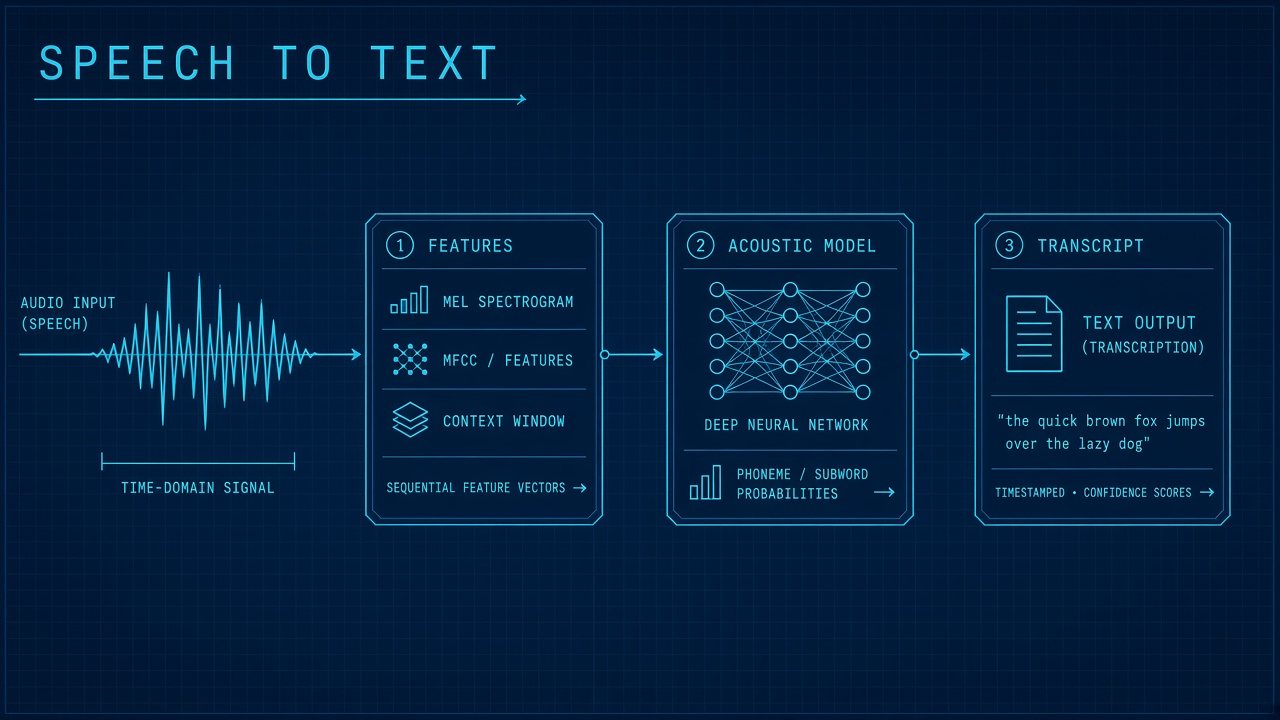
A developer records a standup on a laptop mic, uploads the file, and expects searchable notes in minutes. Speech to text AI explained simply: automatic speech recognition (ASR) models convert audio waveforms into written text, optionally adding punctuation, speaker labels, and word-level timestamps. ASR underpins meeting bots, voice assistants, contact center analytics, and captioning pipelines inside AI code tools that transcribe technical interviews, plus AI automation flows that trigger workflows from spoken commands. Accuracy varies sharply by accent, background noise, domain vocabulary, and whether the API streams live audio or processes finished files.
ASR Pipeline Overview
Modern ASR stacks map audio to text through feature extraction, an acoustic model that predicts phoneme or token likelihoods, and a language model or decoder that chooses the most probable word sequence. Classic pipelines used hidden Markov models with Gaussian mixtures; neural ASR replaced much of that with end-to-end architectures (CTC, RNN-T, Transformer, Conformer) trained on thousands of hours of labeled speech.
| Stage | Role | Typical failure |
|---|---|---|
| Audio capture | Sample rate, channel mix, noise suppression | Clipping, echo, wrong sample rate |
| Feature extraction | Mel spectrograms or learned features | Loss of high-frequency detail |
| Acoustic model | Map frames to tokens or phonemes | Confuses similar sounds in noise |
| Decoder / LM | Rescore with language context | Homophone errors (their vs there) |
| Post-processing | Punctuation, casing, profanity filter | Wrong sentence boundaries |
Whisper-style multimodal models treat ASR as a sequence task: audio tokens in, text tokens out, with optional task tokens for translation or language identification. Vendor APIs (AssemblyAI, Deepgram, Google Speech-to-Text, Azure Speech, Amazon Transcribe) wrap models with diarization, redaction, and custom vocabulary hooks.
Streaming vs Batch Transcription
Streaming ASR emits partial transcripts as audio arrives, optimizing latency for live captions and voice agents; batch ASR processes complete files with higher accuracy and simpler retry logic. Streaming trades some accuracy for responsiveness: partial hypotheses may revise as more context arrives. Batch mode suits podcasts, legal depositions, and archived calls where seconds of delay are acceptable.
| Mode | Latency profile | Best use case |
|---|---|---|
| Real-time streaming | Hundreds of ms to low seconds | Live meetings, IVR, voice bots |
| Async batch | Minutes per hour of audio | Media archives, bulk call analytics |
| On-device | Low network dependency | Mobile dictation, privacy-sensitive capture |
WebSocket vs REST integration
Streaming integrations open a WebSocket, send audio chunks (often PCM or Opus), and receive interim and final transcript events. Batch jobs POST a file URL or upload bytes, poll a job ID, then fetch JSON or SRT output. Engineering teams should handle reconnects, backpressure, and endpointing (detecting when the user stopped speaking) for voice UIs.
Accuracy Factors: Accent, Noise, and Domain
Word error rate (WER) measures insertions, deletions, and substitutions versus a human reference; lower is better, but WER on clean English news does not predict performance on accented technical standups in open offices. Reported vendor benchmarks often use LibriSpeech or similar clean corpora. Your evaluation set should mirror real microphones, codecs, and vocabulary.
- Accent and dialect: Models trained heavily on US English may underperform on Indian English or regional UK variants.
- Background noise: Cafe noise, HVAC hum, and cross-talk raise WER; denoise upstream or pick noise-robust models.
- Domain vocabulary: Medical, legal, and engineering terms need custom vocab or fine-tuned models.
- Audio quality: 8 kHz phone lines vs 48 kHz studio WAV change effective bandwidth.
- Code-switching: Mid-sentence language switches challenge monolingual decoders.
Human-labeled evaluation remains essential: sample 50 clips per environment (Zoom, phone, field recorder) and score WER plus critical error rate (did the model miss a dosage, account number, or safety instruction?).
Punctuation, Diarization, and Timestamps
Post-ASR layers add punctuation and capitalization, attribute speech to speaker labels, and attach word or sentence timestamps for search, subtitles, and compliance redaction. Punctuation models are often separate neural components; they can misplace commas in lists read aloud. Diarization clusters voice embeddings into Speaker 1, Speaker 2 without knowing legal names until calendar metadata maps labels.
Subtitle and caption formats
Exporters produce SRT, VTT, or JSON with start/end times per cue. Frame-accurate captions for broadcast need reading speed limits and speaker cues. Word-level timestamps enable click-to-seek UIs in podcast players and searchable legal review. Verify whether your vendor charges extra for diarization or punctuation; some bundle them only on premium tiers.
Privacy and Retention for Voice Data
Voice data is biometric-adjacent sensitive content: define retention windows, encryption, access controls, and whether vendors may train on customer audio. Enterprise speech APIs offer zero-retention modes, private VPC endpoints, and HIPAA-eligible configurations where applicable. Inform users when calls are transcribed; obtain consent under GDPR, state privacy laws, and union agreements.
| Control | Why it matters | Question for vendors |
|---|---|---|
| Retention TTL | Limits breach blast radius | When are audio and transcripts deleted? |
| Training opt-out | Prevents customer audio in global models | Is model improvement on by default? |
| Redaction | PCI, PHI, SSN patterns masked | Pre- or post-transcription? |
| Regional residency | Data sovereignty compliance | Which regions process audio? |
WER Measurement in Practice
To compute word error rate, align the ASR transcript to a human reference, count substitutions, insertions, and deletions, then divide by reference word count; multiply by 100 for a percentage. A reference of "schedule the meeting" transcribed as "scheduled the meeting" counts one substitution. Inserted filler words and dropped negations both hurt WER but carry different severity in production. Track a separate critical error log for medically or financially consequential mistakes even when overall WER looks acceptable.
Normalizing audio before ASR
Resample to the sample rate your API documents (often 16 kHz mono PCM). Downmix stereo to mono unless the vendor uses spatial cues. Apply gentle loudness normalization without crushing dynamics. Telephony pipelines at 8 kHz need models trained on narrowband audio; feeding phone calls to wideband models inflates error rates. Store original files alongside normalized derivatives for dispute replay.
ASR in Automation Workflows
Automation platforms chain ASR outputs to summarization, ticket creation, CRM field updates, and compliance keyword alerts; brittle integrations fail when punctuation or speaker labels do not match downstream parsers. A Zapier-style flow might trigger when a voicemail transcript contains "cancel subscription." Define idempotent actions and human approval gates before irreversible operations execute on spoken intent alone.
- Webhook delivers final transcript JSON with confidence scores per word.
- Rules engine flags low-confidence spans for human review.
- LLM summarizes only after diarization labels separate agents from customers.
- Audit log stores audio hash, model version, and transcript text for disputes.
Pair ASR with intent classifiers rather than raw keyword grep when accents produce spelling variants. Test automation with diverse speakers before enabling auto-refunds or account changes driven by voice commands.
Choosing an ASR Vendor
Compare models on your audio, not slide decks: test streaming latency, custom vocabulary hit rate, diarization quality on overlapping speech, and price per audio hour at your expected volume tier. Open-source Whisper deployments offer control and no per-minute fees but require GPU ops and scaling expertise. Managed APIs reduce time to market for prototypes and production bots alike.
- Collect 30 to 60 representative clips with human transcripts.
- Measure WER and critical error rate per vendor and model size.
- Stress-test streaming under packet loss and reconnect scenarios.
- Review DPA, retention, and subprocessors before processing employee calls.
- Pilot custom vocabulary with product names and acronyms from your domain.
Hardware and Codec Considerations
Microphone placement, room acoustics, and Bluetooth codec choice affect ASR more than marginal model upgrades; a headset mic in a quiet room beats a laptop mic in a open office even on the same API tier. Opus and AAC compress audio for streaming; extreme compression can erase consonants that discriminative models rely on. For archival transcription, upload lossless WAV or FLAC when bandwidth allows. Field recordings with wind noise benefit from physical windscreens plus high-pass filtering before the ASR call.
| Capture scenario | Recommended setup |
|---|---|
| Zoom meetings | Cloud bot with separate audio track per participant when available |
| Call center | 8 kHz mono tap, PCI redaction before storage |
| Podcast editing | 48 kHz WAV batch, word timestamps for cut lists |
| Voice commands | Streaming with endpointing and noise suppression on device |
Frequently Asked Questions
How many languages do speech-to-text APIs support?
Major vendors list 50 to 100+ languages, but quality tiers vary; auto language detection can mislabel short utterances. Specify locale when known and maintain separate evaluation sets per language you ship.
Can ASR run in real time on mobile devices?
On-device models (Apple Speech, Android SpeechRecognizer, smaller Whisper variants) enable offline dictation with tradeoffs in vocabulary breadth and update cadence. Cloud streaming still wins for large-vocabulary meeting transcription on phones.
How do custom vocabularies work?
Providers accept phrase lists, boosts, or fine-tuning corpora so product names and medical terms transcribe correctly instead of as homophones. Lists have size limits; extremely rare strings may still fail without audio in the fine-tune set.
Should we self-host Whisper or buy an API?
Self-host when data cannot leave your VPC and you have GPU SRE capacity; buy APIs when you need diarization SLAs, phone support, and elastic scale without managing inference clusters. Hybrid designs route sensitive audio on-prem and public podcasts to cloud batch jobs.
When is human transcription still required?
Court proceedings, medical documentation, and broadcast captions often mandate human transcribers or human QA on ASR output where regulations specify accuracy thresholds. ASR accelerates drafts; humans certify final records.
Confidence Scores and Human Review Queues
Many ASR APIs return per-word confidence scores; routing segments below a threshold to human reviewers catches errors before transcripts reach customers or downstream LLM summarizers. Confidence calibration differs by vendor, so set thresholds empirically on your audio. Do not auto-publish subtitles when average confidence drops during crosstalk or background music spikes.
Multichannel and Multilingual ASR
Stereo recordings with one speaker per channel simplify diarization; single-mic roundtables remain the hardest case for both speaker separation and overlap handling. Multilingual meetings may require language identification up front or a model that code-switches within one stream. Some APIs accept a language hint list to narrow decoding search space and improve accuracy when participants mix English and Spanish, for example.
Broadcast and podcast workflows often separate music detection from speech segments so theme songs are not transcribed as lyrics. Music suppression false positives can delete short utterances; tune VAD thresholds per show format. Export transcripts in formats your CMS accepts (JSON, TTML, plain text) before committing to a vendor whose export options are proprietary.
Regulatory Context for Transcription
Healthcare, finance, and legal teams face retention rules that dictate how long call recordings and transcripts must be stored, who may access them, and whether cross-border processing is permitted. Map ASR vendor regions to data residency requirements before enabling call recording in the EU, UK, or healthcare contexts. Redaction of card numbers and health identifiers should occur before transcripts land in searchable indexes shared with broad internal groups.
Conclusion
Speech to text AI explained for builders is a pipeline from waveform to tokens, offered in streaming or batch modes, with accuracy governed by noise, accent, and domain fit. Layer punctuation, diarization, and timestamps when the product needs readable meetings or searchable archives. Treat voice as sensitive data with explicit retention and consent. Benchmark on your own microphones and vocabularies before betting customer experience on a vendor datasheet WER number.