The gap between a flashy demo and a reliable computer-use agent remains wide, but 2026 research papers closed part of it. Labs now publish agents that browse documentation visually, retain milestone screenshots across long workflows, and verify intermediate artifacts before declaring success. Product teams watching OpenAI Operator, Anthropic Computer Use, and Google Gemini agents need a map from arXiv to production roadmaps.
Multimodal agent research 2026 spans vision-language-action (VLA) models, GUI-grounded agents, and omni-modal tool harnesses. This survey covers dominant research themes, named labs and papers, emerging product demos, and safety gaps that benchmarks expose. Use it to prioritize R&D bets in AI code automation and AI image pipelines that increasingly feed agent perception stacks.
Key Multimodal Agent Research Themes in 2026
Three themes dominate 2026 papers: long-horizon memory and self-correction, visual-centric knowledge retrieval instead of text-only RAG, and closed-loop verification where agents must inspect artifacts they create. Each theme addresses a failure mode visible in 2025 commercial agents: intent drift, inability to handle unseen software UIs, and premature answers without checking tool output.
Reflection Memory and Milestones
OS-Symphony, from the OS-Copilot team, introduces a Reflection-Memory Agent that stores milestone screenshots and audits trajectories for loops or intent drift. The framework's Orchestrator coordinates specialized modules rather than relying on a single monolithic prompt. On OSWorld, OS-Symphony reports 65.84% success, and on WindowsAgentArena about 63.5%, setting new open-source-friendly results for generalist computer-using agents.
SeeAct Visual Search as a Tool
Standard RAG over GUI documentation strips layout cues. OS-Symphony's Multimodal Searcher uses a SeeAct paradigm: the agent opens rendered help pages, interacts visually, and synthesizes tutorials on demand when execution gaps appear. That shifts retrieval from static indexing to just-in-time visual learning, closer to how human operators search unfamiliar software.
Closed-Loop Verification
TOBench, introduced in 2026, evaluates task-oriented omni-modal agents across 100 executable tasks backed by 27 MCP servers and 324 tools. Agents must perceive heterogeneous inputs, call tools, inspect intermediate files, and self-correct. Even strong systems score modestly: the benchmark design stresses that perception, tool use, and verification are one problem, not three separate leaderboards.
Notable Papers and Labs Driving Progress
CVPR 2026, arXiv cs.AI, and industry lab blogs converged on professional software agents, ultra-hard visual scenarios, and omni-modal benchmarks within the same quarter. The table below lists influential 2026 releases and what each contributes to the multimodal ai agents papers conversation.
| Paper / benchmark | Lab / venue | Focus |
|---|---|---|
| OS-Symphony | OS-Copilot / arXiv | Reflection memory + visual tutorial search for CUAs |
| ProSoftArena | CVPR 2026 | 456 tasks across 13 professional apps; best agent 20.6% on L2 |
| TOBench | arXiv 2026 | Omni-modal MCP tool use with artifact inspection |
| AgentVista | arXiv 2026 | 209 ultra-hard visual tasks; best model 27.3% accuracy |
ProSoftArena's hierarchy is sobering for enterprise buyers. Level 2 software-level tasks top out around 20.6% success for the best agent tested; Level 3 multi-application workflows see near-total failure. That gap between general web browsing demos and Photoshop-plus-Excel workflows explains why vendors gate professional computer use behind trusted-access programs.
Vision Language Action Models
Robotics and embodied AI research increasingly shares tooling with digital agents. Vision language action models unify perception, language planning, and low-level control. Digital CUAs borrow the same architectures without physical actuators: screenshots replace camera frames, and click coordinates replace joint torques. Papers on tool-using VLAs and visual foresight planning in 2026 often cite parallel gains on both robot manipulation benchmarks and GUI control suites.
Product Demos Emerging from Research
Commercial milestones in 2026 include OpenAI's computer-use hooks in GPT-6 Astra, Anthropic's Computer Use API, Google's Gemini agent orchestration in Vertex, and Meta's Muse agent coding tools. Research ideas surface in products on a 6-18 month lag, but the direction is consistent: multimodal perception, explicit planning graphs, and human confirmation for high-risk actions.
- OpenAI bundles browsing, code execution, and desktop automation into Astra agent modes with Preparedness review for cyber capabilities.
- Anthropic ships screenshot-driven UI control with tool schemas familiar to developers already on Claude Code.
- Google ties Gemini 3.8 Flash agents to Workspace, Antigravity IDE flows, and Vertex Agent Builder updates.
- Open-source stacks like OS-Symphony prove strong CUAs can run on open-weight VLMs, pressuring API pricing.
Teams building internal agents should prototype with research frameworks that expose memory and verification hooks, then harden with vendor SLAs when workloads graduate to AI code production.
Safety and Eval Gaps in Multimodal Agents
Benchmarks improved faster than safety cases for autonomous clicking, credential handling, and cross-application data exfiltration. AgentVista shows that many failures begin with visual misidentification, which cascades into wrong searches and unreliable tool calls over long horizons. TOBench highlights missing unified evaluation of perception plus MCP tool ecosystems. ProSoftArena adds human-in-the-loop efficiency metrics that pure automation scores ignore.
Product teams should require: scoped permissions per application, screenshot redaction, action confirmation for irreversible operations, and session logging compatible with emerging agent governance deadlines. Research papers rarely include enterprise IAM integration; that remains engineering work on your side.
Frequently Asked Questions
What is a multimodal agent in 2026?
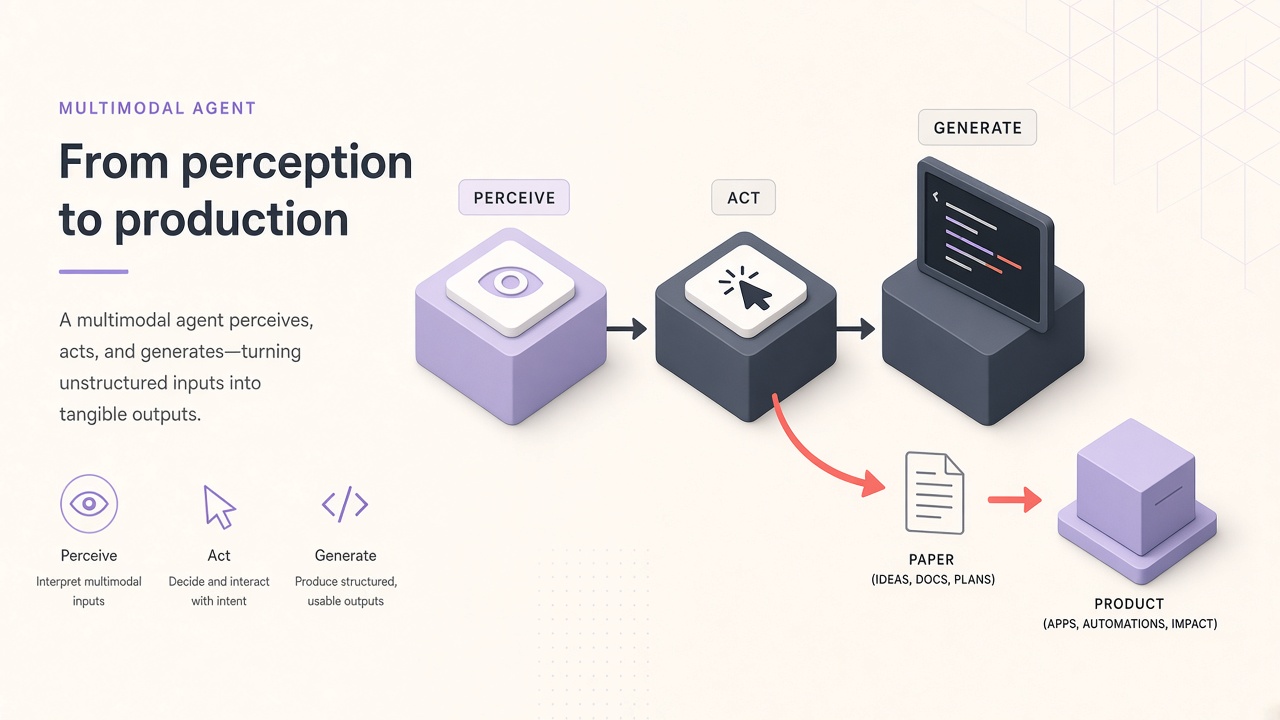
A multimodal agent accepts images, text, audio, or structured UI state, plans actions, calls tools or issues GUI commands, and verifies outcomes over multiple steps. Computer-use agents are a subset focused on digital environments.
What did OS-Symphony achieve?
OS-Symphony reported about 65.8% on OSWorld and 63.5% on WindowsAgentArena, with reflection memory and visual tutorial search as core components.
Why does ProSoftArena matter for enterprises?
It tests professional applications like creative and engineering tools on real computers. Top agents still fail most software-level and cross-app workflows, warning against over-trusting general demos.
How long from paper to product?
Typical lags run 6-18 months for harness features, longer for safety certification. Monitor vendor trusted-access programs as early signals of near-production capability.
Can open-weight models run computer-use agents?
Yes. OS-Symphony demonstrates competitive benchmark scores with open-source VLMs, though latency, safety, and hosting costs still favor managed APIs for many teams.
What is the biggest evaluation gap?
Closed-loop verification across heterogeneous tools and real enterprise IAM constraints. Public benchmarks improve quickly but rarely include your compliance stack.