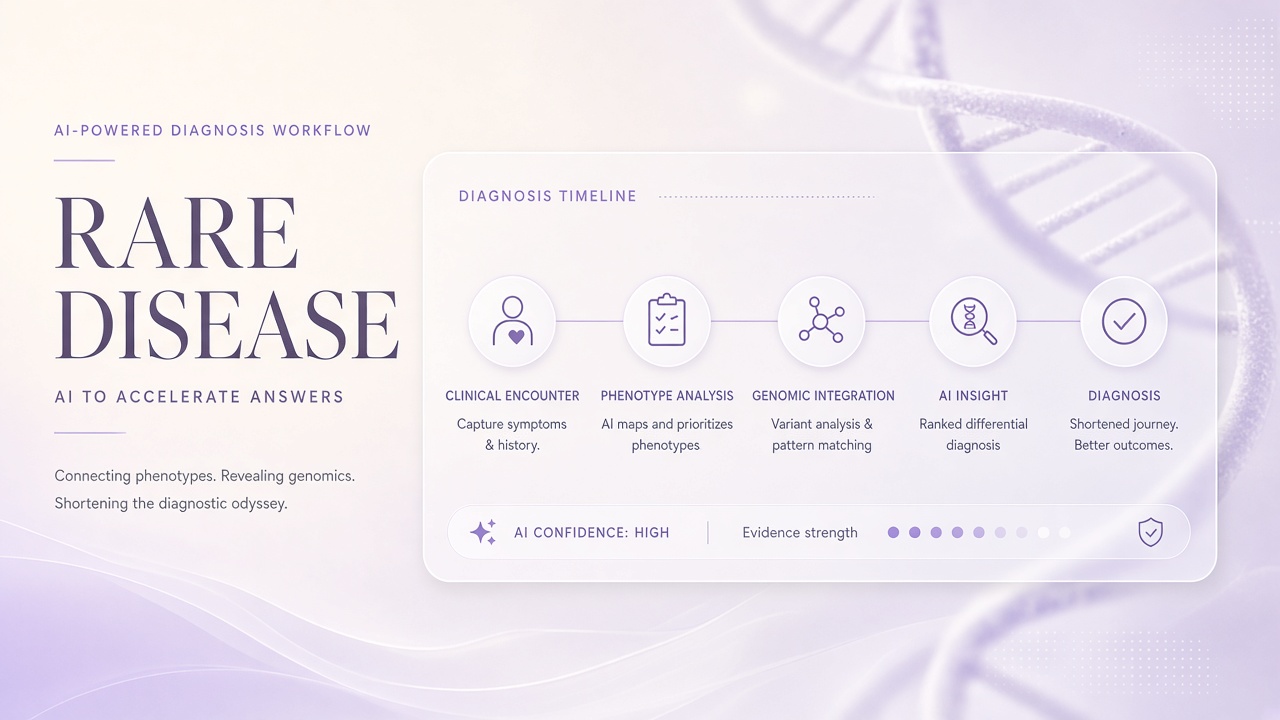
A child presents with subtle dysmorphic features, developmental delay, and a normal first-line genetic panel. Years can pass before a rare Mendelian diagnosis emerges. AI tools now compress parts of that search: Face2Gene ranks syndromes from facial photos and Human Phenotype Ontology (HPO) terms, while Exomiser and Mendelian prioritize variants against phenotypic profiles. The stakes are human. Misranking a syndrome or variant can send families down the wrong testing path. This workflow guide frames where AI research assists rare disease diagnosis, where clinicians retain authority, and why teams should not treat AI chatbot-style conversational tools as diagnostic substitutes in genomics clinics.
Use Case Boundaries: Where AI Helps and Where It Does Not
AI for rare disease diagnosis belongs in differential narrowing, test prioritization, and variant re-ranking, not in autonomous diagnosis or treatment decisions. Next-generation phenotyping (NGP) tools analyze structured phenotypes and facial gestalt to suggest syndromes clinicians may not have encountered recently. Genomic prioritizers score exome or genome variants against those phenotypes. Neither replaces physical examination, family history, or confirmatory molecular testing.
| Appropriate use | Out of scope |
|---|---|
| Suggest syndromes for expert review | Definitive diagnosis without confirmation |
| Prioritize exome variants given HPO terms | Replace genetic counseling conversations |
| Document phenotypes in standardized ontology | General symptom chat for undiagnosed patients |
| Change testing strategy when gestalt shifts | Emergency triage without clinician oversight |
Retrospective studies report Face2Gene placing the correct syndrome in the top three suggestions in roughly half to two-thirds of evaluated cases, with higher accuracy when facial analysis combines with curated HPO features. Those numbers justify assistive use, not blind trust. Ultra-rare conditions outside training corpora may appear only after GestaltMatcher-style similarity search or manual literature review.
Input Data Types and Quality Requirements
Effective AI-assisted rare disease workflows combine standardized phenotypes (HPO terms), quality-controlled facial photographs, structured clinical notes, and appropriately filtered genomic variants. Each input type carries failure modes when quality slips.
HPO Phenotypes
The Human Phenotype Ontology encodes clinical features as standardized terms (for example, microcephaly, HP:0000252). Face2Gene FeatureMatcher and tools like Exomiser consume HPO profiles to score syndrome and gene matches. Free-text notes can be converted to HPO via NLP pipelines, but manual curator review catches negated findings and temporal qualifiers automated extractors miss.
Facial Imaging
DeepGestalt, the convolutional model behind Face2Gene, expects frontal facial photographs with consistent lighting and minimal occlusion. Performance varies across ancestries; teams should document when gestalt scores underperform for a patient population and rely more heavily on HPO-driven ranking. Patient consent for facial analysis and secure storage is a workflow prerequisite, not an afterthought.
Genomic Variants
Exomiser integrates variant frequency, inheritance mode, and phenotypic similarity to rank candidate genes after exome sequencing. Mendelian and similar platforms combine literature curation with phenotype matching. Variant lists must reflect current reference builds, correct familial segregation, and updated gene-disease associations. A stale annotation pipeline can outrank the true causative gene despite strong facial gestalt agreement.
AI Assist vs Clinical Decision
The clinician or clinical geneticist integrates AI outputs with examination findings, test results, and family context before any diagnosis is communicated. Document the AI suggestion, the clinician's independent assessment, and the rationale for ordering or deferring specific tests. When Face2Gene shifts a testing strategy in real time, as reported in international case series, the change should reflect deliberate expert review, not automatic acceptance of the top-ranked syndrome.
A practical clinic workflow looks like this:
- Capture standardized HPO terms during or immediately after the visit.
- Upload consented facial photo to NGP software if dysmorphism is relevant.
- Review ranked syndromes; note agreement and discordance with clinical impression.
- Order targeted testing (panel, exome, genome) informed by the combined picture.
- Run Exomiser or equivalent on sequencing output with the same HPO profile.
- Confirm candidate variants with orthogonal methods (Sanger, RNA studies, functional assays).
- Communicate results through genetic counseling with written summary of evidence chain.
PEDIA-style frameworks explicitly merge facial NGP scores with exome prioritization. Treat that merge as a research-informed ranking aid. The final variant classification still follows ACMG/AMP guidelines with human interpretation.
Genetic Counselor Role in AI-Augmented Clinics
Genetic counselors translate probabilistic AI rankings into patient-centered decisions about testing, uncertainty, and follow-up. When Face2Gene suggests a syndrome the family has never heard of, counselors explain sensitivity, false positives, and what confirmatory testing entails. They also guard against anchoring bias: a compelling facial match can discourage consideration of overlapping phenotypes or dual diagnoses.
Qualitative studies of Face2Gene adoption in European university hospitals highlight usability strengths alongside workflow barriers such as IT integration and consent workflows. Successful programs assign counselors early, not only after a molecular result returns. Counselors help families understand that an AI-ranked list is a search shortcut, not a label.
Mendelian and Exomiser in Combined Workflows
Mendelian and Exomiser serve complementary roles: Mendelian surfaces literature-linked gene-disease associations from phenotypes, while Exomiser re-ranks sequenced variants against the same HPO profile after genomic data arrives. Running them in isolation produces inconsistent shortlists. The responsible workflow keeps a single curated phenotype list as the source of truth across NGP, gene prioritization, and variant classification steps.
When Face2Gene shifts a differential toward a syndrome with a known gene panel, Mendelian can confirm whether observed features match published profiles before ordering expensive whole-exome sequencing. After sequencing, Exomiser integrates allele frequency, inheritance pattern, and phenotypic match scores. Discrepancies between facial gestalt rank one and Exomiser rank one are clinical teaching moments, not errors to auto-resolve. Dual diagnoses and incomplete penetrance still require human judgment.
Documentation Template for AI-Assisted Cases
Clinics adopting AI assistance benefit from a lightweight documentation template: date and software version, inputs used (photo yes/no, HPO term count), top three AI suggestions, clinician working differential, tests ordered with rationale, and final molecular result with ACMG classification. That record supports quality review, medicolegal clarity, and training of residents who must learn when to trust or override algorithmic rankings.
Hospital information systems rarely integrate Face2Gene or Exomiser natively. IT barriers cited in European adoption studies include single sign-on gaps and manual export of HPO terms. Planning a rare disease AI workflow therefore requires interface work between EHR phenotyping modules, genomics pipelines, and counseling documentation, not only software licenses.
Liability, Documentation, and Governance
Institutions should treat AI-assisted rare disease tools as decision support subject to clinical governance, audit trails, and clear accountability lines. Document which software version produced rankings, which inputs were used, and which suggestions were accepted or rejected. Avoid entering identifiable photos or genomes into general-purpose chat models lacking BAAs, ISO certifications, or regional compliance guarantees.
- Vendor contracts: Clarify data retention, model retraining on patient inputs, and subprocessors.
- Consent: Separate consent for facial analysis, genomic sequencing, and research reuse where applicable.
- Equity review: Monitor performance stratified by ancestry and age; adjust protocols when bias appears.
- Incident response: Define escalation when AI suggests a syndrome that would alter acute management if wrong.
Liability frameworks vary by jurisdiction, but the consistent clinical standard is that AI does not practice medicine. The licensed professional who orders tests and communicates diagnoses retains responsibility. Tools like Face2Gene change efficiency; they do not transfer accountability.
Equity and Ancestry Monitoring
DeepGestalt training corpora skew toward syndromes and ancestries overrepresented in historical genetics literature. Clinics should track suggestion accuracy stratified by patient ancestry and age, adjusting protocols when gestalt scores underperform. FeatureMatcher and HPO-driven ranking can partially compensate but do not eliminate bias without active monitoring. Responsible deployment treats equity metrics as quality indicators alongside diagnostic yield.
Research programs integrating AI research into genomics should publish periodic bias audits alongside case series so families understand both capabilities and limits before consenting to facial analysis.
Frequently Asked Questions
Can AI diagnose a rare disease alone?
No. AI ranks syndromes and variants against phenotypic profiles. Confirmatory molecular testing, clinical correlation, and expert interpretation remain required before a diagnosis is established or communicated to families.
What is Face2Gene used for?
Face2Gene is a next-generation phenotyping platform that uses DeepGestalt facial analysis, HPO-based FeatureMatcher scoring, and related modules to suggest differential diagnoses for genetic syndromes. Clinicians use ranked lists to prioritize testing and refine differential diagnoses during genetic evaluations.
How does Exomiser fit the workflow?
Exomiser prioritizes variants from exome or genome sequencing by combining variant pathogenicity priors with phenotypic similarity to known disease profiles encoded in HPO. Run Exomiser after sequencing with the same curated phenotype list used during clinical assessment for consistency.
Should patients use AI chatbots for symptoms?
General conversational AI lacks access to structured phenotyping, curated gene-disease databases, and the examination context rare disease diagnosis requires. Direct undiagnosed patients to clinical genetics services rather than self-serve chat diagnosis for complex presentations.
What accuracy should clinics expect?
Published Face2Gene evaluations report the correct syndrome in the top ten suggestions in many cases, with top-three accuracy around fifty to sixty percent in single-center retrospectives. Performance depends on syndrome coverage, photo quality, and HPO completeness. Use metrics to set expectations, not guarantees.
Who should not use NGP tools alone?
Primary care settings without access to genetic counseling and confirmatory testing should avoid presenting AI-ranked syndromes as diagnoses to families. NGP software assumes downstream expert review. Telehealth models must still route complex dysmorphism cases to clinical genetics rather than closing the loop inside a general AI chatbot interface without structured phenotyping.
Can Exomiser replace clinical judgment?
No. Exomiser ranks variants given a phenotype profile and inheritance model. Clinicians must reconcile rankings with segregation data, RNA splicing evidence, and phenotypes that evolve over time. A high Exomiser score on an incompletely penetrant variant still demands counseling about uncertainty.