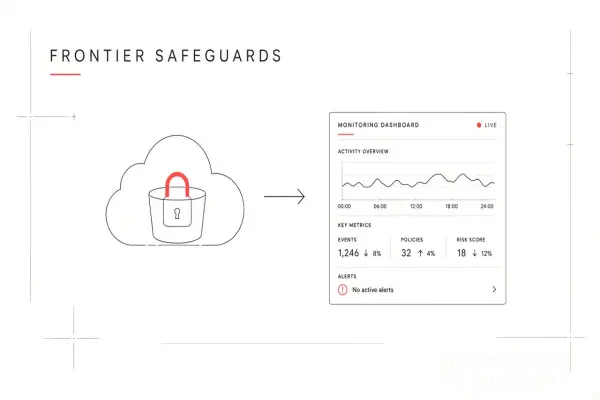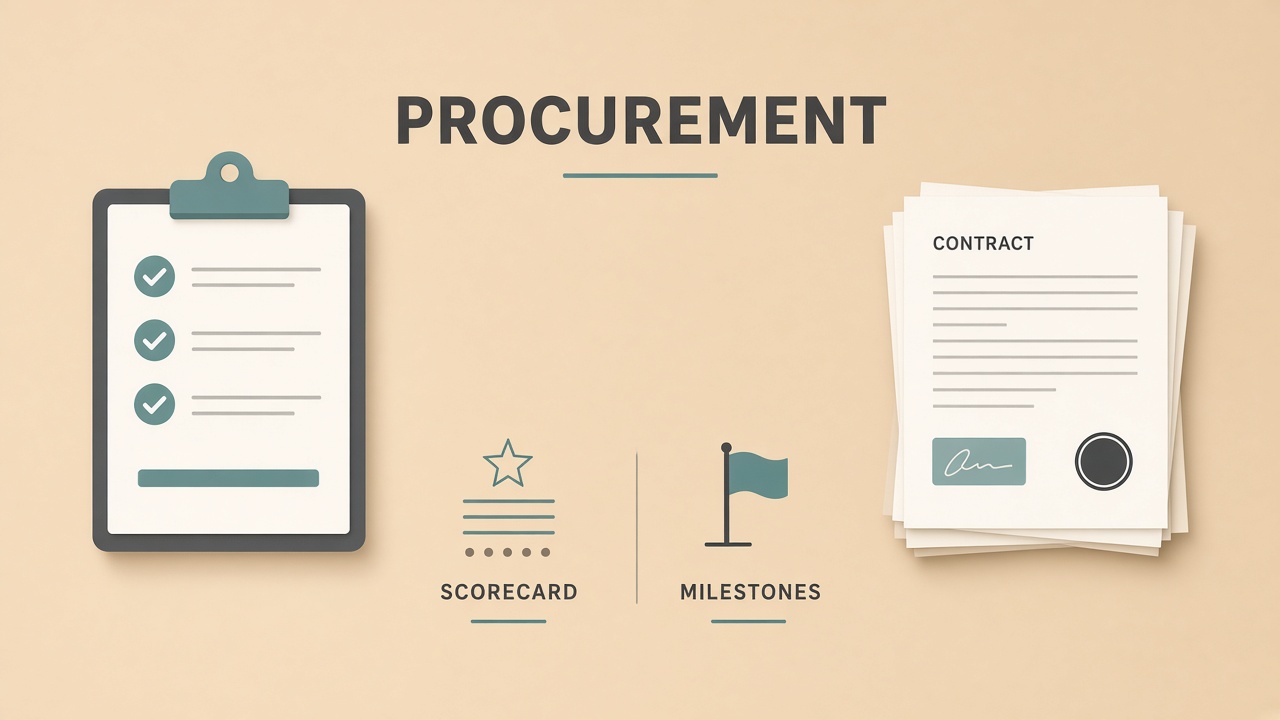
Anthropic announced Enterprise Frontier Safeguards (EFS) in September 2026 as an opt-in control plane that stores monitoring artifacts in customer cloud accounts while automated systems flag serious misuse. Procurement teams buying Claude via direct API, Amazon Bedrock, Google Agent Platform, or Microsoft Foundry need contract language that turns EFS promises into auditable obligations. This efs procurement guide maps safeguard domains to RFP clauses, evidence requests, vendor scorecards, and milestone schedules.
EFS does not replace zero data retention for every workload. It addresses the enterprise objection that pure ZDR blinded providers to cross-session abuse. Buyers should reference AI governance frameworks and align EFS evidence to NIST AI RMF functions while negotiating with vendors who offer AI chatbot and agent platforms.
EFS Domains to Include in AI RFPs
Structure RFP sections around three EFS domains: customer-held monitoring storage, automated misuse detection on rolling traffic windows, and customer-controlled retention with enterprise-managed encryption keys. Each domain should specify supported cloud providers (Amazon S3, Azure Blob, Google Cloud Storage), data categories logged, and whether human review occurs at the vendor or only inside the customer environment.
| EFS domain | RFP requirement | Pass criteria |
|---|---|---|
| Customer-held storage | Artifacts land only in buyer cloud tenant | Architecture diagram plus IAM boundary proof |
| Automated detection | Rolling window analysis for serious misuse | Published harm categories and alert schema |
| Customer review | Alerts route to buyer SOC without vendor content review | Sample alert payload and SIEM integration guide |
| Retention control | Buyer sets TTL and encryption keys | KMS configuration documentation |
Sample RFP clause: "Vendor shall support Enterprise Frontier Safeguards or equivalent customer-controlled monitoring with automated serious-misuse detection, storing all monitoring artifacts exclusively in Buyer-designated cloud storage with Buyer-managed keys. Vendor employees shall not access Buyer content for routine safety review." Adapt jurisdiction and defined terms to your legal template.
Evidence and Audit Requests for Frontier Safeguards
Procurement should request evidence artifacts before contract signature and annually thereafter: architecture diagrams, data flow maps, sample alert payloads, penetration test summaries on monitoring pipelines, and third-party SOC 2 or ISO 27001 scopes covering EFS components. Vague "we support EFS" statements without artifacts fail diligence.
Minimum evidence packet for frontier safeguards rfp evaluations:
- Data flow diagram from model API to customer storage bucket.
- List of logged fields (prompt metadata vs full content, tool arguments, session IDs).
- Misuse category taxonomy aligned to Anthropic published harm areas or buyer policy.
- Incident response SLA for false positive disputes and true positive escalations.
- Subprocessor list if any monitoring relay touches vendor infrastructure.
- Pricing model for cloud storage and egress attributable to EFS.
Regulated industries (financial services, healthcare, defense contractors) should add mapping tables from EFS logs to NIST AI RMF Govern, Map, Measure, and Manage functions. EU buyers should cross-reference AI Act logging and human oversight duties for high-risk systems.
Scoring Vendor Responses on Safeguard Maturity
Use a weighted scorecard so legal, security, and procurement score independently before negotiation. Suggested weights: technical architecture (35%), evidence completeness (25%), integration fit with existing SIEM (20%), commercial terms (10%), roadmap and multi-cloud parity (10%).
| Score (1-5) | Architecture | Evidence |
|---|---|---|
| 5 | Full EFS parity, buyer-only storage, documented APIs | Complete packet plus customer references |
| 3 | Partial monitoring, some vendor-held metadata | Diagrams without pen test or SIEM guide |
| 1 | Marketing claim only, no customer-controlled storage | No artifacts delivered during RFP |
Disqualify vendors that cannot demonstrate customer-managed keys if your policy forbids vendor access to prompt content. For ai vendor scorecard efs programs, publish scoring rubrics to bidders upfront to reduce protest risk and speed consensus among stakeholders.
Contract Milestones for EFS Rollout
Phase EFS implementation across contract milestones rather than treating safeguards as a day-one binary switch. Anthropic planned phased EFS rollout beginning fall 2026; buyers should align payment and SLA triggers accordingly.
- Milestone 1 (design): Signed architecture, IAM roles, bucket policies within 30 days of award.
- Milestone 2 (pilot): Non-production workload with alert routing to SOC within 60 days.
- Milestone 3 (production): Full tenant coverage, runbook tested, executive sign-off at 90 days.
- Milestone 4 (audit): Annual evidence refresh and tabletop exercise on misuse alert handling.
Include termination rights if vendor fails to deliver EFS-equivalent controls by a fixed date. Tie renewal discounts to successful third-party assessment of monitoring pipelines. Budget cloud storage and SIEM ingestion costs explicitly; EFS itself may be free from Anthropic but infrastructure is not.
Multi-cloud enterprises should require equivalent controls on every distribution channel (direct API, Bedrock, Foundry, Google Agent Platform) in a single order form schedule. Fragmented rollouts create coverage gaps attackers exploit by shifting traffic to the least monitored endpoint.
Frequently Asked Questions
Does EFS replace zero data retention?
No. EFS is an alternative pattern for enterprises that need misuse visibility without vendor-held logs. Some workloads may still require pure ZDR. Contract both options per use case with clear workload tagging.
Can we require EFS-like terms from non-Anthropic vendors?
Yes. Frame requirements as customer-controlled monitoring with automated serious-misuse detection. Competitors may use different names but should meet the same architectural tests.
Who pays for EFS infrastructure costs?
Typically the customer pays cloud storage, networking, and SIEM ingestion. Clarify in the RFP whether the vendor charges platform fees for enabling EFS connectors.
When should procurement insert EFS clauses?
Insert in new frontier model RFPs immediately. For existing contracts, negotiate an amendment before scaling agentic workloads that increase misuse blast radius.