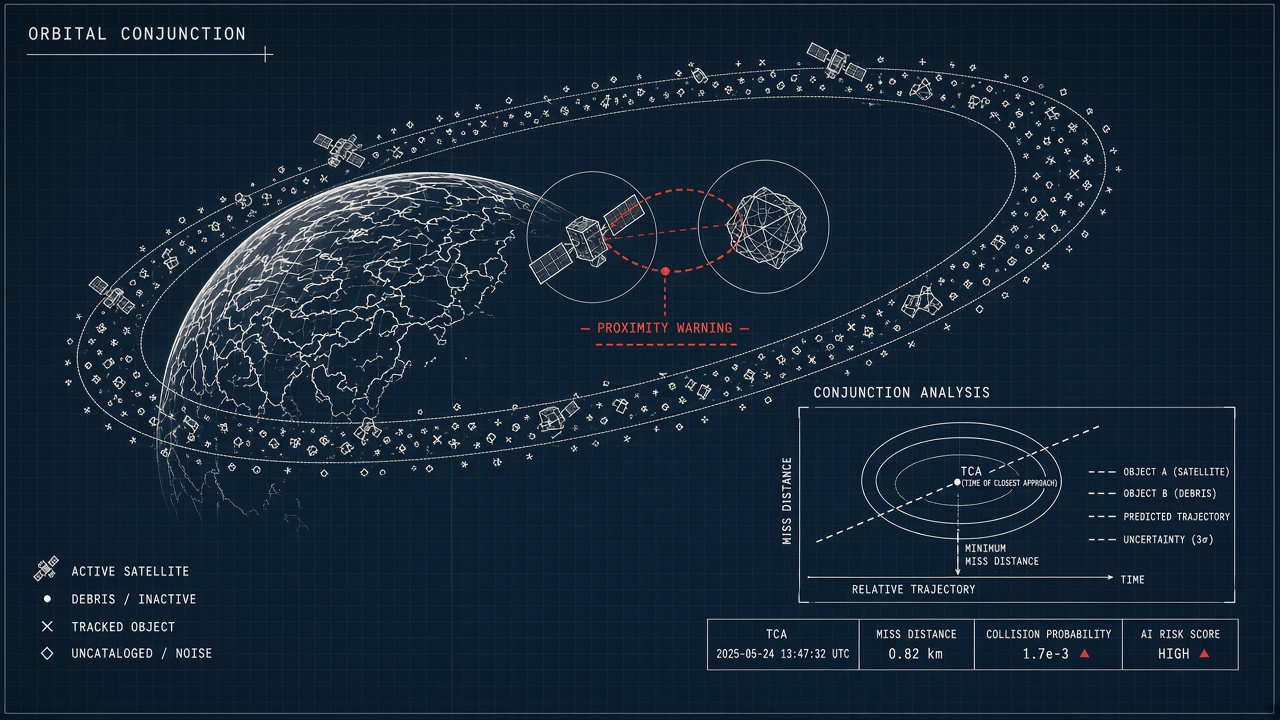
A single fragment the size of a bolt can destroy a billion-dollar satellite. Low Earth orbit now holds tens of thousands of tracked objects, and mega-constellations add conjunction events faster than human analysts can review them. Operators receive Conjunction Data Messages (CDMs) from U.S. Space Force squadrons, compute probability of collision (Pc), and decide whether to burn fuel for avoidance. Space debris collision prediction AI applies machine learning to CDM time series, covariance evolution, and catalog growth models so teams can prioritize high-uncertainty events before maneuver deadlines pass.
Satellite operators, national agencies, and constellation owners all face the same scaling problem: too many close approaches, too little analyst time. Teams evaluating AI chatbot assistants for mission operations should understand that conjunction workflows remain physics-governed even when neural networks accelerate triage. More research explainers appear on the EliteAI.tools blog index.
What Space Debris Collision Prediction AI Means in Plain Language
Space debris collision prediction AI is the use of machine learning models to forecast which satellite close approaches will remain risky, which will self-resolve as tracking improves, and which catalog objects contribute most to long-term collision pressure. The starting point is almost always a CDM: a standardized message listing primary and secondary object states, covariances, miss distance, and Pc at the Time of Closest Approach (TCA).
NASA's Conjunction Assessment Risk Analysis (CARA) program screens agency spacecraft against the Department of Defense catalog, performs risk analysis on flagged events, and advises projects on mitigation. CARA is not a single model; it is an operational service backed by tools like the Conjunction Assessment System (CAS) and research into AI/ML augmentation. Commercial operators receive similar CDM streams and must make go/no-go maneuver decisions, often within a seven-day identification window before TCA.
The Kessler formulation, named after Donald Kessler's collision-frequency theory, estimates long-term collision rates between orbiting objects by integrating over overlapping orbital volumes. NASA CARA's LongTermRisk tooling uses Kessler rates and Monte Carlo conjunction analysis to evaluate colocation risk when planning new missions. As catalogs grow, the Kessler-style library of rate estimates helps planners see which altitude shells accumulate the most collision pressure, a backdrop for why short-horizon CDM AI must scale as well.
| Term | Role in prediction | Typical source |
|---|---|---|
| CDM | States, covariances, Pc at TCA | 18th/19th Space Defense Squadrons |
| CARA | NASA conjunction screening and risk analysis | Goddard Space Flight Center |
| Kessler rate | Long-term average collision frequency | TLE catalogs, LongTermRisk tool |
| Maneuver deadline | Last safe time to execute avoidance burn | Mission-specific operations plan |
How the Underlying AI Pipeline Works
A conjunction AI pipeline ingests sequences of CDMs per event, engineers features from state vectors and covariance matrices, trains classifiers or sequence models on historical outcomes, and outputs ranked risk flags or predicted miss distances that human analysts or tiered automation review before maneuvers. Published approaches differ by prediction target: Pc threshold crossing, miss distance at TCA, or persistent high covariance that will not shrink with routine tracking.
NASA CARA research on CDM time series and LSTM models
CARA's AI/ML compendium analyzed more than 450,000 CDMs from 2015 through 2018, testing supervised learning, clustering, fuzzy inference, deep neural networks, and Long Short-Term Memory (LSTM) architectures. LSTM networks handle variable-length CDM sequences: each new message updates the conjunction picture, and gates retain information about how miss distance and uncertainty evolved. CARA researchers also explored Bayesian framing of parameter uncertainty when fusing sparse tracking updates, aligning with broader Bayesian deep learning work on conjunction events where posterior distributions over miss distance matter as much as point estimates.
The LSTM groups in the CARA study used masking layers for uneven sequence lengths and predicted miss distance with lead times averaging about 1.8 days to TCA. High-risk close approaches are rare in training data (on the order of dozens of events among hundreds of conjunctions in some splits), which immediately raises the class imbalance problem discussed below.
Slingshot high-covariance predictive model
Slingshot Aerospace published a contextual predictive model for early identification of high-covariance conjunctions, peer reviewed in the Journal of the Astronautical Sciences. The model uses LightGBM gradient boosted trees on temporal CDM features plus contextual object metadata (size, orbit class, pattern of life). It predicts which events will still carry uncertainty above roughly one kilometer at about one day before TCA, up to five days in advance, so operators can task sensors for additional observations instead of maneuvering on immature ephemerides.
On evaluation sets drawn from OneWeb constellation CDM histories, the contextual model outperformed baselines that used covariance magnitude or observation counts alone, reaching about 84.8% of the top-ranked performance in reported top-160 conjunction tests. This is a triage model, not a replacement for orbital propagators: it answers which events deserve scarce tracking resources.
Class imbalance and F2 recall tradeoffs
Conjunction datasets are severely imbalanced: the vast majority of CDMs resolve safely, while catastrophic collisions are vanishingly rare in labeled history. A random forest trained on tens of thousands of messages without imbalance handling can report 99.4% accuracy while achieving zero recall on risky events, the classic accuracy paradox. Operational pipelines therefore apply SMOTE oversampling, class-weighted loss, or threshold tuning on a modified F-score.
The F2-score weights recall twice as heavily as precision (beta equals 2). For collision avoidance, missing a true high-risk event is often considered worse than issuing extra false alarms that trigger human review. Hybrid pipelines that optimize the F2 threshold can reach perfect recall on rare risk classes at the cost of lower precision and more analyst workload, a deliberate safety-critical tradeoff deployed in tiered architectures where ML screens widely and operators adjudicate the short list.
| Approach | Prediction target | Strength | Limitation |
|---|---|---|---|
| CARA LSTM on CDM sequences | Miss distance evolution | Captures temporal CDM dynamics | Scarce high-risk labels; research stage |
| Slingshot LightGBM contextual model | Persistent high covariance | Five-day lookahead for sensor tasking | Depends on contextual metadata quality |
| F2-tuned hybrid classifier | Risky vs safe event flag | High recall for rare collisions | More false positives for analysts |
| Kessler / LongTermRisk screening | Long-term colocation pressure | Mission design and orbit selection | Not a short-horizon maneuver trigger |
Probability of collision and maneuver policy
Physics-based conjunction assessment computes probability of collision (Pc) by integrating the overlap of position uncertainty ellipsoids at TCA. Operators compare Pc against mission-specific thresholds that balance fuel use against risk tolerance. SpaceX and other constellation owners have tightened automated maneuver policies as catalog growth increased event rates. ML does not replace Pc math; it forecasts whether Pc will rise or fall as new CDMs arrive, helping teams avoid premature burns when covariance should shrink after the next tracking pass.
Typical operational workflow
- Receive CDM stream from Space Force squadrons or commercial SSA provider.
- Propagate owner ephemeris; compare against catalog object state from CDM.
- Run physics-based Pc and miss distance computation (CARA CAS or equivalent).
- Apply ML triage: LSTM miss-distance forecast, Slingshot covariance persistence, or F2-biased classifier.
- Human analyst reviews flagged events; request supplemental tracking if covariance remains high.
- Plan collision avoidance maneuver if Pc exceeds policy threshold before maneuver deadline.
- Log outcomes to retrain models and audit false alarm rates.
Published Evidence and Industry Deployments
CARA has supported NASA missions since 2005 with routine conjunction screening, while its AI/ML compendium documents extensive offline experiments rather than wholesale replacement of human risk analysts. The study concludes that data scarcity, stochastic orbital mechanics, and explainability requirements remain barriers to autonomous maneuver authority based solely on neural networks.
Slingshot's high-covariance model represents commercial operational research integrated with constellation operator data via platforms like Slingshot Beacon. National studies using Korean Aerospace Research Institute 2025 operational CDM volumes (hundreds of thousands of messages) show conjunction frequency correlating with altitude congestion, especially near 450 to 550 km shells where object counts grew more than one hundredfold since 2015 in some analyses.
Population-level TLE ranking models achieve very high holdout accuracy on proxy-risk labels derived from orbital crowding features, useful for prioritizing which catalog entries deserve detailed CDM review. Those scores measure environmental density, not confirmed imminent collisions, and should sit upstream of physics-based conjunction assessment.
Limits, Risks, and Ethical Guardrails
Collision prediction AI trained on historical CDMs inherits catalog biases: untracked debris, state estimation errors, and maneuver secrecy can make models confident on the wrong side of a close approach. Covariance matrices in CDMs are themselves estimates; ML that predicts covariance persistence amplifies any upstream ephemeris flaw if operators treat outputs as ground truth.
- Explainability: Regulators and mission owners require traceable rationale before fuel burns.
- Distribution shift: Mega-constellation maneuver policies differ from legacy satellites.
- Dual-use SSA: Improved conjunction models also enable proximity operations and rendezvous.
- Kessler cascade: Long-term models warn of debris belts; short-horizon AI does not remove fragmentation risk.
- Liability: False negatives could invite litigation; false positives waste fuel and mission time.
Ethical guardrails include keeping humans in the loop for maneuver authority, publishing model limitations, sharing anonymized CDM features for community benchmarks, and aligning automated thresholds with international space debris mitigation guidelines. Operators should not delegate collision avoidance to models that optimize accuracy on imbalanced data without explicit recall guarantees.
Who Should Use This and Who Should Wait
Constellation operators drowning in CDM volume, CARA-class agency programs, and commercial SSA vendors should deploy ML triage for covariance persistence and class-imbalance-aware screening now, with physics-based Pc remaining authoritative for maneuvers. Hobbyist satellite builders and early-phase mission designers without CDM feeds should focus on Kessler-style long-term colocation analysis instead.
| Audience | Recommendation | Caveat |
|---|---|---|
| Mega-constellation operator | Deploy high-covariance ML triage plus F2-tuned screening | Audit false positive burden on analysts |
| NASA mission project | Use CARA services; monitor CARA AI/ML research | NPR 8079.1 mandates CARA for agency spacecraft |
| Commercial SSA startup | Benchmark LSTM and gradient boosting on licensed CDM archives | Validate on operator-specific maneuver policies |
| University CubeSat team | Run LongTermRisk/Kessler screening at design phase | ML maneuver automation not appropriate at small scale |
Frequently Asked Questions
What is a CDM in space debris collision prediction?
A Conjunction Data Message is a standardized report of a predicted close approach between two space objects, including position, velocity, covariance, miss distance, and probability of collision at TCA. CDMs are the primary input for both classical conjunction assessment and modern ML pipelines.
How does NASA CARA differ from commercial SSA AI?
CARA is NASA's mandated conjunction assessment service for agency spacecraft, combining catalog screening, human risk analysis, and research tools like CAS; commercial vendors add proprietary ML layers on similar CDM feeds for private operators. CARA's published AI work emphasizes augmentation, not autonomous maneuvers.
What is a Bayesian LSTM in conjunction analysis?
It refers to LSTM sequence models that ingest CDM time series while representing uncertainty in predictions or parameters, often combined with Bayesian deep learning ideas for sparse high-risk events. CARA's compendium implemented LSTM miss-distance forecasting; full Bayesian operational deployment remains research-oriented.
Why optimize F2 instead of accuracy for collision AI?
Because risky conjunctions are rare, accuracy hides zero recall; F2 emphasizes catching true risks even if precision drops and analysts review more false alarms. Safety-critical screening prefers missed detections over silent failures.
What does Slingshot's high-covariance model predict?
It predicts which conjunctions will still have large position uncertainty about one day before TCA, up to five days ahead, so operators can schedule extra tracking before maneuver deadlines. It uses LightGBM on CDM sequences plus object context, not Pc alone.
How does the Kessler library relate to AI collision prediction?
Kessler collision-rate integrals in tools like NASA LongTermRisk estimate long-term colocation hazard from TLE catalogs, complementing short-horizon CDM ML that handles individual events. Mission planners use Kessler rates at design time; operators use CDM AI during flight.
Conclusion
Space debris collision prediction AI sits at the intersection of orbital mechanics and imbalanced machine learning: CDMs supply the data stream, NASA CARA anchors agency practice, Kessler-rate libraries frame long-term congestion, LSTM and Bayesian sequence models explore miss-distance evolution, Slingshot's contextual LightGBM model flags persistent high-covariance events days early, and F2-weighted thresholds trade precision for recall when missing a risk is unacceptable. None of these replace propagators or human maneuver authority today; they prioritize analyst attention in an orbit that grows more crowded every year. Teams adopting the technology should benchmark on their own CDM histories, document tiered review workflows, and treat ML outputs as decision support within established conjunction assessment standards.