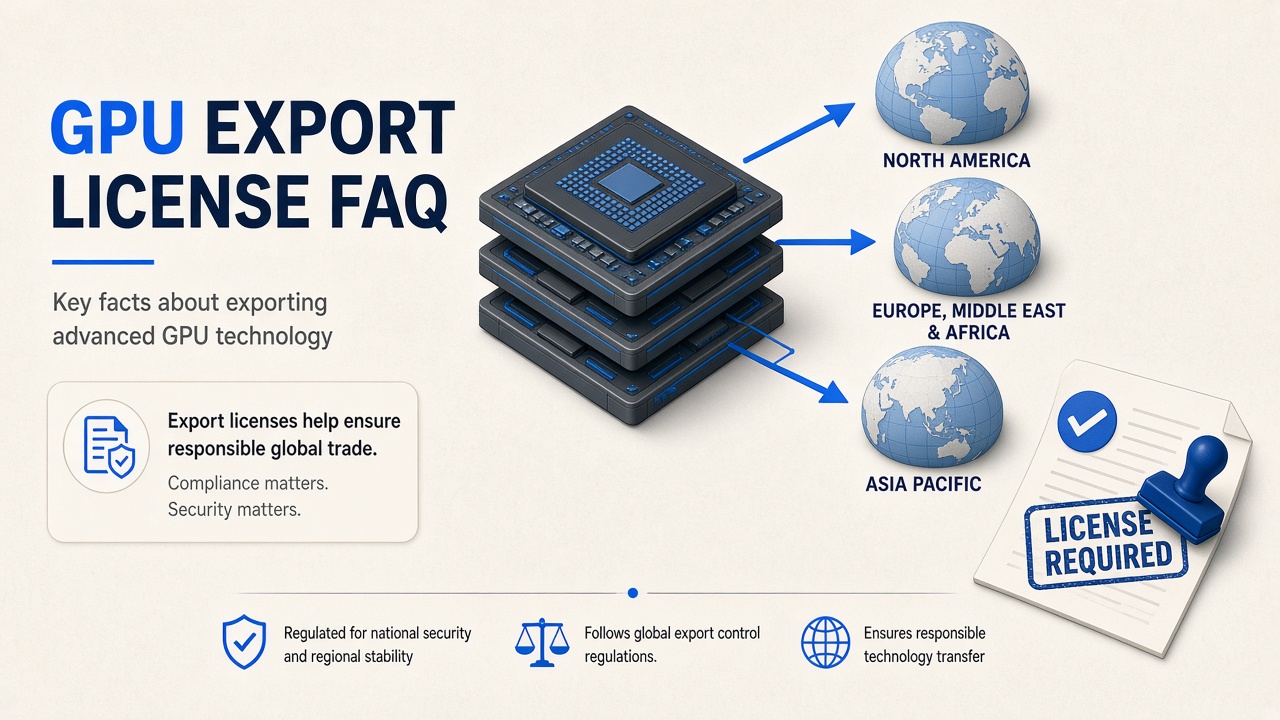
NVIDIA Blackwell B100 and B200 accelerators sit at the intersection of frontier AI demand and U.S. export controls. Procurement teams in Singapore, the UAE, Malaysia, and Europe discovered in 2026 that destination country alone does not determine license need. The Commerce Department Bureau of Industry and Security clarified that entities headquartered in China (Country Group D:5) or Macau, or whose ultimate parent is headquartered there, require licenses for advanced computing items even when operations appear outside those jurisdictions. Cloud resellers, systems integrators, and hyperscale buyers need a practical FAQ, not only legal memos.
NVIDIA Blackwell export license questions should be resolved before purchase orders ship. Map workloads on AI code infrastructure and compare hosting options through NVIDIA AI tools once compliance clears the transaction.
Blackwell SKU Overview for Export Compliance
Blackwell GPUs fall under Export Control Classification Numbers for advanced computing items, including 3A090.a and .b, 4A090.a and .b, and related .z paragraph entries in the Export Administration Regulations. Marketing names such as B100, B200, GB200, and HGX Blackwell systems map to those ECCNs for licensing analysis, not to a separate exemption category.
| Product line | Typical form factor | Compliance note |
|---|---|---|
| B100 / B200 GPUs | Discrete accelerators | Subject to advanced computing ECCNs; license review for restricted end users |
| GB200 superchips | Grace CPU plus Blackwell GPU modules | Treat as integrated advanced computing system |
| HGX Blackwell servers | Multi-GPU boards in OEM chassis | End-user and destination both matter; document ultimate consignee |
| H200 (related tier) | Hopper successor with separate policy track | Case-by-case China pathway; not interchangeable with Blackwell assumptions |
NVIDIA stated the May 2026 guidance did not change its ability to ship where existing Commerce letters already imposed license requirements. Buyers should still verify current ECCN classifications on each SKU revision because firmware and performance thresholds can shift classifications.
License Tiers by Country and Entity
License need depends on destination, end user headquarters, ultimate parent company, and whether a valid license exception applies under EAR Section 740.2(a)(9)(ii). The May 31, 2026 BIS guidance emphasized entity-headquartered controls that predate the paused AI Diffusion Rule remain fully enforced.
- China and Macau destinations: Presumption of denial for most advanced computing items, including Blackwell, unless a specific authorized pathway applies (such as the separate H200 case-by-case program).
- Non-D:5 destinations, D:5-headquartered buyer: License required worldwide when the purchaser or ultimate parent is headquartered in China or Macau, closing routing through Hong Kong, Singapore, or UAE entities.
- Allied corporate buyers without D:5 parents: Generally eligible for license-free export to friendly destinations subject to standard EAR screening, though AI Diffusion destination tiers remain paused for enforcement of newer requirements.
- Bona fide data center operators: May continue using, storing, and servicing already-deployed systems; guidance targets future transactions, not forced shutdown of installed fleets meeting prior authorizations.
Exporters should not treat the May 2025 non-enforcement announcement on AI Diffusion as a blanket safe harbor. Headquarters-based controls under EAR 742.6(a)(6)(iii)(A) operate independently.
Cloud Access Gray Areas
Leasing GPU capacity in a third country does not automatically bypass headquarters-based end-user controls when the tenant is a Chinese or Macau entity or subsidiary. Cloud marketplaces must perform end-user screening comparable to hardware shippers, including ultimate beneficial owner checks.
Common gray areas in 2026:
- Reseller chains: A Singapore distributor selling to a UAE shell with a Beijing parent triggers license review even if neither Singapore nor UAE alone would.
- Colocation vs cloud: Bare-metal leases to restricted entities face similar end-user rules as boxed GPUs.
- Remote management: Servicing installed systems is generally permitted for bona fide operators; upgrading to higher-tier Blackwell nodes may constitute a new export event.
- Foundry due diligence: Analysts noted remaining gaps around foundry-level checks for front companies, separate from the May 2026 headquarters clarification.
Documentation for Procurement Teams
Procurement should collect end-user statements, corporate org charts showing ultimate parent, intended use descriptions, and export classification references before issuing a purchase order. Keep records for five years per standard EAR recordkeeping practice.
- End-user certificate: Signed statement of headquarters, owners, and end use.
- ECCN confirmation: Vendor letter citing 3A090 / 4A090 classification for the exact SKU.
- License or exception citation: BIS license number or specific EAR exception paragraph.
- Red flag checklist: Document screening for denied parties, entity list matches, and unusual payment routes.
- Contract flow-down: Require resellers to pass compliance obligations and audit rights.
Frequently Asked Questions
Can I buy Blackwell GPUs for a Chinese subsidiary in Singapore?
Generally no without a BIS license. Headquarters in Country Group D:5 triggers worldwide license requirements for covered advanced computing items regardless of shipment address.
Does pausing AI Diffusion mean no licenses are needed?
No. Pre-2025 headquarters-based controls remain enforced. Only certain newer destination-tier requirements from AI Diffusion are paused, and not for D:5-headquartered entities.
Must we shut down existing Blackwell clusters?
BIS guidance indicated bona fide data center operators need not cease lawful use of already deployed systems. Future purchases, upgrades, and transfers still require compliance review.
Who files the export license, buyer or NVIDIA?
U.S. exporters and resellers typically apply, but foreign buyers should cooperate with end-user documentation. Contract language should assign responsibility and liability for denied shipments.