Shipping AI in production used to mean picking a model string and forgetting it. In 2026, deprecation emails arrive quarterly, preview endpoints vanish with two-week warnings, and enterprise contracts must spell out who pays for revalidation when `gpt-5` snapshots sunset in December. Teams that treated model IDs as permanent infrastructure learned expensive lessons during October and December shutdown waves.
AI model deprecation 2026 followed predictable tiers from OpenAI, Anthropic, Google, and Microsoft partners, but the volume of simultaneous retirements strained platform teams. This guide explains why sunsets accelerated, typical notice windows, migration tooling from major labs, contract implications, and architecture patterns that survive the next changelog. Audit your stack against AI code tools and AI chatbot integrations that may pin retired model IDs.
Why Model Deprecations Accelerated in 2026
Labs retired older snapshots faster in 2026 because inference costs, safety reviews, and support surface area grew with every parallel model generation still online. OpenAI's changelog documented Assistants API shutdown on August 26, 2026, DALL-E 2 and 3 removal in May, Realtime API Beta retirement, and a rolling batch of GPT-4 and GPT-5 era snapshots through December. Each active endpoint requires security monitoring, eval regression suites, and documentation. Sunsetting legacy tiers frees engineering to focus on GPT-6 Astra, GPT-5.6 variants, and Responses API features.
Customer demand also shifted. Enterprises wanted stable SKUs with clear upgrade paths, not dozens of differently dated `gpt-4o` snapshots with subtly different behavior. Consolidation reduced choice but improved predictability for buyers writing multi-year contracts.
Platform Consolidation Drivers
OpenAI steered developers from Assistants to Responses and Conversations APIs, deprecating reusable prompt objects, Evals platform features, and Agent Builder on published timelines. That platform churn forced migrations unrelated to raw model weights. Teams had to replatform orchestration logic even when the underlying LLM stayed constant.
Typical Notice Windows by Model Tier
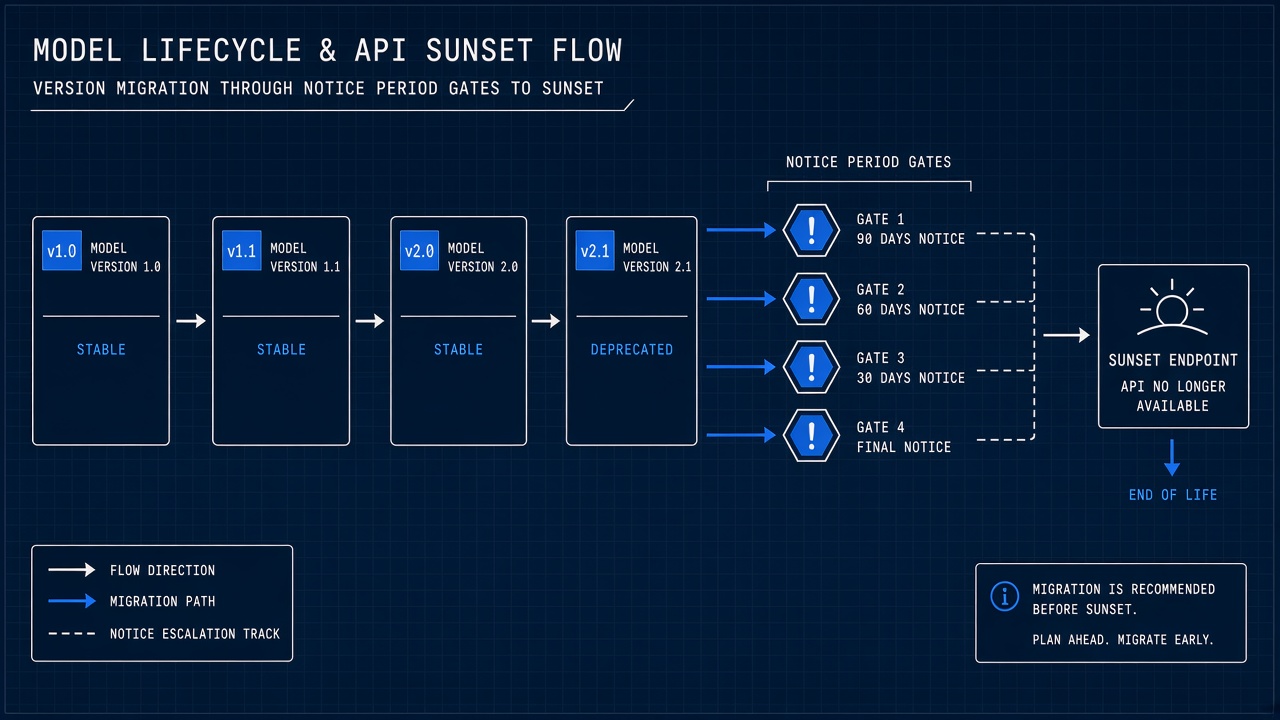
OpenAI publishes minimum notice floors of six months for generally available models, three months for specialized variants such as chat-latest and Codex tiers, and as little as two weeks for preview models unless safety concerns require faster retirement. Anthropic commits to at least twelve months before retiring active models such as Claude Fable 5.1, with published earliest retirement dates. Google and Microsoft partners generally mirror upstream lab schedules but may add regional delay for compliance certification.
| Model tier | Minimum notice (OpenAI policy) | 2026 example |
|---|---|---|
| Generally available | 6 months | Transcription models to Feb 2027 |
| Specialized variants | 3 months | gpt-5.2-chat-latest sunset Aug 2026 |
| Preview | ~2 weeks | computer-use-preview class models |
| Platform APIs | Varies (often 6-12 months) | Assistants API Aug 2026 |
2026 Shutdown Calendar Highlights
Major 2026 API shutdowns included July 23 retirements for select GPT-5 and o3 deep-research snapshots, October 23 for a broad legacy GPT-4 and o-series batch, and December 11 for older GPT-5 and o3 model snapshots. Audio and realtime families received notice in July 2026 for January 2027 removal. Teams should subscribe to vendor deprecation pages and route email alerts to platform on-call rotations, not individual developer inboxes that churn during reorganizations.
Migration Tooling from Major Labs
Vendors pair each deprecation with a recommended replacement model, migration guides, and increasingly automated routing hints in SDKs and dashboards. OpenAI's deprecations page maps retiring IDs to GPT-5.6 or GPT-6 tiers. Anthropic documents successor models in platform release notes with tokenizer change warnings: Fable 5.1 text tokenizes roughly 30% denser than pre-Opus 4.7 models, affecting cost forecasts during migration.
| Vendor | Migration support |
|---|---|
| OpenAI | Deprecations page, Responses migration guide, email to active users |
| Anthropic | Model docs, retirement dates, partner console notices |
| Google Vertex | Gemini version matrix, auto-upgrade flags where supported |
| Azure / Bedrock | Regional rollout lag documented per SKU |
Eval Gates Before Cutover
Replace model strings only after regression suites pass on production-shaped prompts, not after a single demo thread looks fine. Store golden datasets per workflow: support triage, code review, contract summarization. Run side-by-side scoring between retiring and successor models, tracking cost, latency, and refusal rate shifts.
Contract and SLA Implications
Enterprise MSAs rarely guaranteed a fixed model ID forever, but 2026 renewals increasingly specify minimum deprecation notice, customer-paid revalidation windows, and credits if breaking changes land inside contracted notice periods. Procurement teams ask whether vendor SLAs cover behavioral drift when a recommended replacement model scores differently on internal evals even if uptime stays at 99.9%.
Liability clauses also shifted. Vendors disclaim accuracy; customers own output use. When a deprecated model powered a regulated workflow, auditors want evidence that migration completed before shutdown date with signed validation from the business owner.
Architecture Patterns for Deprecation Resilience
Deprecation-resistant stacks abstract model providers, pin versions in configuration not code, maintain golden evals, and support blue-green routing between model generations. Avoid hardcoding snapshot strings across microservices. Centralize model routing in a gateway that reads from a versioned config store with audit logs.
- Store model ID, temperature caps, and max tokens in feature flags or config service.
- Maintain a provider interface with adapters for OpenAI, Anthropic, Google, and open-weight hosts.
- Run nightly eval jobs against staging successors before production cutover.
- Log prompt hashes and model IDs for every production request to simplify incident replay.
- Budget quarterly engineering sprints for vendor changelog review, not just security patches.
Preview Models in Production
Preview SKUs belong in sandboxes only unless your team can migrate within two weeks without customer impact. OpenAI explicitly discourages business-critical workloads on preview names. If product marketing demands early access features, gate them behind internal tenants with separate on-call ownership.
Frequently Asked Questions
How do I learn about upcoming deprecations?
Subscribe to vendor deprecation pages, API changelog RSS feeds, and ensure billing-contact emails route to a platform alias monitored 24/7. OpenAI emails organizations actively calling retiring models. Silent teams discover shutdowns only when production returns 404 errors.
Can I negotiate model sunset extensions?
Large enterprise customers sometimes receive short extensions for compliance migrations, but preview and legacy snapshot batches rarely move. Document business risk early; last-minute escalations after public shutdown dates seldom succeed.
Do fine-tuned models sunset with base models?
Fine-tunes inherit base model retirement schedules; OpenAI documented separate fine-tune job creation cutoffs ahead of inference shutdown for some GPT-3.5 era models. Plan retraining budgets when base checkpoints announce deprecation.
How fast should we migrate after announcement?
Start evals immediately and aim to finish production cutover before the final month of notice to absorb surprises. Tokenizer changes, refusal policy shifts, and latency differences appear only under load.