Every byte on your SSD occupies silicon real estate measured in nanometers. DNA packs information at roughly exabyte scale per gram of material, survives for centuries when stored cold and dry, and needs no constant power to retain bits. Microsoft and Twist Bioscience demos have encoded megabytes to gigabytes of digital data in synthetic oligonucleotides, then read them back with sequencing machines. AI enters the pipeline for error correction, index design, and retrieval planning because raw biology is noisy. This article explains DNA storage and AI archival futures without pretending your laptop will boot from a genome tomorrow. Researchers browsing AI research archives and teams wiring AI API pipelines into cold storage should understand density claims, speed limits, and realistic timelines.
How DNA Storage Works
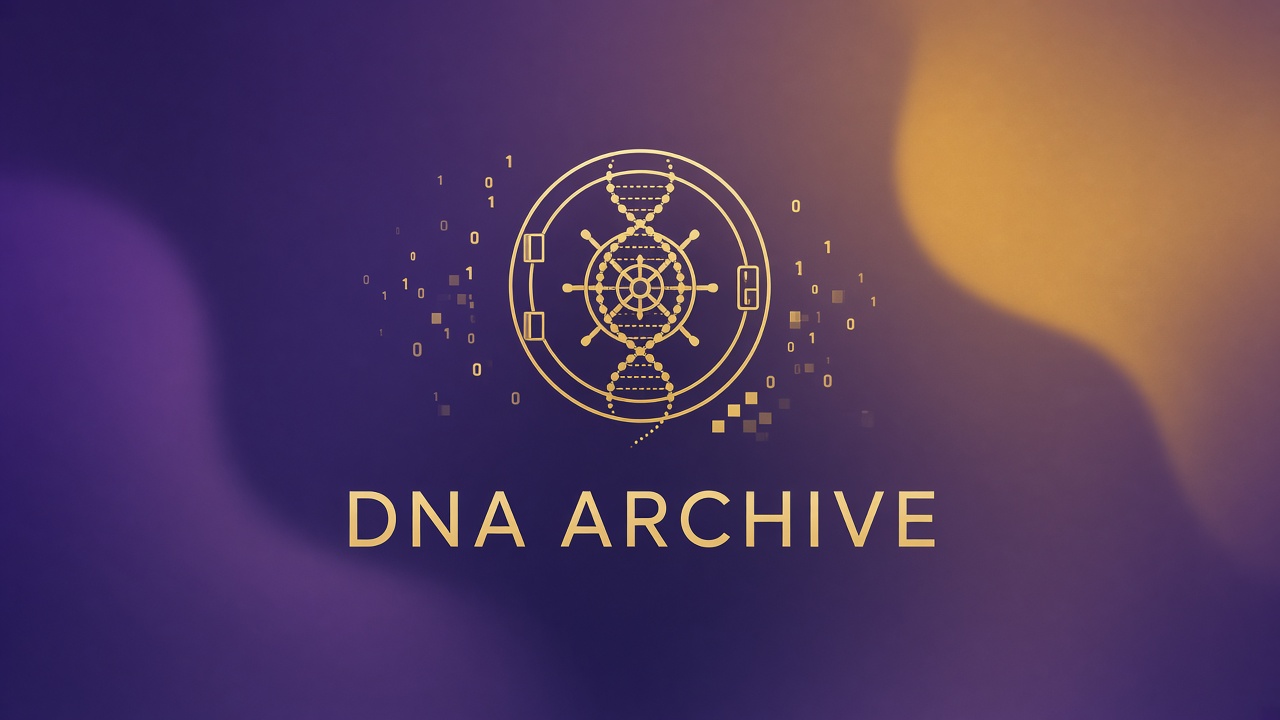
DNA storage converts binary files into sequences of A, T, G, and C nucleotides, synthesizes those strands, stores them physically, and reads them back with DNA sequencing followed by digital decoding. Each base encodes roughly two bits if you use four symbols (more with advanced codes). Files split into chunks; chunks map to oligo designs with redundancy and checksums because synthesis and sequencing introduce errors.
The workflow has four phases: encode (software), write (synthesis), store (cold physical vault), read (sequencing plus decode). Unlike tape, random access is expensive: you often amplify a subset of strands with PCR before sequencing rather than seeking a byte offset.
Density and Durability Claims
Theoretical density reaches exabytes per gram; demonstrated lab demos sit at megabyte to gigabyte scale per synthesis run with durability measured in decades under controlled conditions, not infinite shelf life in a desk drawer. Marketing slides multiply theoretical density by hypothetical synthesis cost curves. Procurement teams should ask for encoded volume, error rate after decode, and storage temperature requirements on the specific demo they cite.
| Medium | Density (order of magnitude) | Active power | Typical use |
|---|---|---|---|
| NVMe SSD | Terabytes per device | Active when mounted | Hot data, OS, apps |
| LTO tape | Terabytes per cartridge | None when shelved | Enterprise cold archive |
| DNA (lab demos) | Exabytes per gram theoretical | None when frozen | Ultra-cold archival research |
AI Role in Encoding and Retrieval
Machine learning helps design robust encoding schemes, predict synthesis failure modes, correct sequencing errors, and build semantic indexes that map queries to oligo pools without reading the entire archive. Classical error-correcting codes remain essential; neural models assist where noise patterns are non-uniform across vendors and sequencing chemistries.
Error Correction and Denoising
Sequencing reads strands with substitution, insertion, and deletion errors. Reed-Solomon and fountain codes provide baseline recovery. AI models trained on vendor-specific noise profiles can reconstruct chunks humans would discard, improving effective yield per synthesis dollar. Overfitting to one sequencer model breaks when the archive is read on a different platform a decade later; multi-vendor training data matters.
Indexing and Selective Retrieval
AI-assisted indexing assigns metadata tags to oligo pools so retrieval amplifies only relevant strands, reducing sequencing cost for partial reads. Imagine a national film archive: keyword search should not require sequencing every reel equivalent. Graph and embedding models map catalog metadata to physical pool IDs. This layer connects naturally to AI research on learned indexes and vector retrieval, adapted to wet-lab constraints.
Microsoft and Twist Bioscience Demonstrations
Microsoft's research group published multiple DNA storage prototypes with Twist Bioscience supplying synthetic DNA. Demos encoded Wikipedia-scale text, archival test files, and automated end-to-end write-read loops in lab settings. These proofs validate physics and biochemistry, not price parity with LTO tape. Twist and peers sell synthesis by base pair; archival economics depend on synthesis cost curves flattening over years.
Cost and Speed Limits
Write and read speeds remain orders of magnitude slower than flash; cost per gigabyte still exceeds tape and cloud cold tiers for practical 2026 deployments. Synthesis runs hours to days for meaningful payloads; sequencing read latency plus PCR prep adds more time. DNA storage wins when you need millennia-scale retention in minimal volume and can tolerate week-scale retrieval, not when developers expect S3 GET latency.
- Write bottleneck: Oligo synthesis throughput and error rates cap how fast archives ingest new data.
- Read bottleneck: Sequencing depth determines fidelity; shallow reads save money but raise decode risk.
- Operational expertise: Wet lab staff, biosafety, and chain-of-custody unlike tape robotics.
- Regulatory context: Synthetic DNA orders face screening; archival payloads must pass biosecurity filters.
Why DNA Is Not Your Next SSD
Consumer and enterprise primary storage need random access, rewrite cycles, and microsecond to millisecond latency DNA cannot offer. DNA fits "write once, read rarely, keep forever" niches: cultural heritage, legal records with century horizons, and hypothetical planetary backup copies. Hot AI training data, model checkpoints under active iteration, and transactional databases stay on NVMe and object storage. AI API providers do not serve embeddings from genomes.
Timeline Realism
Commercial DNA archival likely arrives first as specialized vault services for institutions, not as a drop-in cloud storage class before the 2030s. Watch synthesis cost per gigabyte, automated lab robotics, and standard encoding formats (ISO-style specs if they emerge). Pilot participation makes sense for museums and national archives with mandate horizons exceeding tape refresh cycles. Typical SaaS startups should plan on S3 Glacier and tape unless grant funding covers biotech ops.
- 2026-2028: Larger demo archives, improved AI decoders, niche institutional pilots.
- 2028-2032: Possible commercial vault offerings if synthesis economics cross tape for cold-only tiers.
- Beyond 2032: Hybrid archives mixing tape front-end with DNA deep cold if robotics mature.
Tape Refresh Cycles vs DNA Deep Cold
Enterprise tape archives require periodic refresh every seven to fifteen years as drives and formats obsolesce; DNA promises passive stability if storage conditions hold, shifting operational cost from migration to read-rare retrieval. AI model weights archived for regulatory retention face the same refresh problem as financial records. A checkpoint stored on LTO-9 must move to LTO-11 someday. DNA advocates argue physical redundancy (multiple vials in multiple vaults) replaces format migration. Skeptics note synthesis and sequencing chemistry also evolve; decoders written today must remain maintained like tape drivers.
Archiving Model Checkpoints and Training Provenance
Regulators and enterprise AI governance increasingly ask for training data snapshots and weight hashes tied to deployed models. DNA could store immutable bundles: weights, tokenizer files, evaluation logs, and dataset manifests in one encoded object. Retrieval latency makes DNA suitable for legal hold and audit, not rollback during an incident. Hot rollback stays on object storage with versioning. Teams publishing through research consortia should separate "reproducibility archive" from "production serving artifact."
Biosecurity and Order Screening
Synthetic DNA orders pass biosecurity screening against hazardous sequences; encrypted archival payloads must still decode to sequences vendors will synthesize. Plan encoding schemes that avoid false matches to restricted motifs. Institutional buyers need legal review before storing adversarial or sensitive government data in shared synthesis queues. This operational layer rarely appears in density-per-gram keynote slides but blocks naive pilots.
Economic Sensitivity Analysis
DNA storage becomes interesting when synthesis cost per gigabyte crosses LTO total cost of ownership for a defined retention horizon and read frequency. Variables include oligo length limits (chunk size), redundancy factor, sequencing depth per read attempt, and vault fees. AI helps optimize redundancy: learned codes adapt redundancy to expected noise rather than fixed Reed-Solomon overhead. Sensitivity spreadsheets should include failed read retries because biological decode is probabilistic unlike tape bit error rates within spec.
Frequently Asked Questions
| Question | Short answer |
|---|---|
| How much data fits in one gram of DNA? | Theoretical exabyte-scale; practical demos are far smaller until synthesis scales. |
| Can AI models be stored in DNA? | Yes as bit patterns, but running inference from DNA is not the goal; storage is archival. |
| Is DNA storage encrypted? | Encrypt before encoding; anyone who sequences the pool sees plaintext otherwise. |
| How long does retrieval take? | Hours to days depending on pool size and sequencing depth, not milliseconds. |
| Who leads DNA storage research? | Microsoft Research, Twist Bioscience, university labs, and startups in molecular storage. |
| Does DNA storage need power? | Stored strands need cold storage, not electricity; labs need power to read. |
Should I archive AI training datasets in DNA?
Only if retention horizons exceed tape economics and retrieval latency is acceptable. Active training pipelines need hot object storage; DNA suits immutable snapshots for compliance or cultural record.
What if sequencing technology changes?
Forward-compatible encoding standards and redundant physical copies reduce lock-in. AI decoders should document assumptions so future platforms retrain on new noise models.
Standards and Interoperability Outlook
DNA storage lacks the universal LTO drive ecosystem tape enjoys. Encoding formats remain vendor-specific though academic working groups push open reference codecs. AI-assisted decoders should ship as versioned containers with deterministic seeds so archives decoded in 2040 reproduce 2026 bit outputs. Interoperability with API driven catalog systems means treating DNA pools like offline object storage buckets with multi-day GET latency and PCR-based prefix listing instead of HTTP range requests. Document that contract in internal runbooks so SRE teams do not misconfigure DNA vaults like S3 buckets.
Governance for Molecular Archives
Legal hold, chain of custody, and destruction certificates for DNA vials differ from shredding tape cartridges. Compliance officers should define who may order synthesis, which geographies may store vials, and how encrypted payloads interact with export control. AI indexing layers must respect retention schedules: deleting a digital index should not orphan wet-lab vials without physical destruction workflows. Cross-functional teams spanning IT, legal, and facilities biology belong in every DNA pilot charter before budget approval. Pilot success criteria should include decoded bit accuracy after simulated decade storage, not synthesis photo ops alone.
What is realistic read-after-write latency?
Expect days to weeks from bits to stored vials to first successful read in pilot labs, not minutes like object storage uploads. Production vaults may improve with automation but remain unsuitable for transactional workloads or model hot-swapping during incidents.
Is DNA storage related to quantum storage hype?
No; DNA storage is molecular chemistry with demonstrated read/write in labs, distinct from quantum memory research still seeking commercial form factors. Procurement categories should stay separate in RFPs.
Should I use Glacier Deep Archive instead today?
For virtually all 2026 enterprise archives, yes: S3 Glacier or tape beats DNA on cost, latency, and operational maturity. DNA remains a horizon option for multi-century mandates and extreme density vaults.
Conclusion
DNA storage and AI together address extreme-density archival: biology holds bits for centuries; machine learning cleans noisy reads and builds indexes for selective retrieval. Microsoft and Twist demos prove feasibility in labs, not replacement for SSDs or S3. Cost, write speed, and wet-lab operations block mainstream adoption in 2026. Institutions with multi-decade mandates should monitor pilots; everyone else should keep cold data on tape and cloud glacier while tracking AI research on molecular encoding. Your genomes belong to biology; your hot API traffic belongs on silicon.