Enterprise AI agents stopped being single-vendor chatbots in 2026. Teams deployed planning agents from one vendor, data retrieval tools from another, and workflow automations inside existing SaaS platforms. Without shared protocols, every integration required custom glue code, brittle auth flows, and duplicated governance logic. AI agent interoperability standards emerged to solve two distinct problems: how models access tools (MCP) and how agents coordinate with each other (A2A).
This analysis explains why interoperability matters, compares major standards and their backers, maps enterprise architecture impact, and covers security considerations for teams building on AI code tools and AI chatbot platforms.
Why Agent Interoperability Matters Now
Agentic AI systems fail at enterprise scale when each vendor exposes proprietary APIs for tool invocation, task delegation, and identity propagation. Procurement teams select best- of-breed components. Developers need those components to discover capabilities, exchange structured messages, and enforce authorization consistently across organizational boundaries.
Without standards, a Salesforce Agentforce agent cannot reliably delegate a research task to a Google Gemini agent, which then calls a Workday MCP server, without bespoke integration projects for every pairwise combination. Standards reduce N-squared integration work to N implementations per protocol. They also give security teams auditable choke points: API gateways, signed Agent Cards, and scoped OAuth tokens instead of ad hoc API keys embedded in agent prompts.
The 2026 agent protocol landscape consolidated faster than prior AI developer standards. Model Context Protocol (MCP) went from Anthropic launch to cross-industry adoption in roughly sixteen months. Agent-to-Agent (A2A) launched in April 2025 with more than fifty partners and merged with IBM's Agent Communication Protocol (ACP) under the Linux Foundation by August 2025. Both protocols now share JSON-RPC foundations and open governance, though production maturity differs by use case.
Major Standards and Their Backers
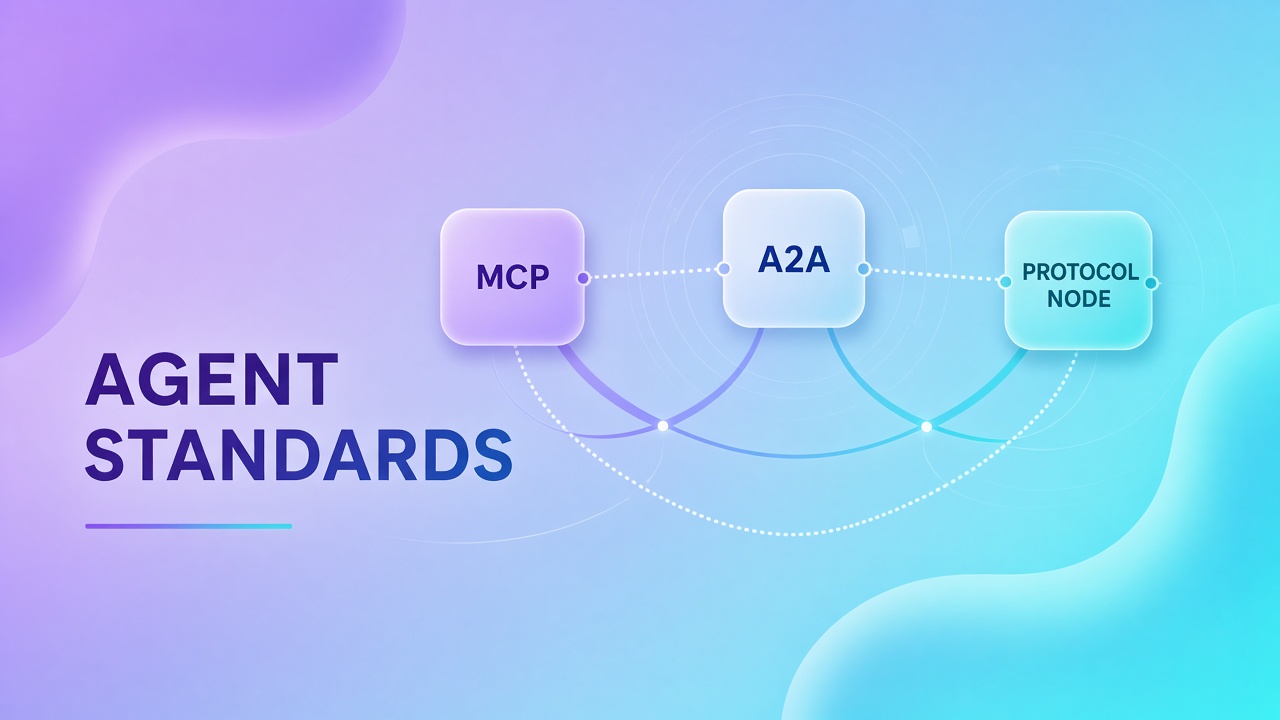
MCP handles model-to-tool communication; A2A handles agent-to-agent coordination. They compose rather than compete in production architectures. Understanding each protocol's scope prevents teams from forcing the wrong standard onto a problem.
| Standard | Scope | Key backers | Discovery mechanism |
|---|---|---|---|
| MCP | Model/app to tools, data, workflows | Anthropic origin; Linux Foundation; broad vendor adoption | MCP server capability listings |
| A2A | Agent-to-agent task delegation | Google launch; Salesforce, SAP, ServiceNow, Workday | Agent Cards at /.well-known/agent-card.json |
| ACP (merged into A2A) | Stateful async agent messaging | IBM Research; consolidated with Google A2A | REST-native multimodal messages |
| ANP | Decentralized agent networks | Research community; early stage | DIDs and JSON-LD graphs |
MCP provides a JSON-RPC client-server interface. An MCP host (the AI application) connects to MCP servers that expose tools, resources, and prompts with typed schemas. Developers publish MCP servers for databases, SaaS APIs, file systems, and internal microservices. The protocol handles authorization at the server boundary, keeping credentials out of model context when implemented correctly.
A2A enables peer-to-peer agent collaboration. Agents publish Agent Cards describing skills, input/output schemas, and authentication requirements at a well-known endpoint. A planning agent discovers a specialist agent, delegates a subtask, receives asynchronous results, and composes a final response. ACP's stateful messaging concepts merged into the unified A2A specification, supporting long-running workflows across vendor boundaries.
Salesforce, Google, SAP, ServiceNow, UKG, and Workday participated in A2A's launch, reflecting enterprise demand for cross-platform agent orchestration in customer experience and back-office workflows. MCP adoption spread faster among developer tool vendors and IDE integrations. Production systems in 2026 typically layer A2A for high-level orchestration and MCP for low-level tool execution within each agent's boundary.
Enterprise Architecture Impact
Interoperability standards shift enterprise AI architecture from monolithic agent platforms toward composable agent meshes with gateway-enforced policy. Architecture teams should plan for protocol-level integration rather than vendor-specific SDKs alone.
Reference architectures in 2026 place an API gateway or agent gateway at the perimeter. The gateway validates Agent Cards, enforces OAuth scopes, propagates W3C Trace Context for OpenTelemetry observability, and rate-limits cross-agent traffic. Internal MCP servers sit behind the gateway, exposing governed tool access to authorized agents only. Identity flows through a central broker so agent prompts never contain raw credentials.
Procurement implications are significant. RFPs increasingly ask whether vendors support MCP tool servers, A2A Agent Cards, or both. Platforms that expose only proprietary APIs risk isolation as enterprises standardize on open protocols. Conversely, vendors with strong MCP server ecosystems gain distribution through any MCP-compatible host, reducing dependency on a single agent UI vendor.
Migration paths start with MCP for tool access because the specification is simpler and adoption is broader. Teams add A2A when multi-agent delegation crosses team or vendor boundaries. ANP and decentralized discovery remain research-stage for most enterprises, relevant mainly for open agent marketplaces rather than regulated internal workflows.
Security Considerations for Cross-Vendor Agents
Agent interoperability introduces authorization gaps that orchestration standards alone do not fully solve, especially portable agent identity across vendor boundaries. Security teams must address authentication, delegation chains, and data exfiltration paths before production deployment.
- Agent Card signing: Verify Agent Card integrity to prevent capability spoofing and unauthorized skill injection.
- Skill-scoped OAuth: Issue tokens limited to specific MCP tools or A2A skills rather than broad API access.
- Portable agent identity: Forrester's "portable agent identity" concept remains unsolved at scale; cross-vendor delegation requires explicit trust frameworks.
- Prompt injection via tools: MCP servers returning adversarial content can manipulate agent behavior; sanitize and sandbox tool outputs.
- Delegation audit trails: Log every A2A task handoff with caller identity, target agent, and data classification.
- mTLS and DPoP: Use sender-constrained tokens for agent-to-agent calls in zero-trust environments.
- Gateway observability: Propagate OpenTelemetry traces across MCP and A2A hops for incident response.
Working groups within the Linux Foundation continue building governance, regulatory compliance, and data safeguard extensions into MCP and A2A. Enterprises should not assume current specifications cover HIPAA, GDPR, or sector-specific logging requirements out of the box. Policy engines at the gateway layer remain mandatory for regulated industries.
The biggest unsolved problem is trust propagation: when Agent A delegates to Agent B, which touches a production database, how does the system verify that Agent B operates under the same authorization context as the original human request? Until portable agent identity matures, enterprises should limit cross-vendor delegation to low-sensitivity workflows or require human approval gates at delegation boundaries.
Frequently Asked Questions
What is the difference between MCP and A2A?
MCP (Model Context Protocol) connects AI applications to tools, data sources, and workflows via a client-server JSON-RPC interface. A2A (Agent-to-Agent) enables agents to discover each other, delegate tasks, and return results across vendor boundaries using Agent Cards and asynchronous messaging.
Who governs MCP and A2A in 2026?
Both protocols are governed under the Linux Foundation. MCP originated at Anthropic before open-sourcing. A2A launched with Google and merged with IBM's ACP under LF AI and Data governance.
Can MCP and A2A be used together?
Yes. Production agent architectures typically use A2A for high-level multi-agent orchestration and MCP for tool execution within each agent's scope. The protocols address different communication layers and compose rather than compete.
What is an Agent Card in A2A?
An Agent Card is a JSON document published at /.well-known/agent-card.json describing an agent's skills, input/output schemas, and authentication requirements. Other agents use Agent Cards to discover capabilities before delegating tasks.
What security gaps remain in agent interoperability?
Portable agent identity across vendor boundaries remains the largest unsolved problem. Teams should implement gateway-enforced OAuth, signed Agent Cards, delegation audit logs, and human approval gates for high-sensitivity cross-agent workflows until trust frameworks mature.