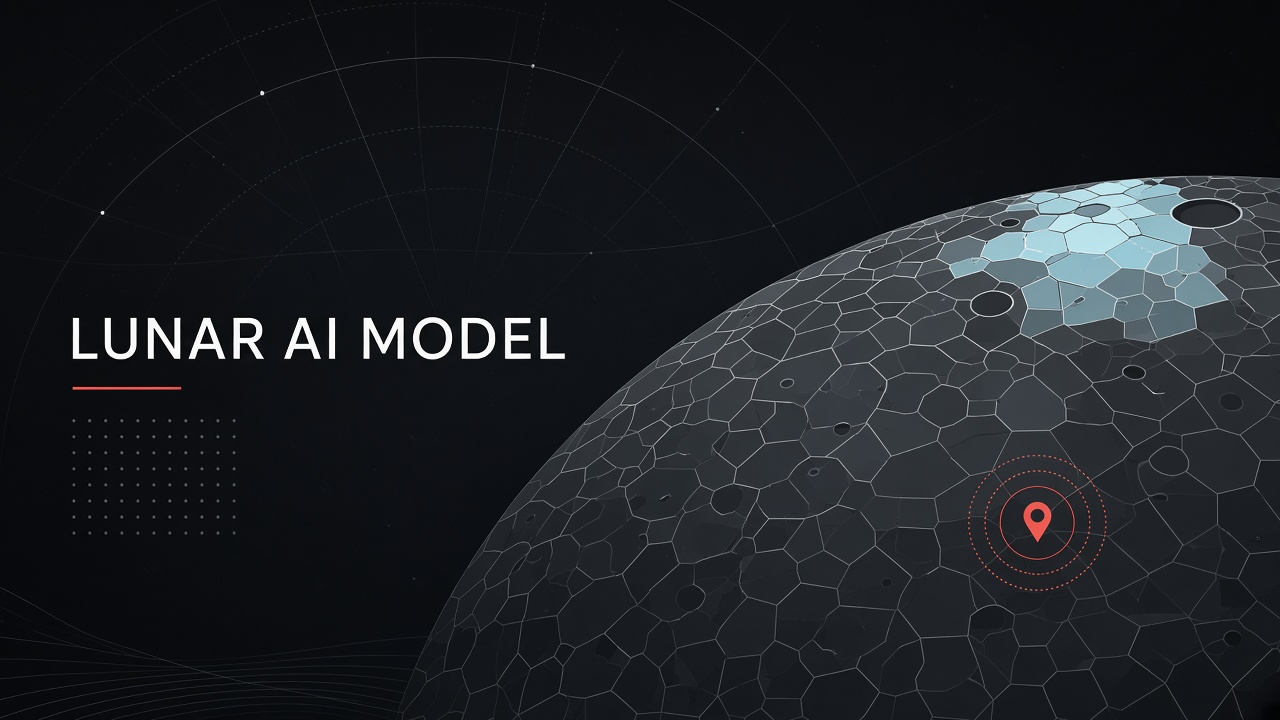
NASA's Lunar Reconnaissance Orbiter (LRO) has orbited the Moon since 2009, collecting more data volume than all other NASA planetary missions combined. Crater counts, polar shadow maps, and boulder fields that once took graduate students years to compile now demand automated analysis at scale as Artemis plans crewed landings and commercial payloads multiply. In September 2025, NASA and IBM Research released the NASA-IBM Lunar Foundation Model (LFM), an open-source geospatial foundation model trained on roughly 2 million co-registered lunar tile bundles. Researchers fine-tune the encoder for crater detection, young volcanic feature mapping, and polar ice prospectivity with lighter compute than training task models from scratch. This explainer covers LRO inputs, SomBench training data, downstream benchmarks, and Artemis landing site implications. Space science readers in AI research or browsing popular AI research topics can download weights from Hugging Face and adapt them through IBM's TerraTorch toolkit.
Why the Moon Needs Modern ML Maps
Lunar science still relies on harmonizing datasets acquired at 1-meter nadir resolution, 100-meter multispectral context, 60-meter topography, and 20-kilometer gravity grids that were never designed as one fused product. GRAIL mapped gravity at coarse scale to probe crust thickness while LRO Narrow Angle Camera (NAC) imaged individual boulders. JAXA's SELENE and NASA's Lunar Prospector added complementary chemistry and elevation layers. Manual alignment across modalities slows hypothesis testing: where are young volcanic vents near permanently shadowed regions with favorable traverse slopes? Foundation models learn shared embeddings so downstream tasks inherit cross-modal context after modest fine-tuning.
Kevin Murphy, NASA chief science data officer, framed the release as turning petabytes into discoveries. IBM positions LFM alongside Prithvi EO for Earth and Surya for heliophysics, extending the agency's open-science AI model portfolio announced through the Impact AI team at Marshall Space Flight Center with contributions from Goddard and Ames.
LRO Data Products Used for Training
SomBench bundles about 1.036 million LROC NAC tiles near 1 meter per pixel and 963,609 LROC WAC tiles near 100 meters per pixel with 11 co-registered modalities including topography, slope, aspect, and gravity-derived context. Training applied the TerraMind masked-token recipe to lunar data with modality-specific VQ-VAE tokenizers and a ViT-B encoder-decoder (12 layers, patch size 8 at 256 pixel inputs per Hugging Face model card). Pretraining ran 150 epochs on 16 NVIDIA H100 GPUs with geographic splits reserving the Apollo zone and permanently shadowed regions for held-out evaluation to reduce spatial leakage.
Additional missions fed static context maps: GRAIL gravity, Lunar Prospector elemental maps, and SELENE terrain products. The model card lists NASA award 80MSFC25M0084 and open-weights licensing for research and commercial adaptation, though users should verify current license text on Hugging Face before redistribution.
| Modality (examples) | Typical resolution | Science use |
|---|---|---|
| LROC NAC imagery | ~1 m/px | Rocks, craters, lander hazards |
| LROC WAC multispectral | ~100 m/px | Regolith composition, regional geology |
| DTM / slope / aspect | ~60 m | Traversability, illumination |
| GRAIL gravity | ~20 km | Crustal structure, mascons |
Downstream Tasks: Craters, Ice, and Volcanism
Benchmarks on Robbins crater catalogs, meter-scale NAC craters, irregular mare patches, and polar ice prospectivity show foundation fine-tuning beating or matching SwinV2 and ConvNeXt baselines with less labeled data. On Robbins WAC craters with 50 percent of labels, full fine-tuning reached mAP 0.2541 versus SwinV2-B 0.2313; LoRA adaptation at 100 percent labels hit mAP 0.2581 versus 0.2420 baseline. NAC meter-scale craters were roughly even with SwinV2 (0.1543 vs 0.1552 mAP), reflecting harder resolution and label noise. Irregular Mare Patches segmentation achieved IoU 0.5709 with a frozen encoder, beating ConvNeXtV2-B at 0.5687 while random-init LFM scored only 0.3142, demonstrating pretraining value. Polar ice prospectivity regression lowered RMSE to 0.0293 versus 0.0377 for SwinV2-B.
IBM reports LoRA adapters fine-tuned roughly 10 percent of weights while keeping 90 percent frozen, matching full fine-tune quality on several tasks. That matters for researchers with limited GPU budgets who want Artemis-relevant maps without cluster-scale pretraining.
Open-Weight Access for Researchers
Weights, TerraTorch training recipes, and SomBench splits ship on Hugging Face under nasa-ibm-ai4science with GitHub code for inference and adaptation. Any-to-any multimodal generation is supported as a qualitative probe of learned structure, though production science workflows emphasize encoder fine-tuning for detection and regression. Teams should document which modality subsets they fine-tune because patch grids may differ from pretraining defaults.
Open release aligns with NASA's broader push for science-ready AI: Prithvi EO variants already support Earth disaster response; LFM extends the pattern to planetary surfaces where labeled data is scarcer than ImageNet but unlabeled orbital archives are vast.
Comparison to Earth Prithvi Models
LFM adapts the TerraMind masked modeling recipe that IBM and NASA refined for Earth observation Prithvi models, swapping marine clouds and vegetation seasons for regolith, impact rays, and permanently shadowed terrain. Earth practitioners already fine-tune Prithvi EO 2.0 embeddings for flood mapping and crop classification; lunar researchers get analogous encoder weights without pretending Blue Marble statistics transfer to airless bodies. FoundationSoil's 2025 use of Prithvi for U.S. soil carbon mapping shows the same pattern on Earth: pretrained spatiotemporal tokens plus environmental covariates beat pixel baselines when labels are sparse.
Any-to-any generation in LFM lets scientists probe whether the model learned physically plausible relationships, such as correlating slope with illumination at polar latitudes. Generative outputs are not flight-ready products, but they help debug fine-tunes before committing GPU weeks to crater detection sweeps across Artemis candidate regions.
Implications for Landing Site Selection
Artemis planners weigh illumination, slope, boulder density, and water ice proximity; LFM-style models accelerate trade studies but do not replace in situ verification. Polar permanently shadowed regions near Peary or Shackleton craters interest resource scouts because cold traps may host ice delivered by comets. Automated ice prospectivity maps narrow desktop candidates before engineers demand NAC stereo pairs for human landing ellipses. Young volcanic features (irregular mare patches) inform geologic hazard timelines: is the surface quiescent for infrastructure lifetime?
Commercial landers from Intuitive Machines, Astrobotic, and others benefit from the same maps when filing hazard reports. Foundation models lower the cost to rerun analyses when new LRO downlinks arrive or when planners shift from south pole to equatorial science sites. They do not eliminate independent verification cross-checks required by mission assurance.
Frequently Asked Questions
When was the Lunar Foundation Model released?
NASA and IBM announced the open model in September 2025, with public weights on Hugging Face and coverage in NASA Science and IBM Research blogs dated around September 10 to 12, 2025.
Is there a Mars foundation model from this team?
The September 2025 release focuses on the Moon. NASA and IBM's Earth Prithvi and heliophysics Surya models cover other domains. Mars researchers may transfer techniques but should not assume lunar weights generalize to dusty atmospheres and different instrument suites without retraining.
How does LFM compare to training Swin from scratch?
Published SomBench benchmarks show mAP and RMSE gains on crater and ice tasks with equal or fewer labels, especially when using LoRA or frozen encoders. Meter-scale NAC craters remain challenging for all architectures, with near parity between LFM and SwinV2-B.
Can commercial landers use the model?
Open weights target research and commercial adaptation, subject to license terms on Hugging Face. Landing safety still requires institutional review, independent hazard datasets, and terrain relative navigation on board the spacecraft.
What is SomBench?
SomBench is the co-registered lunar tile dataset (~2 million bundles) used to pretrain LFM, with geographic holdouts for Apollo and polar zones. It pairs NAC and WAC imagery with terrain and context modalities at aligned footprints.
What is TerraTorch?
TerraTorch is IBM's geospatial machine learning toolkit used to train and fine-tune LFM. Researchers load pretrained weights, attach task heads for detection or regression, and run LoRA adapters without reimplementing the ViT-B encoder from scratch. NASA award 80MSFC25M0084 supported integration with open SomBench assets.
Does LFM directly detect water ice?
Ice prospectivity tasks regress proxy scores learned from orbital remote sensing correlates, not in situ neutron spectroscopy. Confirmation still requires rovers, drills, or impact ejecta spectroscopy. Treat outputs as prioritization maps, not drill orders.
Artemis and Commercial Lander Planning
Artemis mission planners weigh science return against landing risk. High-resolution NAC stereo pairs still define human landing ellipses, but LFM-derived hazard maps prioritize which ellipses deserve expensive stereo acquisition. Commercial CLPS landers with smaller tolerance for boulder fields may accept different risk thresholds than crewed missions. Open weights let multiple contractors run consistent analyses rather than each rebuilding crater catalogs from scratch.
Polar resource campaigns combine illumination models with ice prospectivity scores. Permanently shadowed regions near the south pole interest water ice hunters, yet traverse routes must avoid steep crater walls visible in DTM derivatives bundled in SomBench tiles. Foundation embeddings help correlate ice proxy signals with terrain roughness before rovers commit to multi-kilometer drives. Hugging Face model cards document ViT-B depth, tokenizer counts, and benchmark tables so reproducibility reviewers can match published mAP and RMSE figures without proprietary binaries.
Students comparing LFM to training SwinV2 from random initialization on Robbins craters should note the large gap random-init LFM exhibits (mAP 0.2197 at 50 percent labels versus 0.2541 fine-tuned), evidence that lunar pretraining transfers even when downstream patch sizes differ from SomBench defaults. Irregular Mare Patch segmentation with a frozen encoder nearly matched ConvNeXtV2 while random initialization collapsed, a practical tip for teams with limited GPU budgets targeting young volcanic features near candidate landing corridors.
The NASA-IBM Lunar Foundation Model compresses decades of LRO and companion missions into a reusable geospatial encoder for planetary science. Open weights, SomBench benchmarks, and LoRA-friendly fine-tuning lower the barrier to crater catalogs and polar resource maps that support Artemis and commercial exploration. For adjacent astronomy AI workflows, see AI research articles indexed under popular AI research. Download SomBench splits from the release repository before fine-tuning so your held-out polar and Apollo zones match published benchmarks when you report crater mAP or ice RMSE to mission partners. The September 2025 NASA Science announcement emphasized that LRO alone exceeds the data volume of all other NASA planetary missions combined, which is why a foundation model approach finally pays off where task-specific CNNs struggled to fuse gravity, topography, and meter-scale imagery jointly. LoRA fine-tuning that adjusts roughly 10 percent of weights while freezing the encoder makes classroom-scale GPU rentals viable for crater detection homework that previously required institutional clusters. Polar ice prospectivity RMSE 0.0293 versus SwinV2-B 0.0377 on SomBench benchmarks gives resource teams a quantitative reason to prefer foundation fine-tunes over scratch CNNs. Kevin Murphy's September 2025 quote framing petabyte-scale lunar archives as discovery opportunities captures why open weights matter for Artemis-era science planning. Download links remain on Hugging Face under the nasa-ibm-ai4science organization with full TerraTorch training recipes.