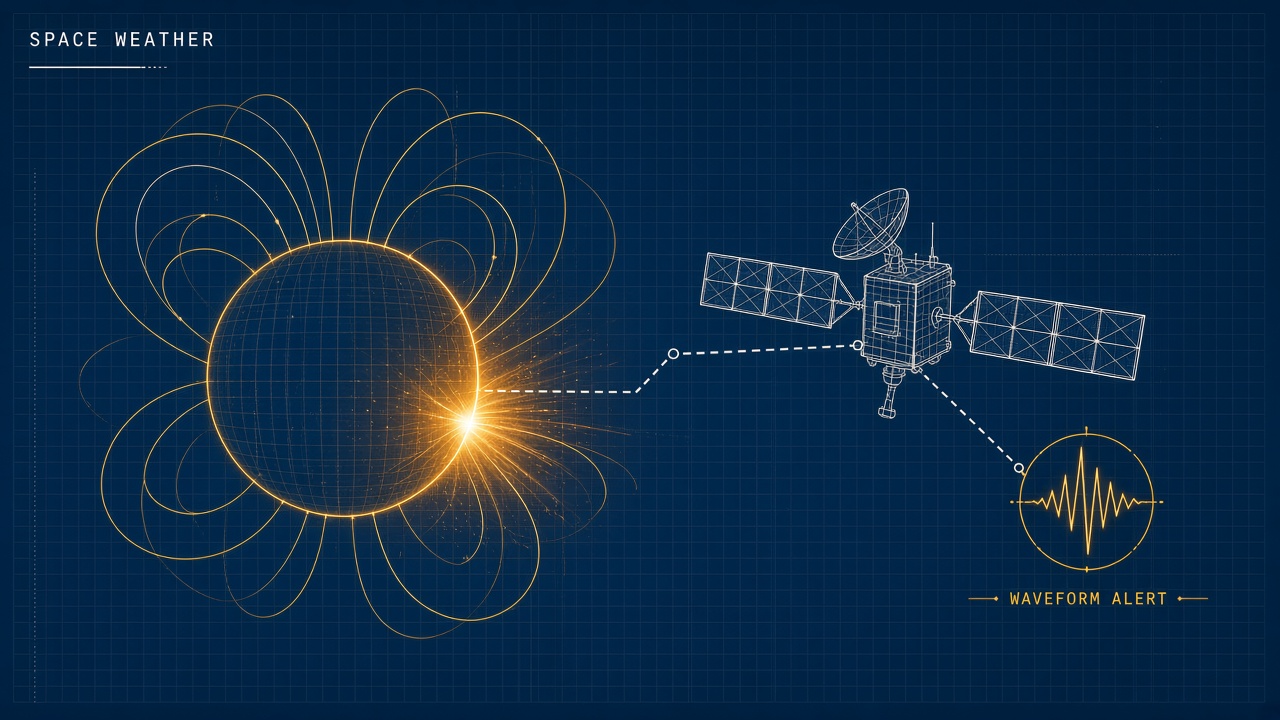
A geomagnetic storm knocks out a power transformer in Quebec. A satellite operator scrambles to put spacecraft in safe mode before a proton storm arrives. Airlines reroute polar flights. Each of these responses depends on knowing that the Sun is about to erupt, often hours before particles and radiation reach Earth. That early warning chain starts with solar flare prediction, and modern pipelines increasingly use machine learning on magnetogram images, X-ray flux time series, and physics-informed features. Solar flare prediction AI combines convolutional networks, bidirectional LSTMs, vision transformers, and multimodal foundation models trained on data from the Solar Dynamics Observatory (SDO), GOES satellites, and newer missions like ASO-S.
Space weather affects power grids, GPS accuracy, airline radiation exposure, and satellite hardware. NOAA's Space Weather Prediction Center (SWPC) issues alerts that downstream operators act on. Research teams at NASA's Community Coordinated Modeling Center (CCMC) benchmark forecasting models against operational baselines. Teams evaluating AI chatbot products for operations centers should understand that flare prediction quality upstream determines every downstream alert. For broader context on research explainers, browse the EliteAI.tools blog index.
What Solar Flare Prediction AI Means in Plain Language
Solar flare prediction AI is the use of machine learning models to estimate the probability that an active region on the Sun will produce a flare of a given class (C, M, or X) within a defined forecast window, typically 24 hours. A solar flare is a sudden release of magnetic energy in the solar atmosphere, visible in soft X-rays and associated with coronal mass ejections (CMEs) that can drive geomagnetic storms at Earth. Prediction models do not simulate full magnetohydrodynamics; they learn statistical patterns from historical observations.
Inputs fall into three families. Magnetograms from SDO/HMI and SHARP active-region patches show magnetic field strength and polarity inversion lines where flares often originate. Time series from GOES X-ray sensors track ongoing flare activity and background flux. Knowledge-informed features extract physics-motivated scalars (total unsigned flux, shear, gradient measures) that classical solar physics has linked to eruptive potential.
| Flare class | X-ray peak flux | Typical impact |
|---|---|---|
| C-class | < 10-5 W/m2 | Minor radio blackout on sunlit Earth |
| M-class | 10-5 to 10-4 W/m2 | Moderate radio blackout; radiation concern for aviation |
| X-class | ≥ 10-4 W/m2 | Major blackout; satellite and grid risk if CME Earth-directed |
How predictions become alerts
Research models output probabilities per active region; operational centers like NOAA SWPC integrate those scores with human forecaster judgment, coronagraph CME detections, and in-situ solar wind measurements before issuing public alerts. A high M-flare probability does not automatically mean a geomagnetic storm: the CME must be Earth-directed and maintain magnetic connectivity. Flare prediction AI addresses the first link in that chain: whether the Sun will erupt at all.
How the Underlying AI Pipeline Works
Modern solar flare prediction pipelines ingest magnetogram sequences or feature vectors, pass them through deep learning backbones, and output calibrated probabilities evaluated with skill scores that account for class imbalance. Flares are rare relative to quiet Sun intervals, so training uses weighted losses, focal loss, or oversampling. Evaluation relies on true skill statistic (TSS) and Brier skill score (BSS) rather than raw accuracy, which is misleading when most samples are non-flaring.
CNN and LSTM models on magnetograms
Early deep learning approaches treated SHARP magnetogram patches as 2D images and applied convolutional neural networks (CNNs) to classify flare potential. Adding bidirectional LSTM layers (CNN-BiLSTM) captures temporal evolution across magnetogram sequences taken at 12-minute cadence from SDO. Attention mechanisms highlight magnetic neutral lines and strong-gradient regions that solar physicists associate with free magnetic energy. These architectures remain strong baselines but are increasingly surpassed by transformer models on the same data.
Transformers and multimodal foundation models
Vision transformers (ViT) and multiscale vision transformers (MViT) treat magnetogram sequences as spatiotemporal volumes. Published work in The Astrophysical Journal Supplement Series (2025) compares CNN, CNN-BiLSTM, ViT, and MViT on SDO/SHARP, SDO/HMI, and ASO-S/FMG data for M-class flare prediction within 24 hours. MViT reached a true skill score of 0.707 on ASO-S/FMG single-active-region data and demonstrated generalization across multisource magnetograms. A separate study introduced iTransformer for knowledge-informed time-series features alongside image-based models, reporting state-of-the-art performance on challenging real-world solar datasets.
Foundational transformer work published in 2025 evaluates SigLIP2 for image encoding, VideoMAE for spatiotemporal video, and Moirai2 for multivariate GOES X-ray time series under consistent splits. Moirai2 achieved TSS near 0.74 using irradiance evolution alone, while image and video models reached TSS around 0.60 to 0.65. These results suggest multimodal fusion that combines magnetograms with X-ray history may be the next operational frontier.
| Model family | Input modality | Reported TSS (indicative) | Strength |
|---|---|---|---|
| CNN / CNN-BiLSTM | Magnetogram images or sequences | Moderate; varies by dataset | Interpretable via Grad-CAM overlays |
| ViT / MViT | Spatiotemporal magnetogram volumes | Up to ~0.71 (MViT, FMG single AR) | Strong cross-mission generalization |
| iTransformer + features | Knowledge-informed scalars | Competitive with NASA/CCMC baselines | Physics features aid interpretability |
| Moirai2 (time series) | GOES soft X-ray flux | ~0.74 | No image preprocessing required |
Link to CME forecasting and satellite alerts
Flare prediction alone does not forecast CME arrival time or geomagnetic storm intensity. Coronagraph instruments on SOHO and STEREO detect CME launches; ENLIL and other heliospheric models propagate them to Earth. Machine learning also enters CME forecasting through image-based deep models on coronagraph sequences. Satellite operators combine flare probabilities with CME direction estimates to decide safe-mode timing, command moratoria, and radiation belt modeling updates. NOAA SWPC products (watch, warning, alert) translate the science into actionable thresholds for aviation, power utilities, and launch providers.
Typical workflow steps
- Download SHARP active-region magnetograms and metadata from SDO archives (or ASO-S/FMG for newer cycles).
- Extract knowledge-informed features (flux, shear, polarity inversion line length) or build spatiotemporal tensor windows (1 to 24 hours).
- Train classifier with class-balanced loss; validate with temporal holdout (no future data leakage).
- Evaluate with TSS and BSS; compare against NASA/CCMC benchmark models on matched active regions and forecast horizons.
- Deploy inference pipeline that scores each active region daily; route high-probability regions to human forecaster review.
- Integrate scores into SWPC or internal ops dashboards alongside CME and solar wind monitors.
Real Deployments and Published Evidence
Solar flare prediction AI has moved from conference posters into peer-reviewed comparisons against NASA/CCMC operational baselines, with open-source codebases publishing MViT and ViT implementations on GitHub. The Intelligent Forecasting for Solar Flares project provides preprocessing, training, and testing scripts for SDO/SHARP, SDO/HMI, and ASO-S/FMG magnetograms. Authors report MViT performance comparable to CCMC methods under matched prediction windows and active-region counts.
NOAA SWPC continues to rely on a mix of empirical rules, human expertise, and physics-based models, but machine learning components are entering research-to-operations pathways through CCMC validation. The 2024 to 2025 solar maximum increased flare rates, providing richer test beds for generalization studies. Multisource magnetogram experiments show that models trained on SDO data can transfer to ASO-S/FMG with modest retraining, important as new missions join the fleet.
Grad-CAM and attention visualizations help forecasters see which magnetic structures drive model scores, bridging the gap between black-box predictions and heliophysics intuition. Operational adoption still requires sustained false-alarm analysis: utilities and airlines need calibrated probabilities, not binary alarms that cry wolf during quiet intervals.
Where satellite operators fit
Commercial constellation operators monitor SWPC scales (S for solar radiation, G for geomagnetic, R for radio blackout) and internal ML dashboards. High M- or X-class flare probabilities trigger reviews of single-event upset risk, charging on solar arrays, and drag from thermospheric expansion. Prediction lead time of 12 to 24 hours allows staged responses rather than emergency safe mode on every alert.
Limits, Risks, and Ethical Guardrails
Solar flare prediction AI faces severe class imbalance, active-region multiplicity effects, and the fundamental limit that magnetic energy buildup does not guarantee eruption timing. Models trained on single active regions outperform mixed-region patches because overlapping magnetic structures confuse spatial attention. X-class flares remain rare even during solar maximum, so miss rates for the most consequential events deserve separate reporting from aggregate TSS.
- False alarms: Over-predicting M-class events erodes operator trust and can trigger unnecessary costly safe-mode cycles.
- CME disconnect: A correct flare forecast with non-Earth-directed CME still produces no geomagnetic storm.
- Data latency: Magnetogram pipeline delays shrink effective lead time; real-time ops need edge inference budgets.
- Regulatory context: Aviation and grid sectors follow standardized SWPC products; ad hoc ML scores are not substitutes without certification.
Ethical guardrails include transparent reporting of skill scores on rare-class events, avoiding deterministic language that implies certainty, and maintaining human forecaster oversight for public alerts. Space weather disproportionately affects high-latitude communities and polar aviation routes; equitable alert communication matters as much as model accuracy.
Who Should Use This and Who Should Wait
Heliophysics research groups, CCMC collaborators, and satellite ops teams with ML engineering capacity should experiment with published MViT and multimodal pipelines now, benchmarking on their own active-region cohorts. Individual pilots, small utilities, and general software teams without space weather training should rely on NOAA SWPC official products rather than deploying research checkpoints.
| Audience | Recommendation | Caveat |
|---|---|---|
| Heliophysics lab | Train MViT or iTransformer on SHARP plus GOES multimodal data | Report TSS per flare class, not accuracy alone |
| Satellite operator | Monitor SWPC; pilot internal ML as decision support | Flare score is not CME impact forecast |
| Power utility | Use G-scale geomagnetic products for transformer risk | Do not act on unvalidated research probabilities |
| ML engineer without solar physics | Wait; partner with heliophysics domain expert | Feature engineering requires magnetic topology knowledge |
Frequently Asked Questions
How accurate is solar flare prediction AI today?
Published true skill scores for M-class 24-hour forecasts range roughly from 0.60 to 0.74 depending on model, data source, and active-region selection; accuracy varies by solar cycle phase and whether single or multiple active regions are in the field of view. No model achieves perfect X-class recall. Validate on your forecast horizon and flare class threshold before trusting operational decisions.
Does NOAA SWPC use machine learning for flare forecasts?
SWPC integrates research products and human forecaster judgment; machine learning models are validated through NASA CCMC pathways before any operational role. Public alerts follow standardized scales. Research GitHub repositories are not official SWPC forecast engines.
Are CNN-LSTM models still relevant compared to transformers?
CNN-BiLSTM remains a useful baseline and runs efficiently on magnetogram sequences, but published comparisons show spatiotemporal transformers (MViT, VideoMAE) generally achieve higher TSS on the same SDO data products. Hybrid pipelines that combine CNN feature extractors with transformer temporal layers are an active research direction.
Can solar flare AI predict geomagnetic storms?
No. Flare prediction estimates eruption probability at the Sun; geomagnetic storm forecasting requires CME detection, propagation modeling, and solar wind magnetic field orientation at Earth. Treat flare scores as one input among several in the space weather chain.
What data do I need to train a flare prediction model?
Minimum viable training sets use SHARP magnetogram patches with flare labels from GOES X-ray catalogs, typically spanning multiple years to capture solar cycle variation. Adding knowledge-informed features from SHARP metadata and multisource missions (ASO-S/FMG) improves generalization. Public archives from SDO and GOES are freely available.
What lead time do AI flare models provide?
Most research targets 24-hour ahead M-class or X-class probability per active region; some pipelines experiment with shorter windows tied to magnetogram cadence (12 minutes for SDO/HMI). Lead time is bounded by how early magnetic signatures precede eruption, which remains an open physics question.
Should satellite operators safe-mode on high AI flare scores?
Operators should follow established SWPC alert protocols and internal risk matrices; unvalidated ML scores are decision-support inputs, not automatic safe-mode triggers. Consider flare class, CME direction, and asset vulnerability before commanding power-down sequences.
Conclusion
Solar flare prediction AI applies CNNs, LSTMs, vision transformers, and multimodal foundation models to magnetograms and X-ray time series from SDO, GOES, and newer observatories. MViT and iTransformer research demonstrates skill comparable to NASA/CCMC baselines; Moirai2 shows strong performance from time series alone. NOAA SWPC remains the authoritative alert source for operators, while CME forecasting and heliospheric propagation handle Earth-impact prediction. Success depends on class-aware evaluation, multisource validation, human forecaster integration, and clear communication that flare probability is not storm certainty. Teams building in this space should benchmark on temporal holdouts, report rare-event recall separately, and treat space weather ML as infrastructure for decision support rather than a standalone oracle.