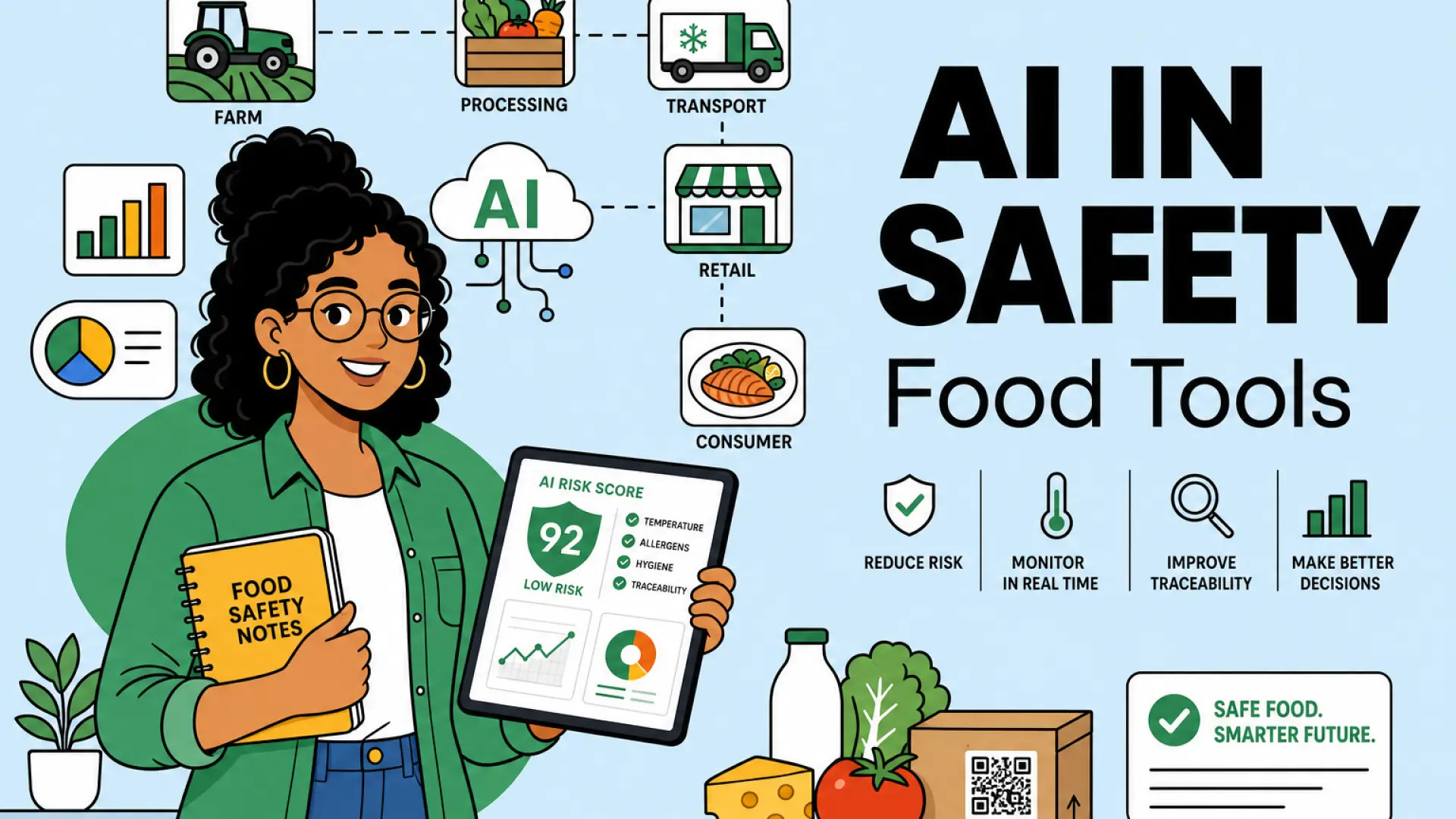
AI food safety audit preparation tools help quality teams assemble HACCP logs, supplier certificates, and corrective action narratives before FDA, USDA, GFSI, or customer audits. Regulators and auditors care about traceability and contemporaneous records, not polished prose that appeared after the inspection was scheduled.
This guide covers document collection workflows, corrective action drafting, supplier certificate tracking, and recall simulation documentation. Review AI design tools for label layout assistance and AI writing tools for narrative drafts only inside your validated quality management system.
Document Collection for Audits
AI excels at indexing scattered PDFs, temperature logs, and cleaning records into an audit-ready binder, but every document must retain original timestamps and electronic signatures where required. Reorganizing files for readability must not alter metadata auditors use to verify authenticity.
| Audit evidence type | Regulatory reference | AI assist boundary |
|---|---|---|
| HACCP plans and hazard analysis | FDA HARPC, Codex HACCP | Index and gap-check only; PCQI approves content |
| Monitoring records (CCP logs) | 21 CFR Part 117, FSMA | Flag missing shifts; never backfill readings |
| Supplier approval files | FSMA FSVP, GFSI SQF | Track expiry; human verifies certificates |
| Allergen control programs | FALCPA, FASTER Act sesame rules | Cross-check label art against formula BOM |
| Sanitation and pest control | GMP, customer audit schemes | Summarize trends; cite source log entries |
Food safety AI documentation workflows should run inside your QMS or document control system. Exporting records to consumer chatbots breaks chain of custody and may violate customer confidentiality.
Corrective Action Narrative Drafting
AI can structure corrective and preventive action reports with root cause, immediate action, and verification steps, but investigators must supply facts from the production floor. Invented root causes or verification dates constitute audit fraud.
- Interview operators and collect physical evidence before opening the AI draft template.
- Map each CAPA section to a specific log entry, lot number, or equipment ID.
- Require quality manager approval before CAPA closes in the system.
- Link effectiveness checks to follow-up microbiological or sensory test results.
- Retain draft history showing human edits, not single-click AI completion.
HACCP AI tools should never auto-close deviations. Use AI to detect recurring deviation patterns across lines and suggest preventive maintenance, not to justify skipping verification.
Supplier Certificate Tracking
Certificate of analysis, kosher letters, organic certificates, and third-party audit reports expire on different cycles; AI tracking prevents last-minute scrambles but cannot replace vendor qualification decisions. A valid PDF on file does not prove the supplier shipped compliant material for your specific lot.
- Parse certificate expiry dates and alert buyers 60 and 30 days before lapse.
- Flag mismatches between certificate product scope and incoming SKU descriptions.
- Queue expired certificates for hold status on affected raw materials automatically.
- Document human approval when temporary waivers are granted during supply disruptions.
Recall Simulation Documentation
Mock recalls test traceability speed and communication templates; AI helps draft exercise scenarios and after-action reports while participants perform real trace exercises. Simulated lot numbers must not contaminate production inventory systems.
Run tabletop exercises that include media statements, retailer notifications, and FDA Reportable Food Registry timelines. AI-generated press drafts need legal and communications approval before any external use, even in drills marked internal only.
| Simulation phase | AI role | Human owner |
|---|---|---|
| Scenario design | Draft contamination vectors from historical near-misses | Food safety director selects final scenario |
| Trace execution | None during timed trace window | Warehouse and QA staff on floor |
| After-action report | Structure findings from facilitator notes | PCQI signs final report |
HACCP Plan Maintenance With AI Support
When process changes alter hazard analysis, AI can diff the old and new HACCP plans and highlight affected CCPs, but the PCQI must approve every change before production adopts it. FDA expects hazard analysis to reflect actual operations, not aspirational flowcharts the model inferred from outdated SOPs.
FSMA Traceability and One-Up-One-Back Records
Section 204 traceability rules require searchable records linking lot codes across the supply chain; AI indexing helps auditors find records in minutes instead of hours. Records must remain tamper-evident. AI reorganizing files cannot remove original creation timestamps from source systems.
| Audit type | AI prep role | Human certification |
|---|---|---|
| GFSI certification | Clause evidence mapping | Quality manager walk-through |
| FDA inspection | Missing record detection | PCQI on-site with originals |
| Customer audit | Questionnaire pre-fill from QMS | Sales and QA joint review |
| Organic inspection | Ingredient trace reports | Organic compliance officer |
Environmental Monitoring Program Support
AI trend analysis on environmental monitoring swabs can flag recurring Listeria or Salmonella positives by zone before auditors ask why patterns were not investigated. Corrective actions triggered by trends still need root cause analysis from the sanitation team, not auto-generated text claiming "cleaning improved" without evidence.
Supplier Approval Workflow Automation
Automate certificate expiry alerts and missing document flags, but retain human approval before adding vendors to the approved supplier list. AI should never auto-approve a supplier because a certificate PDF looks structurally similar to a valid one. Verify issuer, scope, and audit dates against the certifying body database when available.
Corrective Action Verification Standards
Every corrective action record needs objective evidence of completion: photos, retest results, retraining sign-in sheets, or equipment calibration certificates. AI narratives without evidence attachments fail GFSI and FDA inspections. Auditors ask "show me proof," not "show me prose."
Supplier Certificate Audit Trail
When AI parses supplier certificates, store parse confidence, source file hash, and reviewer ID alongside the approved record. During recalls, traceback speed depends on reliable supplier lot linkage. A misread allergen statement on a certificate puts the entire product line at risk.
Recall Simulation Success Metrics
Measure mock recall performance by time to identify affected lots, time to notify customers, and accuracy of quantity calculations. AI after-action reports summarize gaps but do not replace facilitator-led root cause sessions. Regulators expect annual or semi-annual exercises for high-risk facilities.
Internal Audit Preparation Cycles
Run internal audits thirty days before external certification visits using AI to flag missing records by clause. Internal findings close with the same rigor as external ones. Auditors respect plants that found gaps first and documented closure.
Allergen Change Control With AI Support
When formulas change, AI compares old and new ingredient declarations and flags allergen deltas for regulatory affairs review before production runs. Cross-contact risk assessments still need sanitation validation swabs. Never ship label updates based on AI alone.
Organic Integrity Documentation
Organic certifiers require traceability from seed to shelf; AI helps index organic certificates and buffer crop documentation but certifying agents verify on site. Keep National Organic Program compliant records in systems the certifier has approved. AI summaries are working papers, not substitute for organic system plans.
HACCP Verification and Validation Records
Verification activities proving the HACCP system works must remain distinct from validation of control measures; AI helps schedule and document both without conflating them. PCQIs sign verification logs after reviewing monitoring records and corrective actions. Auditors ask for evidence that verification happened on schedule, not that AI generated a plausible narrative.
Pest Control and Sanitation Trend Analysis
AI flags recurring pest activity by zone and correlates with sanitation schedule gaps. Pest control operators validate findings on site. Automated reports support root cause meetings but do not replace physical inspection of bait stations and exclusion points.
Customer Audit Readiness Programs
Retail and foodservice customers audit suppliers with proprietary checklists; AI maps your QMS records to each customer question set. Maintain customer-specific evidence folders updated quarterly. Last-minute AI assembly before a Walmart or Costco audit still needs plant manager walkthrough.
Traceability Technology Integration
Barcode, RFID, and ERP lot tracking systems feed AI audit prep with real-time genealogy; manual spreadsheets are fallback only. Integration tests before audit season confirm lot codes propagate from receiving through shipping labels. Mock recalls exercise the full technology stack, not just document folders.
Food Safety AI Implementation Roadmap
Pilot on document indexing and certificate tracking before corrective action drafting; indexing delivers value without touching regulated narrative content. PCQI signs validation protocol before phase two. Plant managers conduct gemba walks to ensure floor culture still values handwritten contemporaneous records where required.
Plant Floor Culture and AI Documentation
Operators must understand that AI assists documentation after they complete monitoring and sanitation tasks, not instead of performing them. Supervisors reinforce that falsified records are criminal regardless of whether AI polished the narrative. Gemba walks verify behavior matches documentation.
Food safety culture surveys include questions on whether staff feel pressured to skip steps because AI will fill gaps later. Address toxic pressure immediately.
Multi-Site Quality Harmonization
Multi-plant companies harmonize HACCP and audit prep AI templates while allowing site-specific hazard differences. Corporate quality shares best practices without forcing identical CCP limits where equipment or product mix differs. Central dashboard shows audit readiness by site.
Cold Chain and Temperature Monitoring Documentation
Refrigerated and frozen products require continuous temperature monitoring records; AI flags gaps in logger data before auditors find them. Corrective actions for temperature excursions need product disposition decisions documented with QA sign-off. Never rely on AI to declare product safe after a excursion without microbiological assessment when required.
Sanitation SSOP and Pre-Op Verification
Sanitation standard operating procedures benefit from AI gap analysis against master sanitation schedules, but pre-op inspections remain visual and physical. Swab results validate sanitation effectiveness. AI schedules tasks; humans verify execution.
Align AI audit prep calendar with certification body surveillance schedule and customer audit windows to avoid duplicate evidence gathering. Single source of truth in QMS reduces auditor fatigue from repeating the same document requests. Plant managers receive weekly readiness scorecards during peak audit season.
Water Testing and Environmental Monitoring Programs
Processing plants monitor water quality, air compressors, and compressed air food contact surfaces; AI correlates test results with sanitation events. Out-of-trend results trigger engineering review before QA drafts corrective actions. Environmental swab programs for Listeria environmental monitoring require zone-based trending AI supplements but not replaces.
Regulatory inspectors increasingly ask how digital systems prevent backdated records. Immutable timestamps from validated LIMS integration satisfy auditors better than AI-generated PDF compilations from email attachments.
Validation Protocol for Food Safety AI Tools
Validate AI audit prep tools like any computerized system: intended use, accuracy testing on representative records, user training, and periodic revalidation when models update. Validation protocols document acceptance criteria such as ninety-five percent certificate expiry detection accuracy. Failed validation blocks production use until remediation.
Corporate quality should benchmark AI audit prep time savings across plants and share winning practices without mandating identical vendor stacks. Plants with unique product risks customize evidence folders while using shared indexing standards for corporate visibility.
Temperature logger calibration certificates belong in the same AI-indexed folder as monitoring records so auditors verify measurement validity, not only readings. Expired calibrations invalidate associated monitoring data until instruments recalibrate.
Allergen change control meetings include R and D, quality, and labeling representatives when AI detects formula changes affecting declarants. Cross-functional attendance prevents siloed approvals that auditors challenge during trace exercises.
Sanitation chemical concentration logs and titration records index alongside master sanitation schedules so auditors verify chemical control, not only cleaning completion checkboxes. AI flags missing titration on days high-concentration sanitizer is used.
Internal audit programs use AI to rotate focus areas across plants each quarter so weak spots surface before external auditors concentrate on the same clauses repeatedly. Rotation schedules document which HACCP plans and PRPs receive deep review each cycle.
Foreign material control programs document metal detector, X-ray, and sieve validation records AI cross-checks against production line assignment schedules. Running product on unvalidated detection equipment is a critical audit finding regardless of HACCP plan quality.
Water activity and pH monitoring records for shelf-stable products index with formulation change control so auditors verify critical limits match current recipes after R and D updates. Stale limit references in monitoring programs indicate change control breakdown auditors escalate immediately.
Frequently Asked Questions
Does AI affect organic certification audits?
Organic programs require traceability from certified ingredients through finished goods; AI must not alter organic status fields without certifier-approved change control. Keep National Organic Program documentation in systems your certifier has reviewed. AI summaries are adjuncts, not substitutes for organic integrity plans.
How should AI support allergen labeling reviews?
Use AI to compare formula databases against label artwork and flag missing declarants, but regulatory affairs must approve every label before print. Sesame and major allergen rules vary by market; configure locale-specific checklists rather than generic model prompts.
Are AI-generated records acceptable under FSMA?
FSMA requires accurate, accessible records; the tool matters less than authenticity and retrieval within 24 hours. If AI assists drafting, retain who created, reviewed, and approved each record. Backdated AI narratives fail inspection.
What do GFSI auditors expect regarding AI?
Auditors want to see AI listed in your food safety plan when it influences hazard analysis or monitoring. Document validation that AI alerts match manual review for a representative sample of CCP records before relying on automation in production.