European regulators are moving from abstract transparency rules to operational tooling. Under Article 50 of the EU AI Act, providers of generative AI systems that produce synthetic audio, image, video, or text must implement technical solutions that make outputs machine-detectable as artificially generated or manipulated. Deployers face separate labeling duties for deepfakes and certain AI-generated publications. The European Commission published implementation guidelines in July 2026, and the voluntary Code of Practice on Transparency of AI-generated Content gives concrete marking and detection rules. Against that backdrop, industry and policymakers are converging on detection APIs that verify watermarks, Content Credentials, and other provenance signals rather than relying on visible labels alone.
An EU AI watermark detection API in this context is not a single monolithic Brussels service today. Instead, the emerging model combines provider-side marking obligations, open standards like C2PA and IPTC metadata fields, and third-party verification endpoints from major labs. Google launched an AI Content Detection API on its Gemini Enterprise Agent Platform in 2026. OpenAI offers a Content Provenance API that checks C2PA and SynthID signals in uploaded media. Publishers, platforms, and compliance teams need to understand expected inputs and outputs, accuracy limits, false positive risks, and how detection fits daily editorial workflows. Compare your stack against AI image generator tools and review AI detection resources before Article 50 enforcement scales beyond early adopters.
Why the EU Watermark Detection API Push Exists
Article 50(2) of the EU AI Act requires providers to mark synthetic outputs in a machine-readable format and ensure those marks are detectable using effective, interoperable, robust, and reliable methods where technically feasible. The obligation applies from August 2, 2026, alongside broader GPAI provider rules. The policy goal is to reduce deception in the information ecosystem without banning generative AI outright. Watermarks and metadata signatures let downstream platforms, newsrooms, and regulators verify origin even when visible disclaimers are stripped from social posts.
The Commission's July 2026 guidelines clarify that content manipulation counts alongside pure generation. An AI system that alters an existing photograph or voice recording beyond standard editing triggers the same transparency duties when the result is synthetic audio, image, video, or text. Mixed human-AI content also qualifies when AI materially contributes to the covered modality. That breadth pushes detection APIs beyond simple "was this image made by Midjourney?" questions toward provenance chains that record edits, model identifiers, and issuance timestamps.
Brussels facilitated the Code of Practice on Transparency of AI-generated Content through a multi-stakeholder process led by independent experts and the AI Office. Section 1 targets providers with rules for marking and detection. Section 2 targets deployers with labeling rules for deepfakes and public-interest text. Adherence to the code is voluntary, but Article 50 itself is a legal obligation. Detection APIs become the verification layer that lets deployers prove they labeled content correctly and lets regulators audit provider compliance at scale.
Expected Inputs and Outputs of Provenance Detection APIs
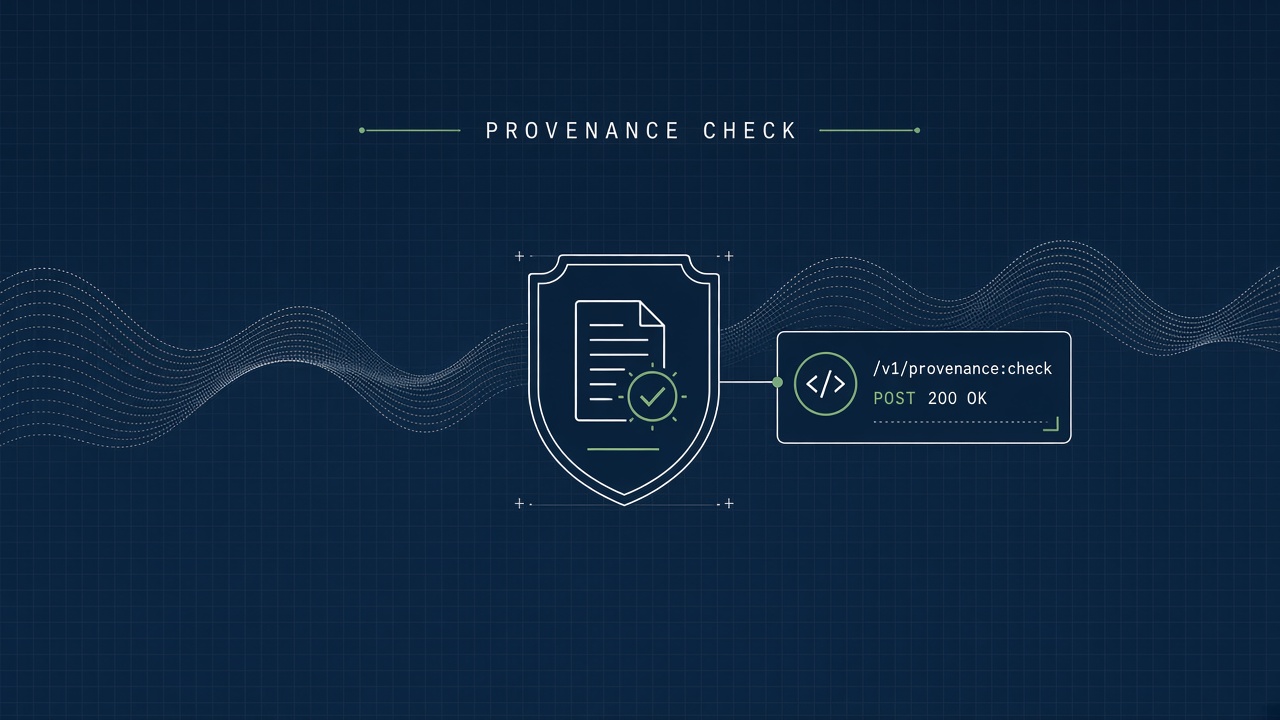
Detection APIs typically accept uploaded media files or URLs and return structured verdicts per signal type,
not a single binary "AI or human" score. OpenAI's Content Provenance API uses
POST /v1/content_provenance_checks for images and audio. Results arrive synchronously with separate
entries for C2PA Content Credentials and SynthID watermarks. A detected outcome confirms that a supported
signal was found. not_detected means the verifier did not find that signal, which does not prove human
authorship and does not rule out content from other providers.
Google's AI Content Detection API, announced for trusted enterprise partners in 2026, aims to identify synthetic media from Google models and other popular generators. Use cases include feed sorting, fraud prevention, fact-checking pipelines, and platform labeling. Google also expanded SynthID verification in consumer products: the Gemini app can check C2PA Content Credentials, with Search and Chrome rollout planned. These consumer features complement API access for organizations that need batch or backend verification.
| Signal type | Typical input | API output | Resilience note |
|---|---|---|---|
| C2PA Content Credentials | JPEG, PNG, WebP with signed metadata | Issuer, AI-use flag, edit history | Vulnerable to metadata stripping; survives if credentials embedded |
| SynthID watermark | Images, audio from supported models | detected / not_detected, model, generated_at | Survives some compression; degrades under heavy editing |
| IPTC Digital Source Type | News agency image metadata | Declared synthetic or trained-on-synthetic flags | Editorial workflow integration; relies on honest declaration |
| Statistical detector (vendor-specific) | Image, video, audio blobs | Probability scores, model family hints | Higher false positive risk; not a substitute for provenance |
EU policymakers expect interoperability. The Code of Practice stresses that marking solutions should work across platforms and tools. C2PA, governed by the Coalition for Content Provenance and Authenticity, provides an open standard for signed origin and edit history. IPTC extensions give news publishers machine-readable fields for digital source type, including synthetic and composite classifications. A future EU-centralized detection gateway would likely orchestrate these vendor APIs and open validators rather than replace them, similar to how eIDAS trust services federate identity providers.
Accuracy Limits and False Positive Risks
Provenance APIs verify whether known signals are present; they are not general-purpose AI detectors and should not be treated as courtroom proof of synthetic origin. OpenAI explicitly states that its API does not identify content from every AI system. A negative result can mean metadata was stripped, watermarks degraded, the file came from a legacy model, or the generator simply uses a different marking scheme. Conversely, a positive C2PA result confirms credential integrity, not necessarily that every pixel was AI-generated, because credentials can document mixed workflows.
False positives arise when statistical detectors misclassify heavily processed camera photos, film grain, or certain compression artifacts as synthetic. Newsrooms that auto-quarantine "AI detected" uploads risk suppressing legitimate photojournalism if thresholds are aggressive. Legal teams should treat detection output as one input to human review, especially for political deepfakes where latency matters but errors carry reputational harm.
False negatives are equally consequential for compliance. Attackers can re-encode media, crop watermarks, or route generation through unmarked open models. Article 50 demands robust methods "as far as technically feasible," which acknowledges perfect detection is impossible. Providers must document residual risk and update marking as adversaries adapt. Deployers cannot outsource liability entirely to a third-party API score.
Publisher and Platform Workflow Impacts
Publishers should integrate provenance checks at ingest, publish, and archive stages rather than only at upload time. A practical workflow for a digital newsroom looks like this:
- Ingest: run detection API on submitted images and audio; flag missing credentials for staff review.
- Edit: preserve C2PA manifests when cropping or color-correcting; re-sign edits with newsroom identity.
- Publish: display machine-readable labels for deepfakes and AI-assisted public-interest articles per Article 50(4)-(5).
- Archive: store API responses alongside assets for regulatory audits and takedown disputes.
Social platforms face higher volume and must balance automation with appeals. A tiered policy works well: auto-label when provenance is detected with high confidence, route ambiguous cases to trust-and-safety reviewers, and allow creators to attach credentials at upload. Platforms that operate in the EU should map deployer duties in the Code of Practice Section 2 to product features before national regulators translate Article 50 into market surveillance practice.
Advertising and UGC marketplaces have parallel needs. If a listing includes synthetic product photos, provenance checks help prevent misleading commerce claims that overlap with consumer protection law. Insurance and fraud teams already pilot Google's detection API for claims imagery; publishers can borrow the same architecture for subscriber-generated content.
Relation to C2PA, IPTC, and Vendor Detection Stacks
C2PA Content Credentials function like a nutrition label for digital media, while embedded watermarks like SynthID add signal resilience when metadata is removed. The EU framework treats both as complementary. C2PA answers "who made this and what happened to it?" Watermarks answer "does this file still carry a generator signature after transformation?" IPTC standards bridge news industry CMS tools, ensuring synthetic declarations travel with agency feeds into downstream detection APIs.
Industry adoption accelerated in 2026. Google reported watermarking over 100 billion images and videos and extensive audio with SynthID. OpenAI, Kakao, ElevenLabs, and NVIDIA Cosmos partners expanded SynthID-compatible marking. Adobe, Microsoft, and camera manufacturers continue C2PA integration. For EU compliance, providers should emit at least one interoperable signal and document which APIs can verify it. Deployers should not depend on a single vendor detector if their audience uploads cross-platform content.
A mature EU detection ecosystem likely standardizes on: (1) mandatory provider marking specs referenced in AI Office guidance, (2) accredited validators for C2PA signatures, (3) federated access to major lab APIs, and (4) transparency reporting on false positive rates by modality. Until that infrastructure is live, organizations should combine OpenAI or Google enterprise APIs with open-source C2PA tooling and human editorial policy.
Procurement teams evaluating detection vendors should score APIs on modality coverage, latency, audit logging, EU data residency, and appeal workflows. A publisher processing thousands of uploads daily needs batch endpoints and clear rate limits. A broadcaster verifying live clips needs sub-second checks with documented error codes when credentials are stripped by social platforms. Contract language should specify that detection results are probabilistic signals, not legal determinations, and that vendors update verifiers as marking standards evolve under AI Office guidance. National regulators may publish sector-specific expectations for broadcasters, political campaigns, and financial promotions where synthetic media poses heightened manipulation risk. Building detection into CMS export pipelines now reduces retrofit cost when those sector rules crystallize in 2027 market surveillance programs. Training staff on provenance literacy, not just button-clicking in a dashboard, remains the highest-leverage compliance investment publishers can make this year. EU policymakers will likely publish additional implementation Q&A as detection tooling matures; subscribe to AI Office updates rather than relying on vendor marketing summaries alone.
Frequently Asked Questions
Is there a single official EU watermark detection API today?
Not as a unified public endpoint. Article 50 creates legal duties; verification today flows through provider APIs, C2PA validators, and emerging enterprise detection services. Watch AI Office implementations for a possible federated gateway.
Does a not_detected result prove content is human-made?
No. It only means the checked signals were absent or unreadable. Content may still be AI-generated from an unmarked model or may have lost metadata during sharing.
Which modalities does Article 50 cover?
Synthetic audio, image, video, and text from AI systems, including manipulation of existing media beyond standard editing exceptions defined in the guidelines.
Are deployers required to run detection APIs?
Deployers must label certain deepfakes and public-interest AI text. Detection APIs are the practical tool to verify provider marks and support consistent labeling, even when the law does not name a specific API vendor.
How should newsrooms handle false positives?
Keep human review in the loop, log API responses, tune thresholds by content type, and preserve original files with credentials intact for appeals and regulatory evidence.