A marketing team asks one assistant to research competitors, draft ad copy, and schedule a campaign report. A single general-purpose large language model can attempt all three, but quality varies: research needs retrieval discipline, copy needs brand voice, reporting needs structured data pulls. A mixture of agents AI architecture assigns each subtask to a specialist agent or model, then coordinates outputs through a router or planner. That pattern is how many production AI chatbot platforms scale beyond one monolithic prompt, and how AI marketing suites chain research, generation, and analytics steps without forcing one model to excel at everything.
Single Model vs Mixture of Agents
A single model handles all tasks in one context window; a mixture of agents decomposes work, routes subtasks to specialists, and merges results through explicit orchestration logic. Single-model flows minimize latency and integration cost. Mixtures improve quality when specialists differ materially (code vs legal vs vision), when tools must run with narrow permissions, or when smaller models reduce cost on easy steps while a frontier model handles hard reasoning.
| Dimension | Single general model | Mixture of agents |
|---|---|---|
| Latency | Usually lower (one call) | Higher (serial or parallel hops) |
| Specialization | Broad, shallow on niche tasks | Deep per domain agent |
| Governance | One policy surface | Per-agent tool and data scopes |
| Debugging | Opaque single trace | Step traces if instrumented |
| Cost control | One token bill | Route cheap models to easy steps |
Router, Planner, and Worker Roles
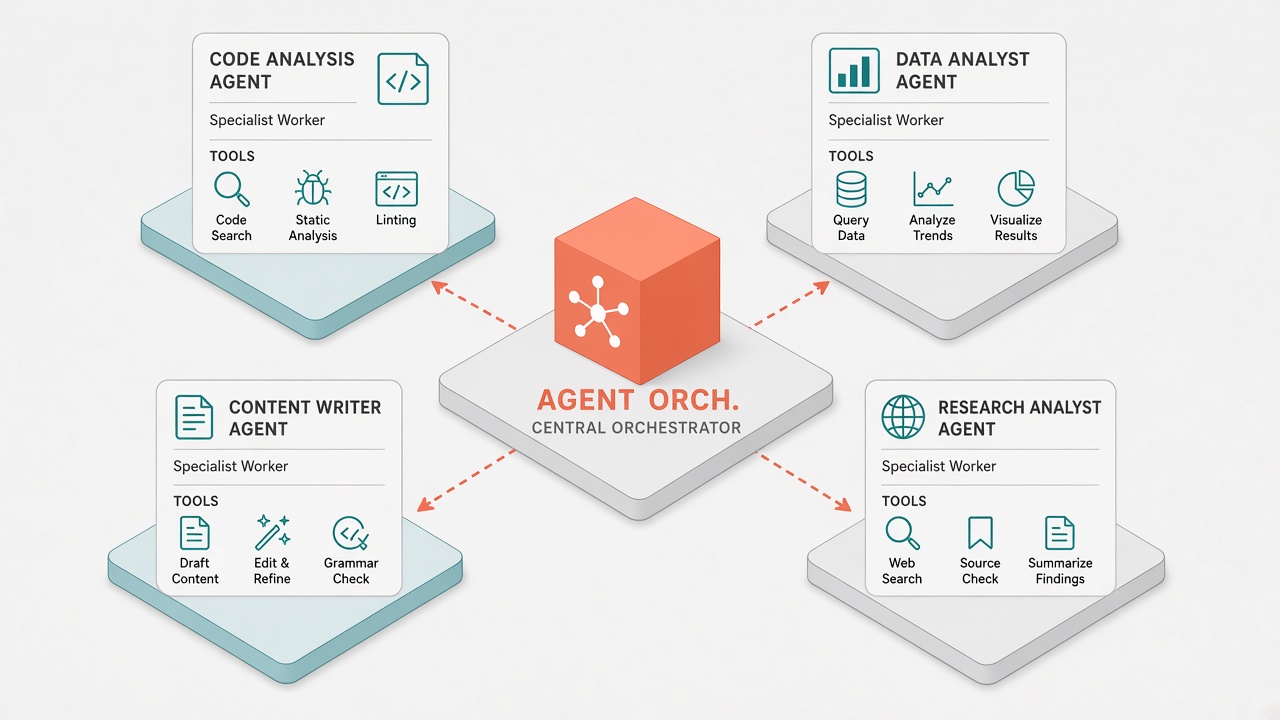
Mixture-of-agents systems typically separate routing (which agent handles the next step), planning (decomposing goals into ordered or parallel tasks), and workers (agents that execute with tools and return structured outputs). The router may be a lightweight classifier, an LLM call with JSON schema, or a rules engine keyed on intent tags. The planner produces a task graph: research before draft, validate before send. Workers encapsulate prompts, retrieval indexes, API credentials, and failure retry policies.
Common orchestration patterns
- Sequential handoff: Research agent passes citations to writer agent.
- Parallel fan-out: Multiple analysts gather data, synthesizer merges.
- Supervisor loop: Manager agent critiques worker output until criteria pass.
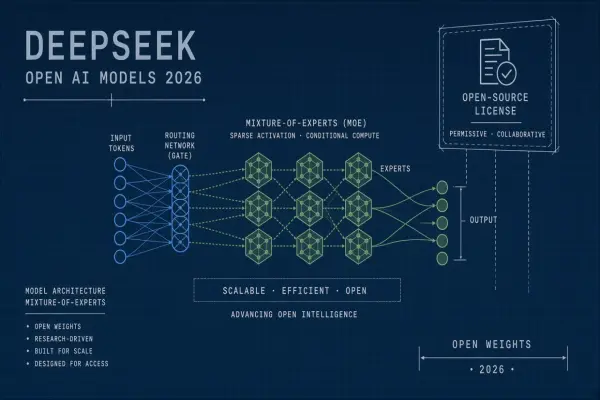
- Mixture-of-experts routing: MoE layers inside one model differ from agent orchestration but share the "specialist" idea at inference time.
Handoff Contracts Between Agents
Reliable multi-agent systems define handoff contracts: required fields, schema, provenance, and acceptance tests before the next agent consumes output. Without contracts, the writer agent invents facts the researcher never supplied. Standardize on JSON payloads with source URLs, confidence flags, and explicit unknowns. Version contracts when agent prompts change.
Example contract fields for a research-to-draft handoff:
claims[]withtext,source_id,quote_spangaps[]listing unanswered subquestionstone_guidancefrom brand agentblocked_topicsfrom policy agent
Observability and Tracing
Multi-agent failures are opaque without distributed traces that record each agent invocation, tool call, token usage, and handoff payload hash. OpenTelemetry spans, LangSmith traces, and vendor agent dashboards should link parent user requests to child agent runs. Log routing decisions with feature flags so you can replay why a legal agent instead of a general agent handled a query.
| Signal | Why it matters |
|---|---|
| Per-agent latency | Find straggler specialists |
| Handoff validation errors | Catch schema drift early |
| Tool denial rate | Expose permission misconfigurations |
| User correction rate | Measure end-to-end quality |
When Multi-Agent Adds Latency
Each agent hop adds model round trips, serialization, and queue time; mixtures help quality but hurt p95 latency unless steps run in parallel or use smaller models. Simple FAQs should bypass the orchestrator entirely. Cap planner depth (max three hops) and cache retrieval results shared across agents. Async workflows (email draft ready in five minutes) tolerate more agents than live chat widgets targeting sub-second replies.
When mixture of agents is worth the complexity
- Distinct compliance boundaries (HR vs IT tools)
- Measurable quality lift on specialist benchmarks
- Need to swap one vendor model without rewiring entire product
- Human-in-the-loop approval between high-risk steps
When a single model suffices
- Short generative tasks with one tone and no tools
- Latency-sensitive voice interfaces
- Teams without tracing and contract maintenance capacity
Reference Architecture for Production
A production mixture-of-agents stack typically includes an API gateway, intent router, planner service, agent worker pool, shared memory bus, tool gateway with scoped credentials, trace collector, and human approval queue for high-risk actions. Stateless workers scale horizontally; state lives in conversation stores and handoff payloads, not inside ephemeral containers.
Memory buses may be vector indexes (per-agent or shared), key-value session stores, or event logs replayed on failure. Tool gateways enforce allowlists so the research agent cannot call payroll APIs. Approval queues pause flows before external email send or database writes.
Implementation Phases
Teams should phase adoption: start with a router plus two specialists, add tracing before adding a fifth agent, and only introduce autonomous planners after handoff contracts stabilize. Skipping phases yields untraceable loops and runaway token spend.
- Phase 1: Binary route (support vs general) with shared transcript.
- Phase 2: Sequential research-then-write with JSON handoff schema.
- Phase 3: Parallel analysts plus synthesizer with merge validation.
- Phase 4: Supervisor loop with automated quality checks and human escalation.
Buyer Questions for Agent Vendors
| Question | Why it matters |
|---|---|
| Max agent depth per request? | Predicts latency and cost ceilings |
| Exportable OpenTelemetry traces? | Required for enterprise debugging |
| Per-agent data residency? | Cross-border handoffs may violate policy |
| Human approval hooks? | Needed for regulated outbound actions |
| Fallback when router uncertain? | Prevents wrong specialist damage |
Anti-patterns to avoid
- Agent sprawl: Ten agents with overlapping prompts and no owner.
- Hidden generalist: Router always picks the same model, adding latency for theater.
- Unbounded loops: Supervisor never accepts worker output, burning tokens.
- Secret sharing: All agents inherit admin API keys.
Frequently Asked Questions
Is mixture of agents the same as mixture of experts in models?
No. Mixture of experts (MoE) is an internal neural architecture routing tokens to expert subnetworks; mixture of agents is an application-level orchestration pattern across separate prompts, models, or services. Products may combine both, but the terms are not interchangeable.
Which frameworks support agent orchestration?
LangGraph, CrewAI, AutoGen, Semantic Kernel, and cloud agent builders from OpenAI, Google, and Microsoft provide graphs, handoffs, and tool wiring. Evaluate vendor lock-in, trace export, and human approval hooks against your compliance tier.
How do mixtures handle one agent failing?
Define fallbacks: retry with backoff, route to generalist agent, return partial result with explicit gap message, or escalate to human. Silent failure across handoffs produces confident wrong answers.
Do multiple agents always cost more?
Total token spend can rise, but routing easy steps to small models often lowers average cost versus one frontier model for every message. Measure cost per successful task, not per call count alone.
How is data isolated between agents?
Scope each worker's tool credentials and retrieval indexes; the planner should not pass PII to agents lacking clearance. Audit handoff payloads for accidental exfiltration of secrets from one tenant context to another.
Designing Handoff Schemas in Practice
Handoff schemas should be JSON Schema or protobuf definitions checked in CI, with required provenance fields and explicit nullability for missing data. Version schemas (`handoff_v2`) and support dual-read during migrations. Reject handoffs that fail validation rather than passing malformed payloads to the next agent, which causes hallucinated gap-filling.
Include `trace_id`, `parent_agent`, `confidence`, `sources[]`, and `blocked_actions[]` in every handoff. Writers should refuse to invent citations when `sources` is empty. Finance agents should halt when `blocked_actions` contains `transfer_funds` without approval token.
Testing multi-agent systems
Unit-test each agent in isolation with fixture handoffs. Integration tests run golden user prompts through the full graph and assert final JSON shape and tool call counts. Chaos tests disable one agent and verify fallback paths return partial results instead of 500 errors. Record production traces (redacted) to replay regressions when upgrading models.
Case Study Patterns (Abstracted)
Customer support mixtures route billing questions to a payments agent with ledger tools, product bugs to a triage agent with issue tracker access, and general FAQs to a lightweight model. Marketing campaign mixtures fan out competitor scraping, brand voice drafting, and compliance keyword scanning before any ad copy publishes. Each pattern shares the same skeleton: classify intent, scope tools, validate output, merge for the user-facing reply.
Legal review mixtures keep contract clause extraction separate from recommendation generation so attorneys see cited spans before summary language influences decisions. The handoff contract includes page numbers and confidence per clause type.
Latency Optimization Tactics
Parallelize independent agent calls, cache retrieval results at the planner layer, stream partial answers to users, and use speculative routing that starts likely agents before classification finishes. Pre-warm tool connections for high-traffic specialists. Collapse router plus planner into one structured-output call when tasks are simple. For voice interfaces, cap the graph at two hops or fall back to single-model mode.
| Tactic | Latency impact | Complexity |
|---|---|---|
| Parallel fan-out | High savings on multi-source research | Merge logic required |
| Shared retrieval cache | Medium on repeat queries | TTL and ACL aware cache keys |
| Smaller router model | Low per request, adds hop | Routing accuracy monitoring |
| Streaming UI | Perceived latency drop | Partial answer risk |
Governance and Change Management
Agent prompt changes should ride the same change control as microservices: versioned prompts, canary traffic, rollback paths, and owner on-call rotation per specialist. When the research agent prompt updates, rerun regression suites that assert handoff JSON still validates. Multi-agent systems fail operationally when only one hero engineer understands the graph.
Cost governance
Set per-request token budgets and per-agent ceilings. Alert when the planner spawns more than N child tasks or when supervisor loops exceed three iterations. Finance teams need cost attribution tags per agent, not only per API key.
Single-Tenant vs Multi-Tenant Agent Deployments
SaaS products running mixture-of-agents for many customers must isolate retrieval indexes, tool credentials, and handoff payloads per tenant ID at the gateway. Shared agent prompts are fine; shared memory is not. Cross-tenant leakage often appears when planners cache retrieval results without tenant-scoped keys. Pen-test multi-agent flows with two synthetic tenants attempting to reference each other's document IDs.
Enterprise single-tenant deployments may colocate agents on private VPCs with on-prem tool gateways. Latency improves; operational burden shifts to your platform team. Document which agents may call external model APIs versus internal fine-tuned endpoints.
What to Put on Observability Dashboards
Dashboards should show requests per agent, p50 and p95 latency per hop, handoff validation failure rate, tool error rate by agent, token cost per successful task, and human escalation count. Slice metrics by customer segment and intent class to spot routers sending enterprise accounts to the wrong specialist. Alert when supervisor loops exceed two iterations on more than five percent of traffic.
Weekly reviews compare agent-level quality scores from human feedback against routing distribution. If the legal agent rarely triggers but receives low scores when it does, routing thresholds need tuning, not more legal prompt tweaks alone.
Starting Small: Recommended First Graph
New teams should ship a two-agent graph before building five: a classifier router and a single specialist with tools, plus a generalist fallback. Measure whether the specialist beats the generalist on twenty real queries. Only add a third agent when the specialist repeatedly hands off a identifiable subtask (for example, "fetch pricing" vs "draft email"). This discipline prevents ornamental multi-agent architectures that add latency without measurable quality lift.
Document the first graph in an architecture decision record: problem statement, agents included, handoff schema version, success metrics, and date for revisit. Revisit quarterly or when base model providers release major upgrades that shift routing accuracy. Share ADRs with security and finance reviewers so agent scope changes receive the same scrutiny as new microservices.
Conclusion
Mixture of agents AI explained for operators means decomposing work across specialists with explicit routers, planners, workers, handoff schemas, traces, and governance. Adopt the pattern when domain separation, compliance boundaries, or measured quality gains justify added latency and engineering overhead; keep simple queries on a single model path. Phase rollout, instrument every hop, and treat agent prompts as production configuration with owners and rollback plans.