Matrix multiplication consumes most inference energy in modern neural networks. Photonic chips move that math onto light: laser signals pass through programmable interferometers, accumulating analog dot products at the speed of propagation instead of shuttling electrons through memory hierarchies. Vendors such as Lightmatter, Ayar Labs, and Luminous Computing (acquired and reorganized over the years) pitch photonic AI chips as a path to faster, cooler inference in 2026. Training still lives on GPUs; packaging, precision, and reprogrammability keep photonics in the skepticism zone for conservative buyers. This explainer covers how photonic computing works, where inference fits, current demos, limitations, and a buyer checklist for teams comparing AI API hosting costs with custom silicon and AI coding copilots running on accelerated racks.
How Photonic Computing Works for AI
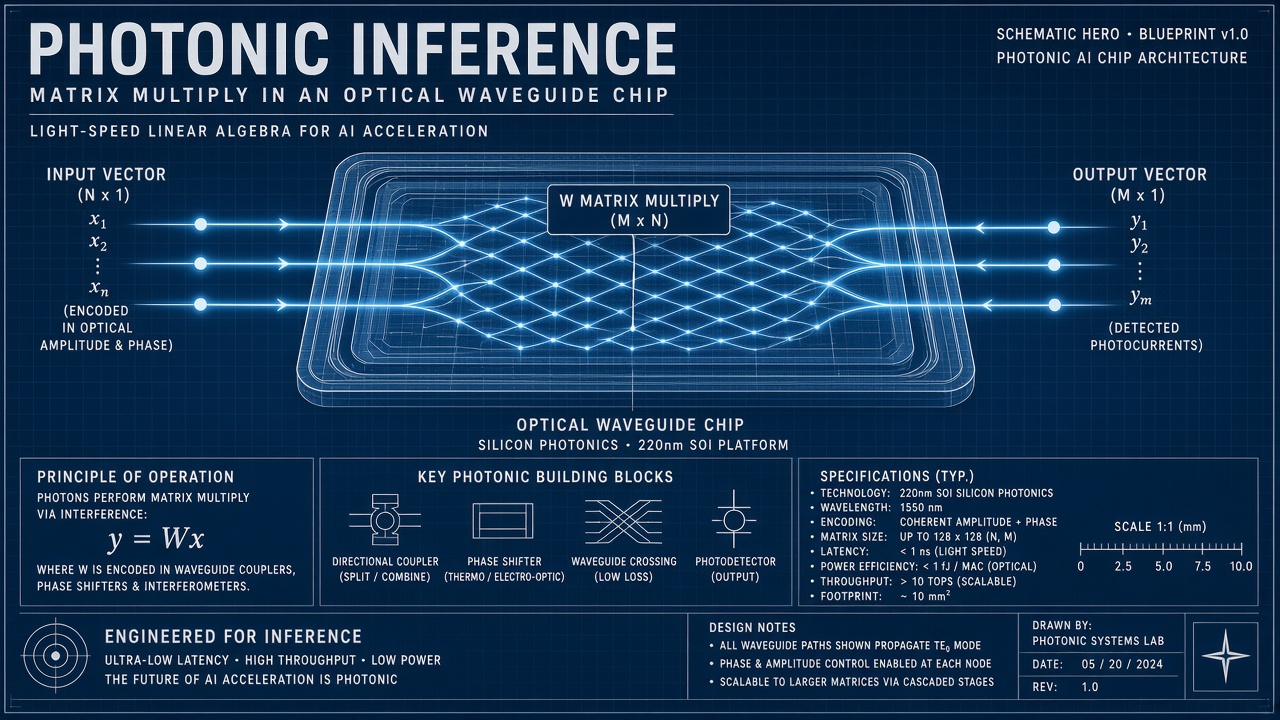
Photonic AI accelerators encode matrix weights and activations into optical signals, perform multiply-accumulate operations via interference and detection, then convert results back to digital form for subsequent layers. Silicon photonics integrates waveguides, modulators, and photodetectors on chip. Analog optical MAC arrays can execute many operations in parallel when wavelengths or spatial modes multiplex the computation.
The pipeline differs from digital tensor cores. Digital GPUs fetch weights from HBM, multiply in FP16 or INT8, and write accumulators. Photonic paths set phase shifters to represent weights, stream activations as optical power, integrate on detectors, digitize, apply nonlinearities in electronic logic, then repeat. Nonlinear activation functions still happen electronically in hybrid designs because pure optical nonlinearities are weak or bulky at scale.
Why Photonics Targets Inference, Not Training
Training requires backward passes, optimizer state, and frequent weight updates ill-suited to slow reprogramming of optical meshes; inference runs fixed weights forward millions of times, amortizing calibration cost. Photonic vendors therefore pitch inference accelerators for recommendation, speech, and moderate-size transformer layers in fixed graphs. Large language model training clusters remain NVIDIA-centric with custom ASICs from hyperscalers.
| Workload phase | GPU fit | Photonic fit (2026) |
|---|---|---|
| Pretraining | Excellent | Poor |
| Fine-tuning | Excellent | Poor to experimental |
| Fixed-graph inference | Strong | Promising in demos |
| Dynamic LLM decoding | Dominant | Early research |
Current Vendors and Demonstrations
Lightmatter sells photonic interconnect and inference products aimed at data center deployment; Ayar Labs focuses on optical I/O between chips; Luminous explored full photonic tensor engines before market shifts. Demos typically show ResNet-class vision or BERT-scale language layers with energy-per-op advantages versus digital baselines on comparable nodes. Production volume shipments to general cloud tenants remain limited compared with GPU availability.
Lightmatter
Lightmatter combines photonic tensor cores with electronic control logic, marketing rack-scale inference acceleration and co-packaged optics for GPU clusters. Their narrative: reduce data movement energy by performing MACs where light travels instead of bouncing DRAM. Customers evaluate TCO models including cooling and power caps in AI-dense data centers.
Ayar Labs
Ayar Labs emphasizes optical chiplets that replace electrical links between processors, enabling higher bandwidth at lower power per bit. While not a full photonic transformer engine alone, optical I/O is prerequisite infrastructure if photonic compute scales. AI clusters bottlenecked on NVLink or PCIe may adopt optical fabrics first.
Packaging and Calibration Challenges
Photonic chips suffer thermal drift, manufacturing variation, and calibration overhead that digital CMOS hides behind deterministic logic. Each unit may need factory or runtime calibration to keep matrix weights accurate. Data center operators accustomed to plug-and-play GPUs must budget maintenance for optical alignment and laser lifetime.
Limitations Buyers Should Know
- Numeric precision: Analog optical paths approximate FP16; error budgets differ from digital INT8 kernels.
- Model flexibility: Static graphs deploy easier than dynamic shapes in autoregressive LLMs.
- Software maturity: CUDA ecosystem depth exceeds photonic SDKs; expect custom compiler stacks.
- Supply chain: Fewer vendors, longer lead times, higher risk for single-source racks.
- Integration cost: Hybrid photonic-electronic boards need specialized cooling and service skills.
Teams shipping AI coding assistants should not assume photonic racks change latency for cloud APIs until providers publish region-level hardware notes. Developer experience stays API-bound.
Buyer Skepticism Guide
Ask photonic vendors for workload-specific tokens-per-watt on your model graph, end-to-end latency including digitization, and failure modes when calibration drifts. Reject slides comparing peak optical MAC throughput to GPU peak FLOPS without memory or host overhead.
- Request benchmark parity: Same model, batch size, accuracy metric, and SLA latency.
- Model static vs dynamic: Confirm support for your ONNX or TensorRT graph or planned export path.
- Operational playbook: Laser replacement, calibration schedule, spare parts.
- Financial structure: Capex vs cloud GPU rental breakeven at your utilization curve.
- Exit strategy: Fallback to digital GPUs if photonic rack underperforms in quarter one.
Matrix Multiply via Photonics in Plain Language
A photonic tensor core sets an interferometer mesh so optical inputs weighted by phases emulate multiplication, and detector arrays sum the interference pattern into an output vector. Think of tuning many tiny beam splitters instead of flipping transistor gates. When dimensions align, one optical pass replaces thousands of sequential digital MAC instructions. Misalignment produces analog noise; digital GPUs trade energy for bitwise repeatability.
LLM Serving and Photonic Feasibility
Autoregressive large language model decoding changes tensor shapes every token; photonic meshes prefer static matmul dimensions, so 2026 photonic wins concentrate on embedding layers, fixed-size classifiers, and recommendation scoring rather than full ChatGPT-class serving. Research explores photonic attention blocks with reconfiguration between requests, but production LLM hosts still batch GPU kernels. Teams building coding copilots should assume photonic racks affect hosting cost curves for specific layers only if vendors publish layer-level benchmarks on models they actually run.
Thermal Management and Laser Lifetime
Optical phase shifters drift with temperature. Data centers already fight hot spots around GPU racks; photonic boards add laser diodes with finite lifetime and calibration cycles. Facility teams must integrate photonic racks into existing CFD models. A photonic inference card saving twenty percent MAC energy but requiring extra cooling airflow may net zero carbon benefit. Buyers should request full rack power under steady inference load, not chip lab measurements alone.
Optical I/O and GPU Clusters
Ayar Labs-style optical chiplets may arrive in GPU clusters before full photonic tensor cores dominate. Replacing electrical NVLink segments with optical links raises bisection bandwidth for giant model parallelism. That is infrastructure AI teams notice even if matrix math stays digital. Roadmaps that separate "optical networking inside rack" from "optical compute" reduce confusion when procurement reviews photonic line items on invoices.
Integration with API Economics
Startups renting AI API capacity rarely touch photonic hardware directly. Hyperscalers and specialty hosts pass savings through per-token pricing if utilization stays high. Watch provider sustainability reports and region hardware notes for mentions of silicon photonics. Until then, photonic inference remains a capital expenditure story for self-hosters with power-constrained colocation contracts and stable graphs exported from mature training pipelines.
Frequently Asked Questions
| Question | Short answer |
|---|---|
| Are photonic chips available to rent in cloud? | Limited specialty offerings; most teams still rent GPUs. |
| Do photonic chips run PyTorch natively? | Through vendor compilers and export tools, not direct CUDA. |
| Can photonics train LLMs? | Not commercially in 2026; inference focus only. |
| What is co-packaged optics? | Optical links integrated beside compute dies to cut electrical I/O power. |
| Who should consider photonic inference? | Hyperscale inference at fixed graphs with power-capped data centers. |
| Is analog compute accurate enough? | Depends on layer tolerance; vision often OK; finance models may reject drift. |
When does photonic TCO beat GPUs?
When power caps block rack expansion and your inference graph is stable enough to amortize calibration, at utilization above vendor breakeven models. Low-utilization workloads should stay on rented GPUs via AI API pricing.
Roadmap Questions for Vendor Calls
Ask whether photonic products support online weight updates for A/B model tests, how calibration drifts over server lifetime, and whether spare laser modules ship with each rack. Ask for customer references running the same model family you deploy via hosted APIs today. Photonic wins that cannot name a production customer after five years of marketing deserve discounted skepticism. Prefer pilot contracts with measurable exit ramps back to GPU baselines your MLOps team already operates for developer tooling and serving stacks.
Competitive Landscape in 2026
Lightmatter pursues full photonic matmul accelerators plus interconnect products. Ayar Labs sells optical I/O chiplets adopted by partners building next-generation AI racks. Luminous and other startups reorganized as the market consolidated around GPU incumbents and hyperscaler custom silicon. Expect continued demo announcements at Hot Chips and OFC conferences rather than sudden availability in every cloud region. Buyers should track which layer (compute vs interconnect) each vendor actually ships this quarter versus slides promising both. Partnership announcements with GPU OEMs signal near-term optical I/O adoption even when photonic tensor cores remain selective.
Deployment Readiness Matrix
| Stage | Photonic status 2026 | Buyer action |
|---|---|---|
| Lab proof | Mature for select layers | Attend vendor benchmarks |
| Pilot rack | Early adopters only | Negotiate GPU fallback |
| Cloud default | Rare | Stay on API pricing |
Why keep nonlinear layers electronic?
Optical materials weakly implement ReLU and GELU at chip scale; hybrid photonic-electronic layers run activations digitally between optical MAC stages. Full photonic nonlinear stacks remain research curiosities for inference product managers in 2026.
How fast can photonic weights change?
Reprogramming optical phase arrays takes milliseconds to seconds depending on mesh size, slower than digital weight swaps in GPU HBM. High-churn A/B tests favor digital inference until photonic vendors publish reprogramming latency for your matrix dimensions. Static recommendation engines and fixed vision backbones remain the practical photonic entry points until dynamic LLM serving matures.
Do photonic chips use INT8?
Photonic paths are inherently analog; digitization happens at detectors, so precision maps to effective bit depth after calibration, not identical INT8 semantics. Compare accuracy on your task, not label parity.
Should startups buy photonic racks?
Startups should rent GPUs and APIs until inference spend exceeds vendor breakeven models with stable graphs; photonic capex suits hyperscalers and power-constrained colos. Keep termination clauses short.
Which data centers suit photonic racks?
Facilities with strict power caps per rack, high inference utilization, and staff willing to maintain optical calibration schedules fit photonic pilots. Greenfield AI factories with spare GPU power may see negative ROI until photonic pricing falls. Document calibration SLOs in vendor contracts alongside traditional uptime SLAs. Treat 2026 as an evaluation window, not a mandatory rip-and-replace cycle for GPU fleets.
Conclusion
Photonic chips for AI inference use light for matrix math where electrons waste energy on memory movement. Lightmatter, Ayar Labs, and peers demonstrate compelling lab and early production wins on fixed inference graphs, not training clusters. Packaging, calibration, and software immaturity demand skeptical procurement. Most teams should continue GPU and API paths while monitoring photonics for power-constrained data centers. Pilot buyers should treat 2026 photonic racks as co-processors beside digital baselines, not rip-and-replace GPU strategies. Pair hardware evaluations with realistic graphs from your coding and serving stacks before signing multi-year silicon deals.