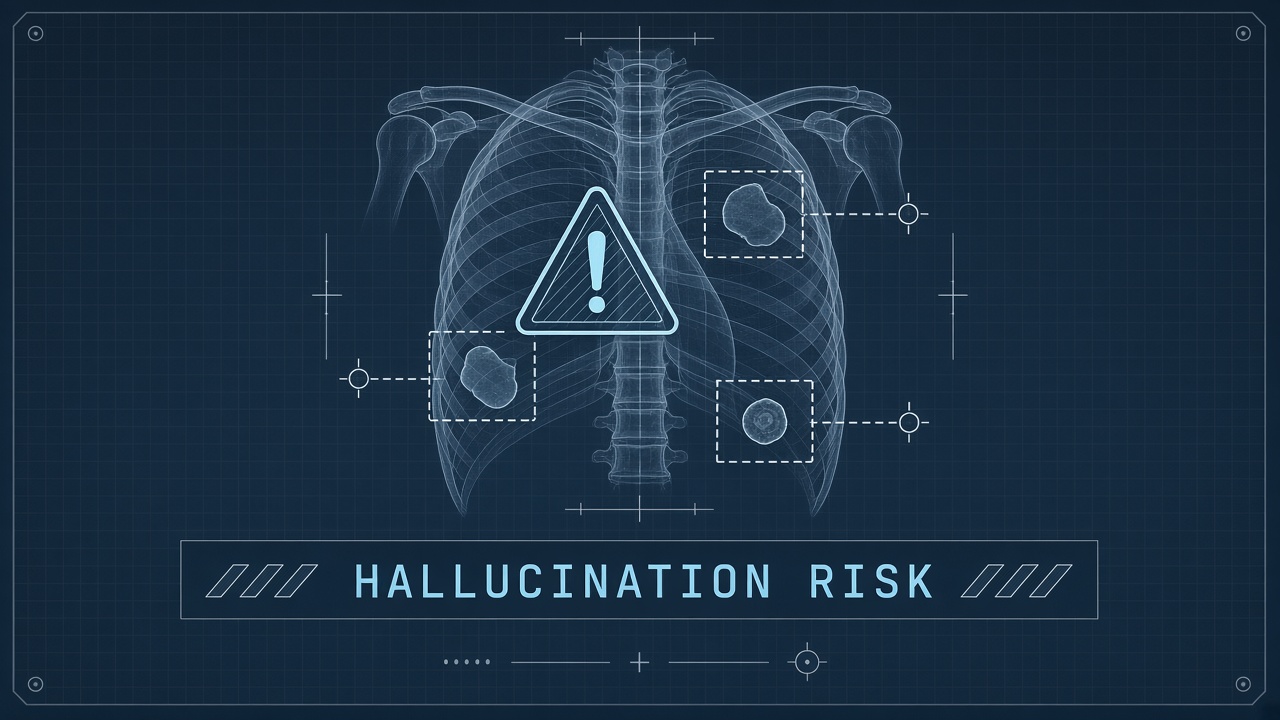
A resident asks a vision-language model to draft a chest CT report before the attending reviews the study. The model confidently describes a 2.3 cm spiculated nodule in the right upper lobe and notes interval growth compared with a prior exam from six months ago. Neither finding exists on the current images, and no prior comparison was provided. AI radiology report hallucinations are confident false statements in generated or AI-assisted narrative text: invented pathologies, fabricated measurements, wrong laterality, and fictional prior-study comparisons that can propagate into treatment decisions if signed without verification.
Radiology departments evaluating large language model assistants must treat draft reports as unverified hypotheses, not documentation shortcuts. Clinicians browsing general AI chatbot tools for imaging questions should never paste model output into the electronic health record without attending radiologist attestation. Further medical AI explainers are listed on the EliteAI.tools blog index.
What Radiology Report AI Hallucinations Are
AI radiology report hallucinations are nonsensical or factually false statements in automatically generated or AI-augmented radiology narratives that are not supported by the underlying images, clinical context, or prior imaging records. In general machine learning terminology, hallucination means the model produces plausible-sounding text not grounded in its inputs. In radiology, the stakes are acute: a hallucinated pulmonary embolism may trigger unnecessary anticoagulation; a missed real embolism hidden behind false reassurance may be fatal. Hallucinations differ from typographical errors or template omissions because they introduce new clinical entities the imager never observed.
Hallucination modes cluster into several families. Finding invention adds lesions, fractures, or hemorrhages absent on pixels. Measurement fabrication cites precise millimeter dimensions without segmentation backing. Prior exam confabulation describes interval change against studies that were never retrieved. Modality or anatomy misidentification mislabels a CT as MRI or locates findings in the wrong organ. Multimodal models that accept both images and text are especially prone to privileging clinical history over pixels when the two conflict.
| Hallucination type | Example in draft report | Potential harm |
|---|---|---|
| Invented finding | "Moderate pleural effusion, left" | Unnecessary thoracentesis workup |
| Fabricated prior comparison | "Stable compared with prior CT 03/2024" | False reassurance on growing malignancy |
| Wrong laterality | Right kidney stone on left-sided pain study | Incorrect surgical planning |
| Modality confusion | MRI signal characteristics on CT slice | Referring clinician mistrust of entire report |
How Report Generation Pipelines Work
Radiology report AI pipelines encode imaging studies into visual tokens, optionally fuse clinical metadata, and decode natural-language impressions through autoregressive language models or encoder-decoder vision-language architectures. Specialized models trained on paired image-report datasets from institutions such as MIMIC-CXR learn statistical associations between visual patterns and lexical templates. General-purpose multimodal large language models (GPT-4V and successors) apply broader pretraining but weaker radiology-specific grounding, increasing hallucination rates in emergency imaging workflows.
Vision-language decoding and grounding gaps
A typical generation loop samples the next report token conditioned on image embeddings and prior tokens. Without explicit grounding constraints (bounding boxes, segmentation masks, retrieval of similar verified reports), the decoder may fall back on disease priors from training text: "pneumonia" appears because the indication mentioned fever, not because infiltrates are visible. A 2024 European Radiology study of GPT-4V on 206 clinical imaging studies found diagnostic accuracy of only 8.3% when images were provided without clinical context, rising to 29.1% with context but still far below radiologist performance. The model fabricated 258 imaging findings across 412 responses and misidentified modalities or anatomic regions in 65 images, demonstrating that fluent prose masks weak visual grounding.
Emergency room multimodal performance
A separate emergency department evaluation of 230 anonymized studies published in 2025 reported that GPT-4V identified pathology correctly in only 35.2% of 216 cases while exhibiting multimodal drift above forty percent in emergency imaging: diagnostic hallucination occurred in 46.8% of cases overall, reaching 60.6% for ultrasound and 51.5% for CT. Modality identification was perfect, but pathology recognition collapsed on ultrasound, where speckle artifacts and operator dependence challenge general vision models. These numbers quantify why standalone GPT-4V cannot be trusted for clinical interpretation despite impressive conversational fluency.
Radiologist-assist workflow hallucination rates
When GPT-4 assists practicing radiologists rather than replacing them, risks persist. A virtual reference radiologist study in European Radiology (2024) found that 23 of 312 AI-assisted responses (7.4%) were classified as hallucinations and 2 (0.6%) as misinterpretations, even though overall diagnostic accuracy improved slightly and confidence rose significantly. Fabricated prior exam comparisons in draft reports were a recurring failure mode addressed by later research applying direct preference optimization (DPO) fine-tuning to suppress prior-exam hallucinations in chest X-ray generators, achieving 3.2 to 4.8 times reduction while maintaining clinical accuracy metrics.
Chest X-ray report generation benchmarks
Systematic evaluation on MIMIC-CXR, CheXpert Plus, and IU X-Ray benchmarks concluded that GPT-4V cannot generate clinically usable chest X-ray reports yet: expert review flagged 14 of 50 cases as remaining clinically unusable, and model-predicted label distributions stayed constant regardless of ground-truth conditions on the image, suggesting the model was not meaningfully interpreting pixels. Specialized supervised models such as fine-tuned Llama variants outperform zero-shot GPT-4V on lexical and clinical efficacy metrics but still require radiologist sign-off and institution-specific validation under FDA software as a medical device pathways when marketed commercially.
Structured reporting and RadLex alignment
Radiological Society of North America (RSNA) and American College of Radiology initiatives promote structured report templates with RadLex-coded findings. When AI generators emit free text without RadLex IDs, downstream cancer registries and quality measures cannot parse results reliably. Binding each generated sentence to a structured finding object (laterality, organ, observation type, measurement source) gives programmatic hallucination checks: if no nodule segmentation exists, suppress nodule sentences. Integrating with DICOM SR objects exported from PACS further ties narrative claims to measurable image regions reviewers can click-to-verify.
Real Deployments and Published Evidence
Regulated radiology AI today focuses primarily on computer-aided detection and quantification (lung nodules, mammography, intracranial hemorrhage) with locked algorithms and prospective reader studies, while generative report drafting remains largely research-stage with alarming hallucination benchmarks. The American College of Radiology (ACR) Data Science Institute publishes use-case directories and transparency labels encouraging manufacturers to document training data, failure modes, and intended populations.
Commercial report impression generators exist in pilot deployments at academic centers, often constrained to structured findings lists rather than free-text narratives. Nuance Communications and other vendors integrate speech recognition with template expansion; adding large language model paraphrase layers reintroduces hallucination risk unless outputs are checked against structured JSON finding objects extracted by deterministic computer vision. FDA-cleared CADe/CADx devices historically required frozen weights and predefined inputs; generative models with online updates demand new post-market surveillance frameworks tracking hallucination incidence in production logs.
| Publication | Setting | Hallucination or accuracy signal |
|---|---|---|
| GPT-4V ED study (2025) | 230 emergency studies | 46.8% diagnostic hallucination rate |
| GPT-4V university hospital (2024) | 206 CT/MRI/X-ray/angio | 258 fabricated findings in 412 responses |
| Virtual reference radiologist (2024) | Radiologist + GPT-4 assist | 7.4% responses classified as hallucinations |
| DPO prior-exam suppression (2024) | Chest X-ray VLM fine-tuning | 3.2 to 4.8x fewer prior-exam hallucination lines |
Limits, Risks, and Ethical Guardrails
Hallucination risk compounds automation bias: faster-sounding AI drafts increase signing speed without proportional increase in image review time, especially for fatigued night-call radiologists. Referring clinicians who read preliminary AI impressions in the EMR may act before attending verification, particularly in emergency departments with tenuous radiology coverage. Medicolegal liability for false findings remains with the signing physician under ACR practice parameters, but vendor contracts may inadequately allocate harm when black-box models change behavior after silent updates.
- Grounding enforcement: Require every sentence link to a structured finding ID or segmentation mask.
- Prior retrieval: Block comparison language unless PACS actually returned priors into the model context.
- Human attestation: Prohibit auto-signature; display AI draft watermark until radiologist edits.
- Confidence calibration: Do not show model self-reported confidence; it poorly correlates with correctness.
- Post-market monitoring: Log hallucination reports from quality committees and retrain or roll back models.
Equity concerns arise when models trained on academic tertiary-center reports underperform on portable X-rays from safety-net hospitals with different technique and prevalence. Pediatric and obstetric imaging have thinner training corpora, increasing invention rates for age-specific normals. Patient consent for AI-assisted reporting is evolving; some jurisdictions require disclosure when narrative text is machine-generated.
Who Should Use This and Who Should Wait
Radiology practices should allow AI drafting only inside research protocols or vendor pilots with mandatory structured grounding, attending review, and hallucination auditing until prospective outcomes data exist. Emergency departments without 24/7 attending coverage should not deploy autonomous report generators on critical studies. Referring clinicians should treat any AI impression line without radiologist signature as preliminary rumor, not fact.
| Role | Safer near-term use | High-risk use to avoid |
|---|---|---|
| Attending radiologist | Template expansion from CAD JSON outputs | Signing unedited GPT drafts on call |
| Resident trainee | Educational differential lists with disclaimer | Pasting chatbot text into preliminary field |
| Hospital CIO | Pilot with QA metrics and rollback clause | Enterprise rollout without PACS integration audit |
| Referring clinician | Wait for signed report | Acting on AI-only impression in EMR preview |
Frequently Asked Questions
Can AI autonomously sign radiology reports today?
No responsible deployment allows autonomous signature. Published hallucination rates above 40% in emergency multimodal studies and 7.4% even in radiologist-assist workflows mandate human verification of every finding.
Why do models invent prior exam comparisons?
Training corpora heavily feature comparison language, so language models reproduce the rhetorical pattern without retrieving actual priors. DPO fine-tuning and retrieval-gated templates are emerging mitigations.
Are specialized radiology VLMs safer than GPT-4V?
Domain-trained models improve lexical metrics but still hallucinate without grounding constraints. Institution-specific validation on local case mix remains mandatory for any architecture.
Does FDA clearance eliminate hallucination risk?
Clearance applies to specific locked indications and performance claims, not open-ended generative reporting. Post-market drift and prompt injection in multimodal chat interfaces fall outside many cleared device labels.
What mitigation stack works best?
Combine structured CAD outputs, retrieval of verified priors, sentence-level grounding checks, and attending edit tracking. No single filter catches all fabrication modes.
Resident education on hallucination awareness
Radiology residency programs should add competency milestones on evaluating AI draft quality, recognizing fabrication patterns, and documenting discrepancies in quality assurance logs. Simulation exercises with planted hallucinated findings teach trainees to slow down rather than accelerate signing when fluency feels convincing. Program directors report rising anecdotal cases of residents pasting chatbot differentials into reports; explicit policy and Morbidity and Mortality conference cases reinforce that AI is adjunct only.
Who is liable for a hallucinated finding?
The signing radiologist retains professional liability; hospitals must contractually define vendor responsibilities for model updates and incident notification. Malpractice insurers increasingly ask about AI assist workflows in credentialing questionnaires.
Peer review and addendum workflows
Academic departments using AI drafts should route all machine-generated preliminary reports through attending peer review before referring services see impressions in the EMR. Addendum policies must clarify whether AI-assisted first reads count toward resident competency milestones or quality metrics. When hallucinated findings are caught after sign-out, corrected addenda should document the error class (invented finding, wrong side, fabricated comparison) so quality committees track whether mitigation investments reduce recurrence rates quarter over quarter.
PACS vendor integration considerations
Picture archiving and communication system vendors increasingly embed large language model APIs into hanging protocols and reporting widgets. Radiology informatics committees should require pre-deployment hallucination benchmarks on local case mixes, contractual rollback rights when model updates degrade performance, and separation of duties so AI cannot auto-populate signed report fields without human edit events logged in the audit trail.
Conclusion
AI radiology report hallucinations are not edge-case glitches but measured failure modes at scale: fabricated findings, fictional prior comparisons, and modality confusion appear in peer-reviewed studies across emergency, outpatient, and assistive reading room workflows. Direct preference optimization and structured grounding reduce specific hallucination families but do not eliminate the need for radiologist attestation. Until prospective trials link generative reporting to patient outcomes, practices should confine AI to deterministic finding extraction and treat every narrative clause as guilty until proven on the pixels.