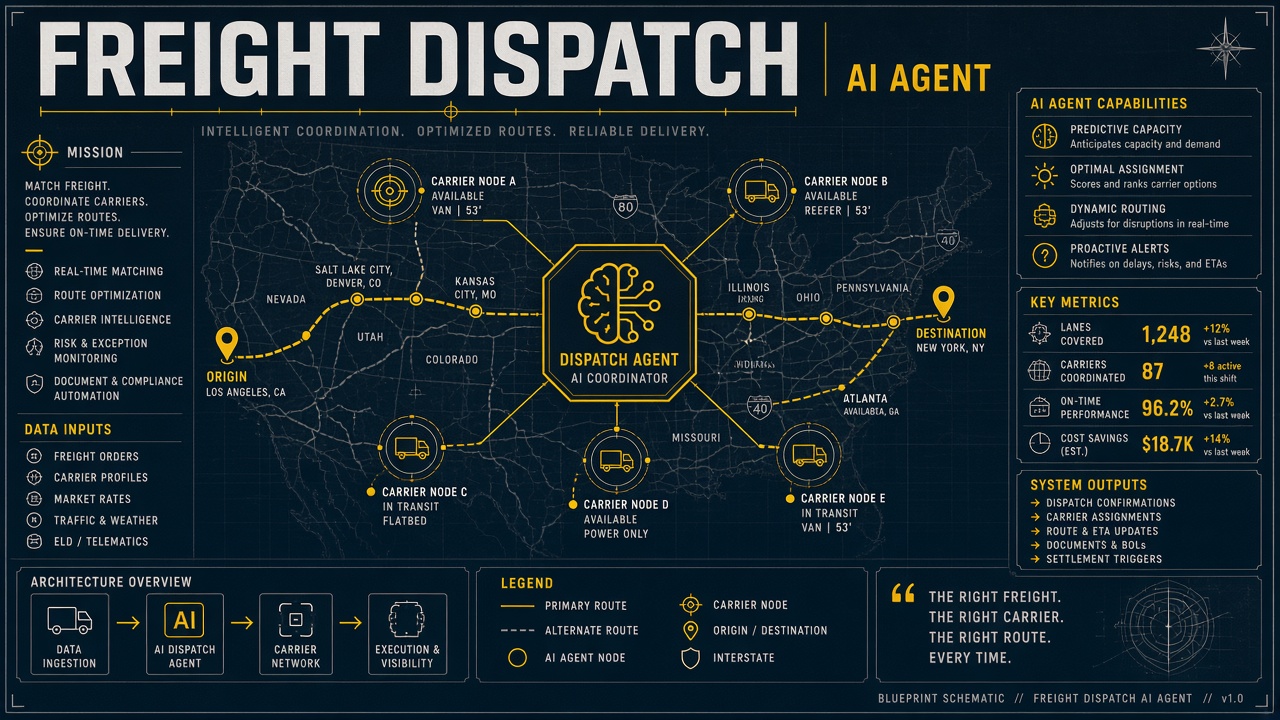
Freight dispatch still runs on phone calls, inbox threads, and tribal knowledge about which drivers cover which lanes. Agentic platforms now embed inside transportation management systems to automate check calls, broker status updates, document matching, and exception escalation. This guide maps the AI freight dispatch agent workflow: what steps agents automate, how exceptions surface, TMS integration requirements, human escalation playbooks, and metrics operators should track. Evaluate tools alongside broader AI automation initiatives and AI productivity programs in logistics back offices.
Dispatch Workflow Steps
Freight dispatch spans tender intake, carrier or driver assignment, rate confirmation, pickup scheduling, in-transit monitoring, document collection, and settlement prep, with broker communication at every stage. AI agents target high-volume, repetitive substeps while leaving contract negotiation and safety-critical judgment to humans.
- Load intake: Parse tenders from EDI, email rate cons, or load boards; validate lanes, equipment, and appointment windows.
- Matching: Assign drivers or carriers using HOS availability, proximity, historical performance, and customer restrictions.
- Rate confirmation: Extract rates and accessorial terms; flag mismatches against customer contracts.
- Pickup and departure: Confirm arrival, capture BOL details, notify brokers of status changes.
- Track and trace: Automated check calls or GPS-based updates; detect delays against appointment times.
- Exception handling: Detention, breakdowns, appointment misses, temperature deviations, OS&D.
- Document and settlement: Match POD to rate con, chase missing paperwork, prep invoices.
Alvys Foundry ships more than twenty pre-built agent templates covering check-call automation, invoice prep, and track-and-trace exceptions inside its TMS. Numeo One bundles seven back-office agents for carriers, including track-and-trace, document abstraction, and broker email response. Integration-first vendors like NeuralChainAI connect to McLeod, Trimble TMW, MercuryGate, and telematics platforms when operators cannot replace core TMS.
Exception Handling
Dispatch exceptions are where revenue leaks and customer relationships break; AI agents must detect, classify, and route exceptions per customer-specific playbooks, not generic scripts. Alvys argues there is no canonical detention process because every shipper contract defines clocks and thresholds differently.
| Exception type | Typical agent action | Human escalation trigger |
|---|---|---|
| Late pickup | Notify broker, log reason code | Customer SLA breach threshold |
| Detention | Start clock per contract rules | Disputed detention amount |
| Breakdown | Alert safety, find recovery option | Hazmat or temperature-sensitive load |
| Missing POD | Chase driver and broker | Invoice hold past aging policy |
Agent Shield-style governance logs every action input and output, routes high-impact decisions for approval, and applies spend guards on model tiers. Exceptions without clear playbook coverage should default to human dispatchers rather than silent failure. Shadow mode during rollout compares agent recommendations to dispatcher decisions on the same load set before supervised autonomy on bounded lanes.
Integration with TMS and Telematics
Dispatch agents deliver value only when they read live load, trip, driver, and document state from the TMS and telematics stack, not a stale copy in a sidecar database. Alvys Foundry built inside Alvys TMS specifically to avoid connector lag. NeuralChainAI integrates via REST and message queues to McLeod, BluJay, SAP TM, Geotab, Samsara, and Motive when rip-and-replace is unrealistic.
Integration checklist for buyers:
- Bi-directional load and status sync with authoritative TMS records
- ELD or telematics feeds for GPS, HOS, and temperature monitoring
- EDI or API connections to shipper tenders and appointment systems
- Document storage for BOL, POD, and rate confirmations with OCR extraction
- Accounting export for invoice and settlement lines
Twelve-week implementation arcs are common for integration-first deployments: weeks one to three connect systems and capture historical dispatcher decisions; weeks four to eight run shadow mode; weeks nine to twelve promote supervised autonomy on defined lane sets per NeuralChainAI's published methodology.
Human Escalation and Operating Model
Operators should design explicit escalation tiers: agents own routine lane execution, dispatchers handle exceptions, senior staff own customer disputes and safety events. Most carriers target sixty to eighty percent automated volume on trained lanes within six to twelve months, leaving twenty to forty percent human-supervised by design.
Escalation playbooks document who receives alerts, response time SLAs, and when agents may negotiate rates or commit to appointment changes. Voice agents calling brokers require disclosure policies and recording compliance. Human dispatchers shift from repetitive check calls to relationship management, capacity planning, and playbook refinement feeding agent rules.
Change management matters as much as APIs. Dispatchers who fear replacement sabotage tooling; carriers that involve floor staff in playbook authoring see faster adoption. Weekly reviews of agent-vs-human disagreement rates tune rules without waiting for quarterly vendor releases.
Metrics to Track
Measure dispatch AI on service levels and labor hours, not model accuracy alone. Tie dashboards to metrics executives already review.
- Check-call coverage rate: Percent of in-transit loads receiving timely status updates without manual dial.
- Broker response time: Median time from shipper inquiry to accurate status reply.
- Exception resolution time: Hours from detection to documented resolution.
- Document match rate: POD and rate con pairs completed before invoice aging triggers.
- Dispatcher hours per load: Labor proxy for ROI; should fall as automate volume rises.
- Customer SLA adherence: On-time pickup and delivery percentages by lane.
- Agent override rate: High overrides signal playbook gaps; near-zero overrides may signal under-escalation.
Intelligent model pickers, like Alvys Foundry's tier selection per task, control compute cost as agent volume grows. Track cost per automated check call alongside service metrics so savings are not eaten by token spend.
Carrier vs Broker vs Hybrid Operations
Dispatch agent requirements differ for asset-based carriers, freight brokers, and hybrid carrier-brokers because data authority and liability sit in different systems. Carriers optimize driver HOS, equipment utilization, and maintenance windows. Brokers optimize carrier coverage, margin per load, and shipper SLAs without owning tractors. Hybrid operators need agents that respect both asset and brokerage workflows inside one TMS. Alvys expanded TMS access to smaller fleets while launching Foundry, signaling that agent templates must scale down to owner-operator complexity, not only enterprise lane density.
Front Office vs Back Office Agents
Load booking agents that scan inboxes and rank board opportunities differ from back-office dispatch agents that run booked freight; Numeo separates Spot Ultra front-office tooling from Numeo One back-office TMS agents. Buyers should not conflate marketing labels: a booking assistant does not replace track-and-trace automation after tender acceptance. Roadmaps that unify both reduce swivel-chair work between sales and operations.
Voice and Messaging Channels
Agents communicate via EDI status codes, email, SMS, and voice check calls; each channel needs disclosure, recording compliance, and fallback when automated outreach fails. Broker customers accustomed to human dispatchers may resist pure bot updates until service levels prove equal or better. Phased rollout by shipper tier reduces churn risk.
Recommended Rollout Phases
NeuralChainAI and Alvys describe a three-phase adoption path: shadow recommendations, supervised execution on bounded lanes, then expanded autonomy with human escalation playbooks. Week one priorities are data connectivity and historical decision capture, not customer-facing automation. Month one delivers exception dashboards comparing agent and dispatcher outcomes. Quarter one targets measurable reduction in manual check calls on top ten lanes by volume.
Executive sponsors should attend weekly override reviews during phase two. Patterns in overrides reveal missing contract rules faster than quarterly business reviews. Document each override as training signal for playbook updates rather than blaming dispatcher resistance.
Vendor Selection Criteria
Shortlist vendors with live TMS integration, tenant-level governance, customer references in your mode (carrier, broker, or hybrid), and transparent logging of agent actions. Ask for shadow-mode trial on historical loads before contractual outcome claims. Confirm telematics vendors on your fleet are supported without custom middleware unless budgeted.
Compliance and Safety Boundaries
Agents must not override safety holds, HOS violations, or hazmat routing restrictions without human safety officer approval. SOC 2 and FMCSA-aware workflows should block automated carrier assignment when driver qualification files expire. Document which decisions remain legally non-delegable in your operating agreement with the vendor.
LTL, FTL, and Multi-Modal Considerations
LTL dispatch adds consolidation, cross-dock timing, and pro-number tracking complexity that FTL lane agents may not handle on first deployment. Start automation on dedicated FTL lanes with repeat shippers before expanding to multi-stop LTL or intermodal handoffs where exception rates spike.
After-Hours and Weekend Coverage
Agents provide twenty-four-hour broker updates without overnight dispatcher staffing, but escalation paths to on-call humans must stay staffed for temperature-controlled and time-critical freight. Define which shipper accounts receive fully automated status only versus white-glove human coverage in service tier contracts. After-hours wins are often the fastest ROI story because labor premiums for night dispatch are high relative to agent compute cost.
Frequently Asked Questions
What is an AI freight dispatch agent?
An AI freight dispatch agent is software that executes dispatch substeps such as status updates, document matching, and exception routing using live TMS and telematics data, escalating edge cases to humans. Agents differ from chatbots by writing system state, not only sending messages.
Do dispatch agents replace TMS platforms?
No. Agents sit inside or integrate with TMS; the TMS remains system of record for loads, trips, and settlements. Rip-and-replace is rare; deep integration is the norm.
Can small carriers use freight AI agents?
Vendors like Alvys extended TMS access to smaller fleets alongside Foundry agents; onboarding timelines vary from one business day for light configs to multi-week migrations for large carriers. Start with highest-volume repetitive lanes.
What is shadow mode in dispatch AI?
Shadow mode runs agents parallel to dispatchers without customer-facing actions, comparing recommendations to human decisions before supervised execution. Essential for building trust and tuning playbooks.
Can agents email and call brokers autonomously?
Yes on routine status updates when templates and disclosure policies are approved; rate negotiations and dispute resolution should remain human-gated. Numeo and similar platforms automate broker email response within configured bounds.
How is customer data protected?
Reputable TMS vendors maintain SOC 2 compliance and enterprise agreements excluding customer data from public model training. Verify subprocessors and retention during procurement.
Can agents learn customer-specific detention rules?
Yes when platforms like Alvys Foundry expose workflow blocks for contract-specific clocks and escalation; agents do not ship one global detention policy. Implementation teams encode rules during onboarding.
When should operators expect ROI?
Meaningful dispatcher hour savings typically appear after supervised autonomy on trained lanes, often months three through six post-shadow mode, depending on integration complexity and lane concentration. Early months invest in playbook tuning, not immediate headcount reduction.
Conclusion
AI freight dispatch agents automate check calls, broker updates, document matching, and exception routing when wired to live TMS and telematics data with customer-specific playbooks. Operators should integrate deeply, run shadow and supervised phases, escalate ambiguous cases to humans, and measure service levels plus dispatcher hours per load. Platforms like Alvys Foundry and Numeo One embed agents natively; integration vendors serve heterogeneous stacks. Align rollout with AI automation governance and AI productivity goals. Agents handle volume; dispatchers own relationships and exceptions the playbook has not learned yet.