You ship a feature that summarizes support tickets with a large language model. Customers love the speed. Regulators and privacy teams ask whether users were told their text would be processed by AI, how long it is kept, and whether humans review outputs. An AI privacy notice for end users answers those questions before they are asked in public or in court.
Customer-facing AI privacy is not a copy-paste of your internal acceptable use policy. Product, legal, and engineering must align on what the model sees, what is logged, and when notices must change. Teams building with AI code assistants and AI coding tools in customer workflows should treat notices as part of the feature, not a footer afterthought.
Required Disclosures: Purpose, Retention, and Human Review
End-user notices should cover the basics regulators and customers expect in 2026:
- Purpose: Why AI runs (draft replies, recommendations, fraud scoring, accessibility captions)
- Data categories: Messages, files, voice, images, behavioral signals
- Automated vs human: Whether a person reviews before impact on the user
- Retention: How long inputs and outputs are stored, including logs and embeddings
- Third parties: Named categories of AI vendors or "our service providers" with link to subprocessor list
- Rights: Access, deletion, opt-out, appeal for automated decisions where applicable
- Training: Whether content is used to improve models (and how to opt out if offered)
Vague "we use AI to improve your experience" fails transparency tests. Tie each disclosure to a specific product surface users interact with.
Layered Notices vs Full Policy
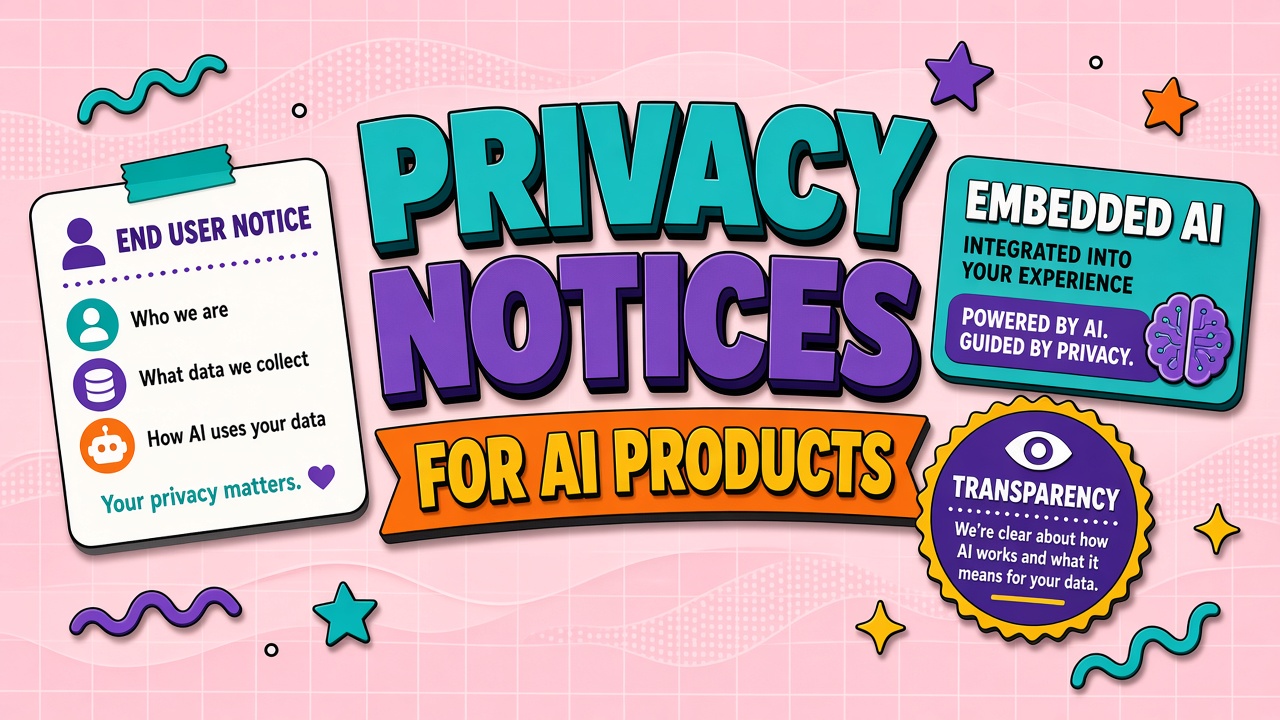
Layered privacy design shows a short in-context notice at the point of AI use, with a link to the full privacy policy for detail. Example layers:
- Just-in-time banner: First time user opens AI chat in your app
- Feature settings: Toggle with explanation of data use
- Privacy policy AI annex: Comprehensive section updated when models change
- Trust center: Subprocessors, certifications, and FAQ for enterprise buyers
Mobile apps need concise copy above the fold; web apps can use expandable "Learn more" drawers. Keep language parallel across layers to avoid contradictory statements.
When Model or Vendor Changes Require Updates
Update notices when changes materially affect users:
- New model capability (e.g., image analysis on uploads previously text-only)
- New vendor or subprocessor with different residency or training policy
- Retention extension or new logging for safety review
- Shift from human-in-the-loop to fully automated decisions
- New lawful basis or consent requirement in a market you serve
Engineering change tickets for AI features should include a privacy review checkbox before deploy. Version notices in git alongside code.
Accessibility and Plain Language
Notices must be readable: short sentences, active voice, glossary for technical terms (embedding, inference). Meet WCAG for contrast, screen reader structure, and not relying on color alone for opt-in controls.
Offer translations for markets you serve. Machine-translate only with human review for legal accuracy. Plain language helps GEO and SEO: clear headings answer "does [product] use AI on my data?" directly.
Building Notice Sections for Product Teams
Product managers should receive a notice section outline before sprint planning, not after legal review at the end of the quarter. Each AI feature ticket lists data categories touched, subprocessors invoked, retention target, and whether human review occurs before user-visible impact. Engineering attaches model version and region to the release notes so privacy can diff notices against deploy artifacts.
A practical outline for customer-facing AI privacy includes six blocks: what the feature does in one sentence, what data is collected, how long it is kept, who may see it (automated systems, employees, vendors), what choices users have, and how to contact your privacy team. Optional seventh block covers accuracy limits for generative outputs so users do not treat AI text as authoritative fact without verification.
For embedded assistants inside SaaS products, mirror the host application's existing privacy center. Users should not hunt a separate microsite for AI while general privacy lives in settings. Cross-link the AI annex from the main policy table of contents with anchor jumps for support macros.
Enterprise buyers will paste your notice language into their own DPIAs. Provide a PDF or markdown export quarterly. Inconsistent dates between marketing site and in-app notice undermine trust during security questionnaires. Version strings like "AI Notice v2026.03" help both sides track drift.
Disclose AI data use in onboarding flows where users upload their customer data on your behalf. If your product processes end-user content from your customer's customers, clarify controller and processor roles in plain language. Ambiguity here drives contract delays and regulatory questions in regulated industries.
Jurisdiction-Specific Addenda
US state privacy laws, EU GDPR, UK GDPR, and sector rules require different rights language. Maintain a core AI notice plus regional addenda linked from the same feature banner. Automated geo-detection should show the correct addendum without hiding weaker protections from users in stricter regions.
Children and teen services need standalone sections with parental rights. AI features that estimate age or sentiment from behavior need extra scrutiny and often explicit consent.
In-product microcopy examples
Good microcopy is specific: "We use AI to draft replies. A human reviews before send. Messages are stored 30 days. Learn more." Bad microcopy: "AI-powered experience." Link "Learn more" to the AI annex, not only the 40-page privacy policy PDF.
Engineering handoff checklist
Before shipping, verify: notice version in config, feature flag ties to notice acceptance where required, analytics events do not fire before display, and localization files updated. Teams using coding assistants to generate UI copy still need legal approval on final strings.
Update Triggers and Version Control
Treat privacy notices as versioned artifacts in the same repository or CMS as product copy. When engineering merges a pull request that switches model providers, adds voice input, or enables human review sampling, the privacy ticket must close before deploy. Changelog entries should link notice version to release tag so support can answer "what did we tell users in March?"
Material changes warrant in-app re-disclosure: banner, modal, or email depending on jurisdiction and contract. Immaterial typo fixes can update silently with version bump in policy footer. Legal defines materiality; product implements display mechanics. Document the decision in compliance records.
FAQ sections on chatbots and biometric features belong in the trust center, not only in legal PDFs. Support macros should quote the same language as the notice to prevent contradictory answers in tickets. Sales engineers need a short FAQ for RFP security sections about AI data use without improvising from memory.
Accessibility reviews should include screen reader traversal of opt-in toggles and notice modals. Plain language targets roughly eighth grade reading level for consumer products; enterprise admin consoles may use slightly higher level but still avoid unexplained jargon. Glossary tooltips for terms like "inference" and "automated decision" reduce support volume.
Internationalization requires parallel notice updates. Launching AI in a new country without translated notice is a common gap. Machine translation plus legal review beats English-only notices where local law expects local language for consumer rights disclosures.
Customer-Facing AI Privacy in Sales Cycles
Enterprise prospects request your end-user notice template to embed in their products. Provide white-label copy blocks with bracketed fields for their brand name and support contact. Clarify whether your company is processor or subprocessor in each integration pattern. Mislabeled roles delay security review and create liability confusion.
API customers building on your platform need sample notices for their users that accurately describe your logging and training defaults. If enterprise tier disables training but free tier does not, sample text must reflect tier-specific behavior or use lowest-common-denominator conservative language.
Frequently Asked Questions
What should chatbot notices include?
State that responses are AI-generated, may be inaccurate, whether chats are logged, retention period, and how to reach a human. Link to full policy from the chat widget footer.
Biometric or voice features?
Many jurisdictions require explicit consent and standalone notices for biometrics. Do not hide voiceprint analysis inside general analytics paragraphs.
B2B customers reselling our AI to their users?
Your DPA and product docs should clarify who drafts end-user notices. Provide a white-label disclosure template customers can adapt.
Products used by teens?
Age-gate where required. Notices should be understandable at the reading level of your audience. Parental controls where law mandates.
We launched without a notice. Now what?
Ship an in-app update immediately, email affected users if material, and document remediation for regulators. Retroactive transparency beats silence.
The Bottom Line
Privacy notices for AI embedded in customer products explain purpose, retention, human review, and rights in layered, accessible language. Update them when models, vendors, or automation depth changes. Product teams using code assistants and coding AI in customer-facing flows should ship notices in the same release train as the feature, not in a follow-up sprint.
Trust Center Alignment
Enterprise buyers compare your trust center to in-product notices. Contradictions kill deals. Single source of truth for AI disclosures should feed website, in-app banners, and sales security questionnaires. Assign one owner for AI notice content across channels.
Changelog the trust center when models change. Buyers on annual review cycles appreciate dated entries showing proactive governance.