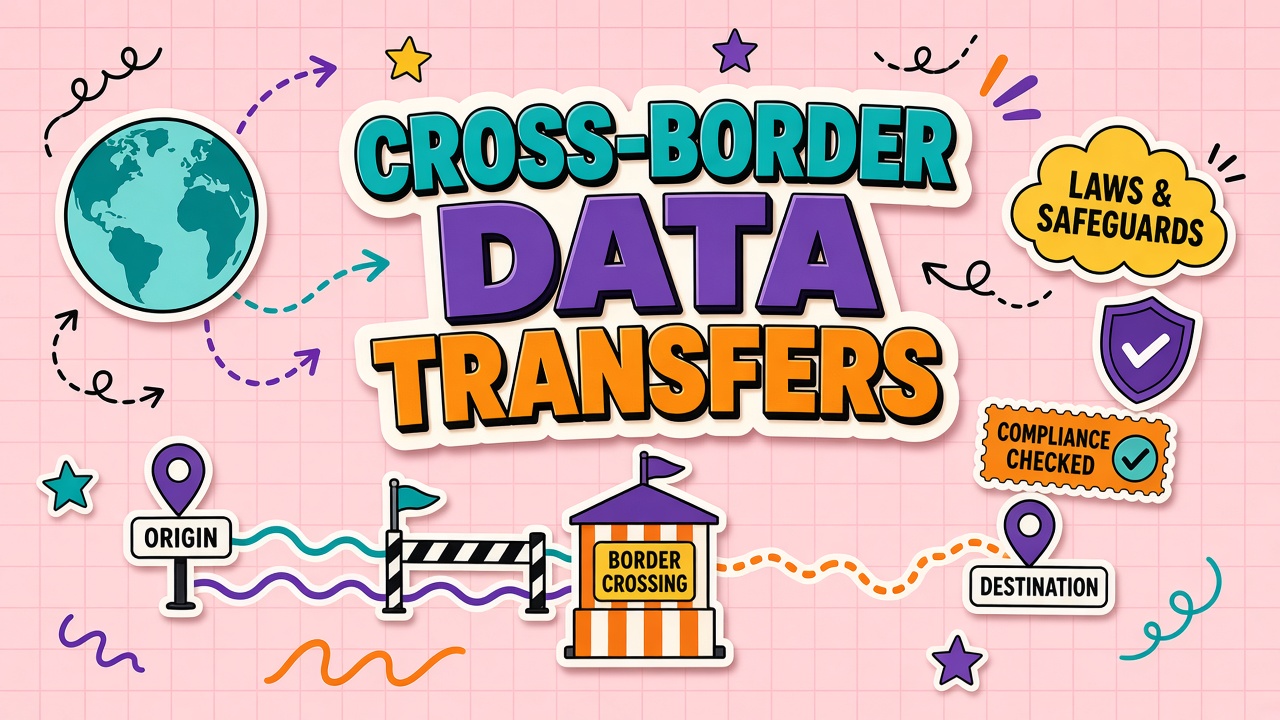
You select a US-hosted AI API for a product serving EU customers. Prompts leave Frankfurt, hit inference clusters in Virginia, and logs replicate to a backup region in Oregon. That path is an AI cross border data transfer even when the user interface feels local. Privacy teams ask whether Standard Contractual Clauses apply, whether regional endpoints are real isolation or only routing labels, and what subprocessors see along the way.
Modern AI stacks multiply transfer points: embedding services, vector databases, labeling vendors, and observability tools each may sit in a different jurisdiction. Buyers evaluating AI research assistants and AI video platforms must inventory where prompts, outputs, fine-tuning datasets, and audit logs cross borders, then match each hop to a lawful transfer mechanism.
Why AI Workloads Cross Borders
AI inference rarely stays in one data center. Load balancing sends requests to the nearest available GPU pool. Failover replicates state across regions. Training and fine-tuning pipelines pull datasets from global object storage. Support engineers in multiple time zones may access logs for incident response.
Latency optimization drives much of the routing. A chatbot hosted in Singapore may still call a foundation model API whose primary region is the United States because that region holds capacity for the model tier you purchased. AI data residency options on marketing pages do not always mean all subprocessors honor the same boundary.
Multi-tenant SaaS AI tools add another layer. Your data shares infrastructure with other customers even when logically partitioned. Ask vendors whether encryption keys are region-scoped and whether support staff access is limited by geography and role.
Transfer Mechanisms: SCCs, Adequacy, and BCRs
EU and UK law require a lawful basis for personal data leaving their jurisdictions. Common mechanisms include adequacy decisions for approved countries, Standard Contractual Clauses between controller and processor, and Binding Corporate Rules for multinational groups. AI vendors often rely on SCCs plus supplementary measures described in transfer impact assessments.
| Mechanism | Best for | AI-specific note |
|---|---|---|
| Adequacy | Transfers to countries with EU approval | Verify subprocessors also sit in adequate regions |
| SCCs | Most vendor contracts | Request SCC AI vendors module covering model training opt-out |
| BCRs | Internal group transfers | Map internal AI experimentation sandboxes |
| Derogations | Rare, explicit consent cases | Not a default for production AI features |
Document which mechanism covers each vendor and subprocessor. When a vendor updates subprocessors, trigger re-assessment. International AI data transfer compliance is a living register, not a one-time checkbox during procurement.
Regional Inference and Storage Options
Major providers now offer region-locked inference for enterprise tiers. Configuration may include selecting a home region for API calls, pinning vector stores, and restricting backup replication. Confirm whether failover still crosses borders during outages and whether you can disable cross-region failover for regulated workloads.
Compare three deployment patterns: global default routing, customer-selected region with in-region processing, and self-hosted or private cloud models with no external transfer. The third pattern reduces transfer risk but shifts security and capacity burden to your team.
Storage residency matters for retention. Prompt logs kept thirty days in Dublin differ from embeddings stored indefinitely in a US multi-tenant index. Align deletion APIs with your privacy notice commitments in each market you serve.
Vendor Questionnaires for Transfers
Security questionnaires should include an AI transfer annex. Ask where inference runs by default, which subprocessors process prompts, whether human reviewers access data from other regions, and how the vendor responds to government access requests. Request architecture diagrams that show data flows, not only corporate headquarters location.
Evidence to collect: signed DPA with SCCs, subprocessor list with regions, transfer impact assessment summary, and configuration guide for region pinning. For startups without full documentation, accept phased evidence with contractual commitments and deadlines.
Operational Controls for Teams
Engineering controls complement legal mechanisms. Route EU tenant traffic through regional API keys. Block paste of national ID numbers into tools without regional guarantees. Tag requests in observability with data residency class so incidents trace to the correct legal playbook.
Review internal R&D practices. Data scientists exporting EU customer samples to US notebooks for experimentation may create transfers your production stack avoids. Centralize experimentation environments with the same residency rules as production.
Maintaining a Living Transfer Register
A transfer register lists every vendor, subprocessor, source region, destination region, mechanism, and owner. Update the register when engineering adds a new embedding provider, when marketing adopts a video AI tool, or when the foundation model vendor adds a training subprocessor in a new country.
Tie register updates to change management. No production API key for a new AI service without a register row reviewed by privacy. Annual attestations from business owners confirm their team's stack still matches the register.
Customer-Facing Residency Claims
Sales may promise EU-only processing. Engineering must verify that claim covers inference, logging, support access, backups, and disaster recovery. Overpromising residency creates contractual liability when a failover event routes traffic abroad. Document allowed failover behavior in customer DPAs.
Transfer assessment questions for AI vendors
- Where does inference run for our selected region?
- Where are prompts and outputs stored, and for how long?
- Which subprocessors process our data and where are they located?
- Does failover cross regions automatically?
- Do support or labeling staff access data from other jurisdictions?
- What transfer mechanism covers each hop?
Breach Notification and Government Access
Cross-border transfers increase coordination complexity during incidents. Contracts should specify vendor notice timelines, contact paths, and whether the vendor will notify you before responding to lawful access requests when permitted. Run tabletop exercises that include a subprocessor in a third country to test playbooks.
Embedding and Vector Store Transfer Risks
RAG pipelines often store embeddings in vector databases hosted separately from inference. Customer text may be chunked, embedded, and indexed in a US region while chat UI promises EU hosting. Map embedding creation, index storage, and query paths as distinct transfer events in your register.
Deletion requests must cover embeddings and derived indexes, not only raw prompts. Ask vendors how long re-embedding after model upgrades takes and whether old vectors persist in backups after customer deletion.
Evaluating Regional Product Tiers From Vendors
Vendors market region-locked SKUs at premium prices. Compare whether the premium buys legal isolation, performance guarantees, or only a configuration flag. Pilot with synthetic personal data before migrating production EU workloads. Document latency and availability tradeoffs when failover is disabled to keep data in-region.
Multi-Cloud and Fine-Tuning Transfer Paths
Custom model training copies datasets to vendor-controlled compute clusters. Fine-tuning jobs may run in a different region than inference. Exporting weights back to your environment is another transfer event. Contract for training region, deletion of training snapshots, and whether shared infrastructure processes other customers' data on the same GPUs during your job.
Human labeling for model improvement often occurs in low-cost regions. If labels include personal data from your customers, that workflow needs the same transfer analysis as inference. Ask vendors whether labelers work under confidentiality agreements and whether screens are monitored.
Frequently Asked Questions
How do UK and EU transfer rules differ for AI vendors?
Post-Brexit UK maintains its own adequacy and IDTA framework. Vendors may offer separate UK addenda. Treat UK and EU customer data flows as distinct rows in your transfer register even when the vendor brand is global.
What about APAC customers using US AI APIs?
APAC countries apply varied localization and consent rules. Singapore, Australia, Japan, and India differ materially. Map each market to vendor region options and local counsel guidance rather than assuming EU SCCs suffice globally.
Does anonymized data still count as a transfer?
Truly anonymized data may fall outside personal data rules, but re-identification risk from prompts is high. Assume prompt text containing user identifiers is personal data until a formal anonymization assessment says otherwise.
Does on-prem AI eliminate transfer issues?
On-prem models reduce external transfers but may still call external APIs for plugins, updates, or hybrid routing. Inventory every outbound connection from the on-prem stack.
How does Schrems II affect US AI vendors for EU data?
EU regulators expect transfer impact assessments and supplementary measures beyond SCCs alone when data goes to countries without adequacy. Document encryption, access controls, and vendor transparency commitments. Revisit assessments when legal guidance or vendor architecture changes.
The Bottom Line
AI cross border data transfer is structural, not accidental. Map inference, storage, logging, and support access paths; match each to SCCs, adequacy, or regional deployment. Evaluate research and video tools with transfer annexes before customer data enters prompts.