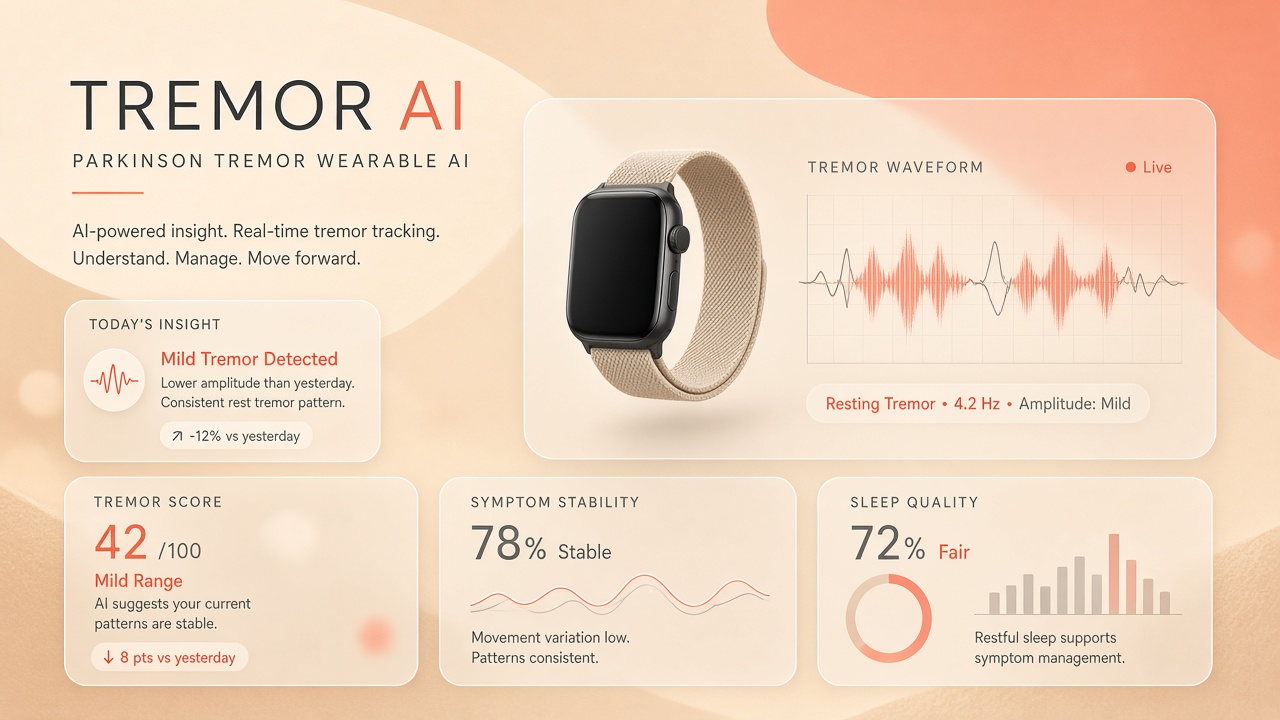
Parkinson tremor detection AI on wearables uses wrist accelerometers and machine learning to estimate resting tremor burden, dyskinesia episodes, and motor fluctuations between neurology appointments. Consumer smartwatches such as Apple Watch expose movement-disorder APIs that classify 3 to 7 Hz resting tremor in one-minute windows. Research platforms including MM4PD and WATCH-PD correlate those digital measures with clinician ratings and medication cycles. These systems are designed to support monitoring and care conversations, not to diagnose Parkinson disease or replace licensed clinicians. Teams evaluating health-adjacent AI chatbot products should treat wearable tremor scores as adjunct data streams, not autonomous medical decisions.
Why Wearable Tremor Monitoring Matters in Parkinson Care
Parkinson disease tremor fluctuates across the day with medication timing, stress, and sleep, yet traditional care relies on brief in-clinic Movement Disorder Society Unified Parkinson Disease Rating Scale (MDS-UPDRS) snapshots. Resting tremor, postural tremor, and kinetic tremor respond differently to levodopa, dopamine agonists, and deep brain stimulation. A fifteen-minute visit may capture an "on" state while the patient spent most of the week in wearing-off discomfort. Continuous wrist sensing offers a complementary timeline that clinicians can review alongside patient diaries.
Regulatory-cleared apps and research studies pursue three overlapping goals: quantify symptom burden for titration, detect subclinical changes earlier than quarterly visits, and supply objective endpoints for clinical trials. None of these goals removes the need for neurological examination, imaging when indicated, and shared decision-making with a movement disorder specialist.
Wearables also lower friction compared with multi-sensor research rigs. A single watch on the more affected wrist can run passively while the user cooks, commutes, or rests. That convenience trades off against specificity: brushing teeth, driving, and other rhythmic arm motion can resemble tremor in raw accelerometer traces unless models account for activity context.
Apple Watch Movement Disorder API and Tremor Limits
Apple's CMMovementDisorderManager measures resting Parkinsonian tremor in the 3 to 7 Hz band and choreiform dyskinesia at the wrist, storing classified results on-device for up to seven days. Apple documents that the API is intended only for users already diagnosed with a movement disorder by a clinician. Developers need a Movement Disorder entitlement, must declare NSMotionUsageDescription, and should place Apple Watch on the most affected arm. The manager records high-rate accelerometer samples (around 100 Hz via CMSensorRecorder), then analyzes data opportunistically to preserve battery life rather than scoring tremor in real time on every sample.
Critical limitations appear directly in Apple's guidance. The API tracks resting tremor, not action tremor or postural tremor, and may miss finger tremor. Dyskinesia tracking applies when chorea affects the instrumented arm. Medical decisions must flow through licensed clinicians; the platform is a data layer, not a diagnostic engine. Third-party apps such as Parky (FDA-cleared for Apple Watch-based symptom monitoring), StrivePD, and research stacks built on ResearchKit consume these signals to produce patient-facing reports.
| Signal | What Apple Watch API measures | What it does not measure |
|---|---|---|
| Resting tremor | 3 to 7 Hz presence and relative severity per minute | Action or postural tremor subtypes |
| Dyskinesia | Likely choreiform movement at the wrist | Non-choreiform dyskinesia patterns elsewhere |
| Storage | Queryable results retained about seven days | Unlimited cloud archival without app design |
Accelerometer AI Models for Parkinson Tremor Detection
Wrist accelerometers combined with convolutional neural networks, prototypical networks, and spectral feature pipelines can classify tremor segments in both laboratory and free-living settings, though wild-environment performance remains harder than scripted clinical tasks. A Sensors journal study on tremor detection "in the wild" reported that a tremor-spectrum preprocessing module plus deep neural network outperformed twelve alternative systems on held-out data, and proposed tracking the percentage of time with tremor over long windows when precise event boundaries are noisy. Multitask CNNs on consumer smartwatch triaxial accelerometers showed high agreement with clinician-rated resting tremor amplitude and constancy in early-stage cohorts.
Prototypical networks trained on home accelerometer data from the Parkinson@Home validation study aimed to separate tremor phenotypes from daily activities that create false positives, such as stirring food or using tools. Leave-one-subject-out validation highlighted that limited labeled data and heterogeneous tremor types remain core engineering constraints. A Journal of NeuroEngineering and Rehabilitation analysis found no significant difference between a flexible research sensor and a commercial smartwatch for tremor classification, suggesting consumer hardware can be adequate when algorithms and study design are rigorous.
Model choice should match the clinical question. Event detection (start and end of a tremor bout) demands sharper temporal precision than day-level burden metrics ("25 percent of awake time with mild tremor"). The WATCH-PD twelve-month study used Apple's API to show increasing tremor proportion over time in early Parkinson cohorts, illustrating how minute-level classifications aggregate into longitudinal trends clinicians can discuss with patients.
MM4PD and Longitudinal Smartwatch Validation
The Motor fluctuations Monitor for Parkinson Disease (MM4PD) system validated smartwatch inertial sensing against expert ratings in 343 participants, with resting tremor correlations around 0.80 and dyskinesia mappings that matched clinician presence assessments during in-clinic tasks. Published in Science Translational Medicine, the work followed a subset for up to six months. In evaluated cases, MM4PD symptom trajectories aligned with clinician expectations after medication or deep brain stimulation changes in roughly ninety-four percent of subjects. In the remaining six percent, wearable timelines surfaced mismatches that prompted medication strategy reviews, demonstrating how passive data can prompt clinical action without automating it.
MM4PD and related platforms emphasize patient-clinician communication: exportable charts that align tremor and dyskinesia curves with dose times. That workflow mirrors how FDA-cleared consumer apps position themselves, continuous capture, periodic review, human interpretation. Buyers should ask vendors for peer-reviewed validation in populations that match their use case (early versus advanced disease, tremor-dominant versus akinetic-rigid phenotypes).
Free-Living False Positives and Real-World Deployment
The gap between clinic-task accuracy and home-environment robustness is the main barrier to trusting parkinson tremor detection AI for autonomous alerts. Accelerometer rhythms from exercise, transportation, and household chores overlap with pathological tremor frequency bands. Models trained only on scripted MDS-UPDRS items may degrade when users perform unstructured activities. Context-aware classifiers, multi-sensor fusion (gyroscope plus accelerometer), and patient-specific baselines reduce but do not eliminate false positives.
Battery and memory constraints also shape product behavior. Apple's opportunistic analysis trades immediacy for wear time. Research devices may stream at high Hz but burden participants with charging cycles that harm adherence. For trial sponsors, the best endpoint may be a coarse daily index that patients tolerate for months, not a maximal-resolution trace abandoned after two weeks.
| Deployment setting | Typical strength | Typical weakness |
|---|---|---|
| In-clinic scripted tasks | High correlation with MDS-UPDRS items | Poor representation of full-day symptom burden |
| Passive home monitoring | Captures motor fluctuations and adherence effects | Activity confounds and adherence drop-off |
| Clinical trial endpoints | Higher temporal resolution than quarterly visits | Regulatory acceptance still evolving per endpoint |
Regulatory-Cleared Apps vs Research Tools
FDA-cleared or CE-marked Parkinson wearable software must document analytical and clinical validation for stated indications, while academic prototypes may publish strong correlations without commercial claims. Parky advertises twenty-four-seven Apple Watch motor symptom monitoring with medication reminders and clinician-ready reports. Research APIs such as MM4PD historically powered studies before general consumer launch. Health systems should verify intended use statements, cybersecurity posture, and whether algorithms update silently after deployment.
Open-source machine learning on public accelerometer datasets can accelerate R and D but rarely meets quality management expectations for patient-facing diagnosis or treatment changes. If a hospital pilots a wearable tremor pipeline, governance should cover consent language, data retention, and explicit clinician review before dose adjustments. Patients should not receive push notifications that imply emergency action without a care team workflow behind them.
How AI Pipelines Process Wrist Motion Data
Typical parkinson tremor detection AI stacks filter accelerometer streams, extract frequency-domain features in the tremor band, classify short windows, then aggregate scores into clinician-facing dashboards. Preprocessing often includes band-pass filtering, segmentation into thirty-second or one-minute epochs, and optional gyroscope fusion. Deep learning models may ingest raw waveforms end-to-end; classical pipelines may use mel-frequency cepstral coefficients adapted for tremor spectra. Multitask heads simultaneously predict tremor presence and severity bins to match MDS-UPDRS-like scales.
Personalization improves fit: baselines captured during known "off" and "on" medication states help models interpret relative change. Federated or on-device training approaches are attractive for privacy but complicate centralized auditing. Explainability remains limited; clinicians usually review trends rather than per-second attributions. Integrations with electronic health records should transmit summary statistics and raw traces only when bandwidth and consent allow.
Privacy, Equity, and Adherence Considerations
Continuous tremor monitoring raises consent, caregiver access, and digital divide questions that technical accuracy metrics alone do not answer. Older adults may lack compatible watches, stable internet for sync, or dexterity to maintain charging habits. Tremor-dominant patients are not the entire Parkinson population; akinetic-rigid phenotypes benefit less from wrist-centric metrics. Rural neurology clinics need reimbursement clarity before staff invest in reviewing wearable PDFs during already compressed visits.
Data minimization helps: store aggregated minute classifications when full 100 Hz traces are unnecessary. Patients should be able to pause monitoring and export or delete history. Vendor policies must clarify whether accelerometer features train global models across users, a sensitive point for regulated health data.
Frequently Asked Questions
Can Apple Watch diagnose Parkinson disease?
No. Apple's movement disorder APIs are explicitly for people already diagnosed by a clinician. Consumer wearables may flag resting tremor patterns consistent with Parkinsonian phenomenology, but diagnosis requires neurological history, examination, and often imaging or dat scan context. Any app claiming standalone diagnosis should be treated skeptically.
Does wearable AI detect action tremor and postural tremor?
Apple's documented API focuses on resting tremor in the 3 to 7 Hz range and does not track action or postural tremor. Some research systems trained on structured postural holds or multitask clinical batteries estimate additional tremor types, but passive all-day wrist sensing remains strongest for resting tremor and certain dyskinesia patterns.
How accurate is AI tremor detection compared with a neurologist?
Published studies report correlations around 0.80 or higher between smartwatch tremor burden and clinician ratings during aligned tasks, but accuracy varies by phenotype, medication state, and environment. Wearables excel at longitudinal sampling; neurologists excel at contextual examination. The two are complementary, not interchangeable.
Why do false positives increase at home?
Daily activities produce rhythmic wrist motion that resembles tremor in frequency content. Models trained only in clinics see fewer confounds. Context detection, personalized baselines, and requiring persistence before alerting reduce false positives but add engineering complexity.
Can wearables replace MDS-UPDRS in clinical trials?
Digital measures increasingly serve as exploratory or secondary endpoints, especially in studies like WATCH-PD, but regulatory acceptance depends on endpoint validation for each trial design. Sponsors should prespecify how minute-level tremor fractions map to clinical meaningfulness and engage regulators early.
Which wrist should wear the device?
Apple and multiple studies recommend the more affected arm for tremor and dyskinesia tracking. Bilateral monitoring can help when symptoms fluctuate across sides, but doubles battery and data review burden.
Conclusion: Wearables as Monitoring Partners, Not Autonomous Clinicians
Parkinson tremor detection AI on wearables transforms intermittent clinic glimpses into day-level motor timelines when patients and clinicians agree on goals, limitations, and review cadence. Apple Watch movement disorder APIs, MM4PD-style validation, and accelerometer deep learning show credible correlation with expert ratings, especially for resting tremor. Action tremor, diagnostic use, and unsupervised alerting remain weak or out-of-scope for many platforms. Health technology buyers should demand peer-reviewed evidence in their target population, clear regulatory status, and workflows that keep neurologists in the loop. For broader context on how AI products present medical information to users, browse the EliteAI.tools blog and compare patient-facing AI chatbot guardrails with the stricter evidential bar wearable neurology requires.
Medical disclaimer: This article is educational and does not constitute medical advice, diagnosis, or treatment. Consult a qualified neurologist or movement disorder specialist for personal health decisions.