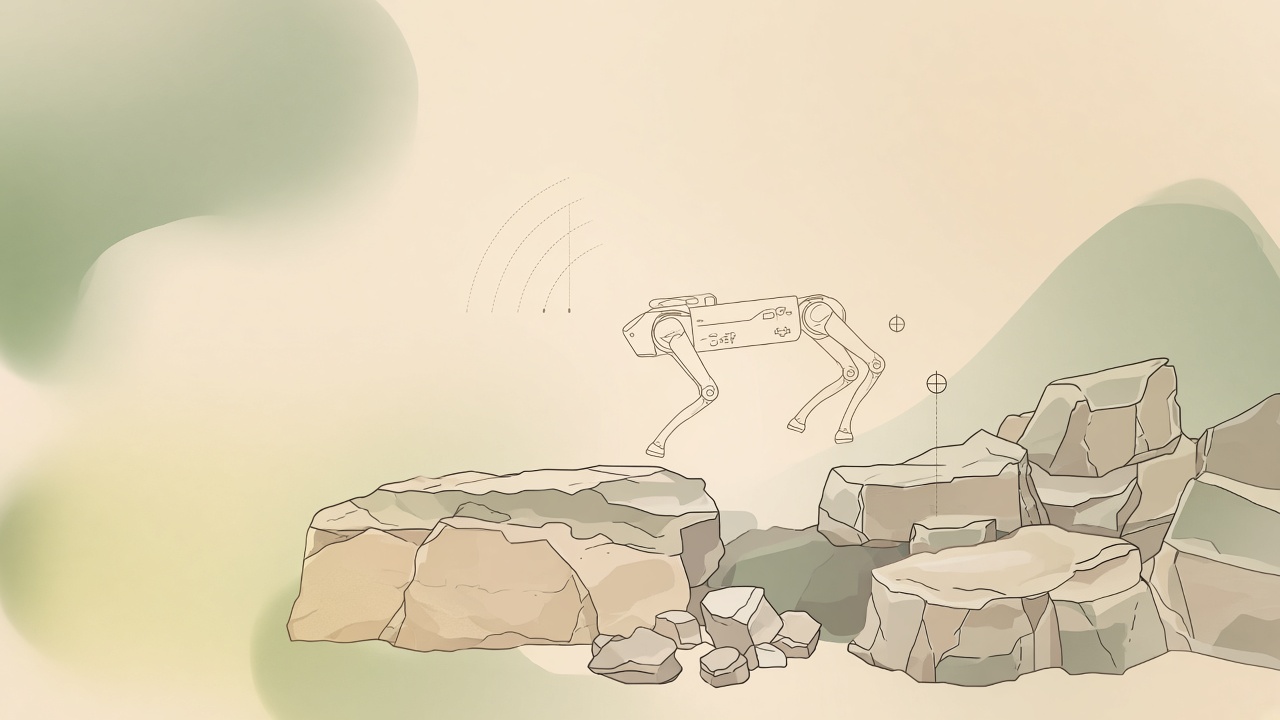
A quadruped sent into a collapsed building cannot assume flat factory floors. Stepping stones, gaps, rubble piles, and slippery slopes each demand different foot placements, body poses, and contact strategies. Legged robot terrain adaptation is the capability to read ground geometry, select locomotion behaviors, and adjust gaits in real time so the robot keeps moving without falling. Modern legged robot terrain AI stacks hierarchical reinforcement learning, terrain-aware perception networks, and classical model predictive control (MPC) into pipelines that ETH Zurich's ANYmal and Boston Dynamics' Spot deploy on hardware today.
Legged locomotion research feeds disaster response, inspection, mining, and defense markets where wheeled platforms stall. Teams exploring AI chatbot assistants for field robotics should remember that chat interfaces do not replace sim-to-real validation on the actual terrain class. For more research explainers, see the EliteAI.tools blog index.
What Legged Robot Terrain Adaptation Means in Plain Language
Legged robot terrain adaptation is the robot's ability to perceive uneven ground, choose appropriate locomotion skills (walk, trot, jump, crawl, climb), and modulate forces so feet land on safe footholds while the body stays balanced. Unlike a fixed gait on flat ground, adaptation implies closed-loop reaction: when a stone shifts or a gap widens, the controller replans within milliseconds. Terrain adaptation spans sensing (depth cameras, LiDAR, proprioception), high-level skill selection, and low-level torque control at each joint.
Wheeled and tracked robots adapt mainly through path planning around obstacles. Legged robots adapt through contact-rich motion: they can step over, onto, or between obstacles that would stop a rover. The tradeoff is control complexity. Each foot contact changes the robot's dynamics, and small perception errors near cliff edges cause falls that are hard to recover from.
| Terrain class | Primary challenge | Typical adaptation strategy |
|---|---|---|
| Gravel and loose soil | Foot slip, sinking | Force control, shorter strides, slip detection |
| Rubble and construction debris | Variable step height, voids | Hybrid RL plus model-based foothold planning |
| Sparse stepping stones | Precise foot placement, dynamic balance | End-to-end RL specialist policies |
| Stairs and ledges | Vertical clearance, edge contacts | Skill library with jump and climb behaviors |
Adaptation versus global navigation
Terrain adaptation handles local footholds and contacts; global navigation chooses which corridor to follow on a map. State-of-the-art systems separate these layers so a navigation planner outputs a coarse path while a locomotion stack handles the next two meters of ground. ANYmal parkour research explicitly couples both: a high-level policy selects among pretrained skills based on reconstructed terrain geometry from noisy depth data.
How the Underlying AI Pipeline Works
Production-grade legged terrain pipelines train locomotion policies in randomized simulation, distill them for onboard inference, wrap them with safety-critical model-based controllers, and validate on progressively harder real-world courses. The loop spans months of engineering, not a single end-to-end network dropped onto hardware.
Hierarchical skill libraries
The ANYmal parkour system, published in Science Robotics (March 2024), trains separate reinforcement learning policies for walking, jumping, climbing, and crouching in simulation, then trains a high-level navigation policy that selects and blends those skills while a perception module reconstructs obstacles from occluded depth and LiDAR data. The hierarchy ensures the navigator knows each skill's limits before commanding a jump across a gap. Real-world tests reported speeds up to 2 m/s across consecutive challenging obstacles without offline motion planning or expert demonstrations per scene.
Generalist-to-specialist reinforcement learning
For risky sparse footholds, researchers train a generalist policy on disorderly stepping stones, then fine-tune specialist policies for narrow beams and irregular gaps. The ANYmal-D platform achieved peak forward velocities at or above 2.5 m/s on stepping stones and balance beams using this two-stage approach, formulated as a navigation task rather than strict velocity tracking to allow rapid speed adaptation. Exploration strategies address sparse rewards common on dangerous terrains where random policies fall immediately.
Reinforcement learning plus MPC on Spot
Boston Dynamics integrates reinforcement learning with Spot's locomotion stack after years of MPC-centric development. Engineers define reward functions and randomized simulation environments ( stair dimensions, friction, terrain roughness), run over a million parallel simulations on a cluster, and deploy policies that improve mean time between falls while reducing onboard compute versus multi-instance MPC selection. The data-driven layer handles edge cases; model-based layers retain interpretable safety envelopes. ETH Zurich's rubble navigation work similarly combines learned flexibility with model-based foothold accuracy for gap crossing.
- Build or import URDF models and high-fidelity terrains in Isaac Gym, RaiSim, or custom simulators.
- Train low-level skill policies with domain randomization (mass, friction, sensor delay, push disturbances).
- Train high-level selectors or finetune specialists from a generalist checkpoint.
- Export policies to ONNX or TorchScript for onboard inference at 50 to 500 Hz.
- Wrap with state estimators, contact detectors, and emergency stop behaviors independent of RL.
- Progressive real-world validation: lab fixtures, outdoor courses, then operational environments with tether or catch rig.
Real Deployments and Published Evidence
Legged terrain adaptation has crossed from lab videos into vendor platforms and peer-reviewed field experiments on ANYmal and Spot-class hardware. ETH Zurich publicly demonstrated ANYmal traversing Swiss hiking trails, parkour-style obstacles, and rubble piles with learned policies transferred from simulation. Boston Dynamics documents RL integration in Spot's commercial locomotion updates, emphasizing fleet-wide sim training before OTA-style policy refinement.
Academic benchmarks and sim-to-real transfer
The parkour paper reports successful hardware transfer despite training only in simulation, enabled by diverse randomized terrains and perception modules trained on noisy partial observations. Stepping-stone work validates two specialist policies on physical stones and beams after generalist pretraining. These results set expectations: sim-to-real works when randomization spans the failure modes of target terrain, not when a single flat-plane policy is hope-tested on rubble.
Industrial and inspection use cases
Energy and construction firms deploy quadrupeds for site inspection where stairs, cables, and mud defeat wheeled drones-on-wheels. ANYbotics markets ANYmal for offshore and industrial inspection with autonomy stacks derived from ETH research. Unitree, Ghost Robotics, and other vendors ship quadrupeds with baseline walking controllers; advanced terrain adaptation often remains a research integration or vendor premium feature rather than a default out-of-box capability on every model.
Simulation ecosystem and reproducibility
Open-source stacks such as Isaac Gym, Legged Gym, and RaiSim lower the barrier to training terrain policies, but reproducibility requires publishing randomization ranges and reward weights, not only demo videos. Teams that skip ablation studies often discover their policy memorized a single stepping-stone layout rather than generalizing foothold selection. Publishing Jacobian-style contact metrics and fall rates across held-out terrain seeds is becoming standard practice in robotics conferences reviewing locomotion papers.
Limits, Risks, and Ethical Guardrails
Legged robots still fall: perception gaps, brittle ice, novel debris shapes, and adversarial terrain defeat policies that never saw those conditions in simulation. Falls risk damage to expensive hardware, downtime in disaster zones, and injury if robots operate near untrained bystanders. Learned controllers are harder to certify than fixed-gait industrial machines under machinery directives.
- Sim-to-real gap: Soft soil mechanics and deformable objects remain poorly modeled; policies trained on rigid meshes fail silently.
- Perception limits: Depth sensors fail in dust, smoke, and direct sunlight; terrain reconstruction errors cause misplaced feet.
- Energy and compute: Dynamic jumping drains batteries; onboard GPUs heat up in sealed industrial enclosures.
- Maintenance: Joint wear accelerates on abrasive terrain; adaptation increases contact forces versus flat walking.
- Dual-use: Legged mobility aids search-and-rescue and surveillance alike; deployment policies should match legal use.
Ethical guardrails include geofenced operating zones, human supervisors with e-stop authority, fall detection that triggers safe collapse poses, and transparent reporting when robots operate in public disaster sites alongside human responders. Do not send unproven policies into unstable rubble without recovery plans for stranded robots blocking rescue paths.
Who Should Use This and Who Should Wait
Industrial inspection teams, robotics research labs with sim infrastructure, and defense integrators with safety harness protocols should adopt hierarchical RL plus MPC stacks on proven quadruped platforms now, scoped to characterized terrain classes. Warehouse operators with smooth concrete, small businesses expecting plug-and-play rubble traversal, and teams without robotics safety expertise should wait or hire integrators.
| Audience | Recommendation | Caveat |
|---|---|---|
| Offshore inspection operator | Deploy vendor autonomy with documented terrain limits | Validate on local grate patterns and stairs |
| University lab | Reproduce hierarchical skill training in open simulators | Budget for hardware repair and harness rigs |
| Disaster response NGO | Pilot on training rubble before live deployments | Robot falls can obstruct access routes |
| Warehouse logistics | Prefer wheeled AMRs unless stairs dominate | Legged CAPEX rarely pays on flat floors |
Common sim-to-real failure modes
Even strong papers report failures when reality diverges from randomized simulation. Slippery leaves, cable snags, and reflective puddles confuse depth sensors trained on synthetic noise models. Contact dynamics differ: real rubber feet compress differently than idealized spring-damper contacts. Battery voltage sag under cold weather reduces peak torque just when a jump policy demands maximum thrust. Teams mitigate these gaps with privileged-information training (teacher policies that see ground truth during sim), system identification on real hardware, and conservative skill gating that refuses jumps when perception confidence drops. Logging fall events with IMU traces and depth snapshots builds the dataset needed to patch policies without retraining from scratch.
Maintenance, falls, and field repair
Terrain adaptation increases mechanical stress: repeated jumps wear actuators, and rubble impacts crack protective shells. Boston Dynamics and ANYbotics publish maintenance intervals; field teams budget spare legs, foot pads, and hot-swappable battery packs. A fall in a disaster zone is not merely embarrassing: it can block a narrow corridor or damage sensitive payloads. Operational doctrine therefore includes tethered first missions, catch rigs in lab-to-field transitions, and human spotters during early rollout. Learned policies should expose diagnostic telemetry (contact counts, slip detections, skill abort reasons) so maintainers can distinguish perception drift from mechanical wear before catastrophic failure.
Fleet operators comparing quadruped vendors should ask for fall-rate statistics on terrain classes matching their sites, not only peak velocity on curated demo courses. Contract language can require policy rollback if logged slip rates exceed agreed thresholds during the first ninety days of deployment.
Frequently Asked Questions
How reliably do legged robots adapt to new terrain?
Reliability is high on terrains represented in training randomization and lower on novel deformable or visually ambiguous surfaces; vendors quote mean time between falls in hundreds of hours on characterized courses, not universal guarantees. Always run site-specific acceptance tests before operational reliance.
Is reinforcement learning required for terrain adaptation?
No. Model predictive control and optimization-based foothold planners handle many structured terrains; RL adds agility on dynamic obstacles and sparse footholds where analytic models are incomplete. Best systems combine both, as ANYmal rubble and Spot fleet updates demonstrate.
Are there specific regulations for legged robots in public spaces?
Most jurisdictions apply general machinery, workplace safety, and public nuisance rules rather than legged-specific statutes; industrial sites follow OSHA-style employer duties for powered equipment near workers. Public sidewalk deployment remains legally uncertain in many cities.
What data is needed to train terrain adaptation policies?
Simulation generates the bulk of training episodes; real-world logs fine-tune perception and calibrate contact models but are too slow to replace sim at scale. Domain randomization parameters should match target terrain statistics (step height variance, friction ranges, obstacle density).
Which sensors matter most for terrain adaptation?
Depth cameras and LiDAR feed terrain reconstruction; IMUs and joint encoders provide proprioception for balance; contact sensors or estimated ground reaction forces detect slips. Sensor fusion quality often limits performance more than policy architecture choice.
How expensive is deployment-ready terrain adaptation?
Industrial quadrupeds cost tens of thousands of dollars per unit plus integration labor; research-grade adaptation stacks require GPU sim clusters and robotics engineers, not a single pretrained download. Total cost of ownership includes falls, spare legs, and supervised missions during early rollout.
Conclusion
Legged robot terrain adaptation merges perception, hierarchical reinforcement learning, and model-based control so quadrupeds traverse rubble, stairs, and sparse footholds at speeds impossible with fixed gaits. ANYmal parkour and stepping-stone research prove sim-to-real transfer on ANYmal hardware; Boston Dynamics integrates RL into Spot's commercial locomotion stack. Limits remain: falls, perception fragility, and certification gaps. Teams should match robot class to terrain statistics, invest in randomized simulation, and treat learned policies as components inside supervised safety systems, not autonomous agents sent blindly into disaster zones.