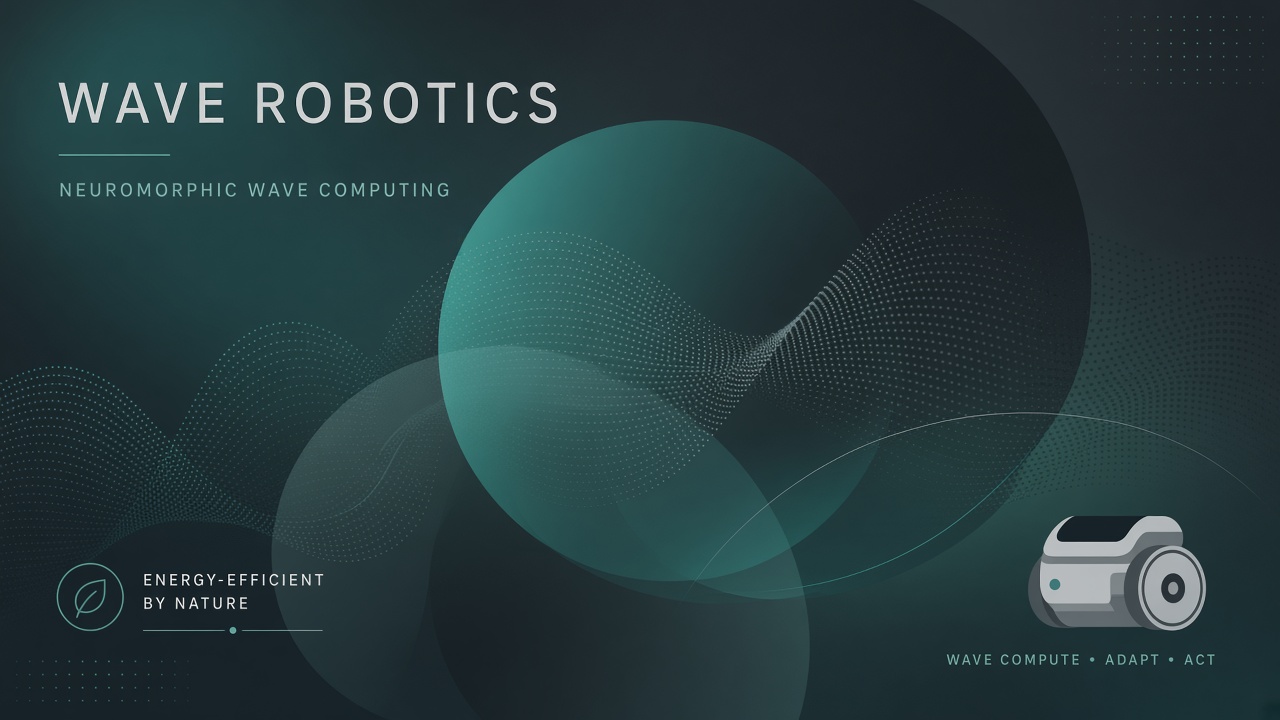
Neuromorphic wave robotics combines brain-inspired computing hardware with physical wave dynamics to run perception and control on the robot itself, cutting energy use and latency compared with cloud-connected GPU pipelines. Recent demonstrations span event-camera spiking networks on quadrotors (2.3 ms end-to-end avoidance latency, 21% of conventional system energy at NeurIPS 2025), fully asynchronous Intel Loihi dodging (4.3% of Jetson Orin NX energy per inference), and water-wave reservoir computers steering Arduino cars (Nature Communications, September 10, 2026). None of these replace general-purpose GPUs for language or vision foundation models, but they target always-on edge sensing where watts and milliseconds matter. Teams tracking AI research on embodied systems or exploring AI research infrastructure should map which robot stack layer each neuromorphic approach fits.
What Neuromorphic Computing Changes at the Edge
Von Neumann robots shuttle sensor data through CPU or GPU memory buses for every inference pass; neuromorphic designs co-locate sensing, spiking or wave dynamics, and readout near the actuator loop, reducing idle power and burst bandwidth. Mobile robots that stream camera frames to cloud vision APIs face network dropouts, privacy limits, and round-trip latency incompatible with dodging obstacles at 10 m/s. Edge inference fixes connectivity but drains batteries when convolutional networks run at 30 Hz on ARM SoCs.
Neuromorphic event cameras report pixel-level brightness changes asynchronously, producing sparse spike trains ideal for spiking neural networks (SNNs). Digital neuromorphic chips like Intel Loihi execute those spikes with event-driven logic rather than dense clocked matrix multiplies. Wave-based reservoirs push further: the physical medium (water, spin waves) performs nonlinear mixing; only a small readout layer trains digitally. Each architecture trades programmability for efficiency on narrow tasks.
Always-on perception dominates robot power budgets when RGB cameras run at 30-60 frames per second through ResNet backbones. Event cameras sample only when scene luminance changes, slashing redundant computation on static backgrounds. Spiking networks propagate information only when input spikes arrive, avoiding multiply-accumulate on silent neurons. Wave reservoirs eliminate digital recurrence entirely for the heavy nonlinear stage. Together these approaches attack the same bottleneck: energy per useful decision at the edge.
Cloud-dependent robots lose function in mines, warehouses with spotty Wi-Fi, and disaster zones. Edge neuromorphic stacks keep reflex behaviors alive when uplinks fail. Latency-sensitive coordination (swarm collision avoidance, prosthetic balance) benefits from sub-10 ms local loops impossible over round-trip cloud inference.
Wave-Based Processing in Plain Language
Wave reservoir computing injects sensor values into wave generators, lets interference patterns settle, photographs or samples the field, and classifies patterns with a lightweight readout, treating ripples or spin waves as a fixed computational reservoir. Imagine six ultrasonic distance readings modulating wave sources in a tank. Distinct obstacle layouts produce distinct steady-state interference images. A camera captures the image; ridge regression or a support vector machine maps pixels to "turn left" or "drive forward." Training adjusts only readout weights, not the wave physics.
The September 2026 Nature Communications study achieved near-perfect obstacle layout recognition on a water-wave platform, then closed the loop on virtual Pygame and physical Arduino cars in a 3 m by 2 m enclosure, updating commands every 500 ms. Supplementary micromagnetic simulations extend the concept to gigahertz spin waves in nanoscale magnetic disks for future solid-state chips, though simulated spin-wave loops ran slower per input than the water demo in reported conditions.
Reservoir computing theory dates to early 2000s echo state networks; wave RC instantiates the reservoir as physics. Input transducers modulate wave source amplitudes; boundary conditions shape interference geometry; readout taps may be camera pixels or magnetic tunnel junction sensors in spin-wave designs. Training collects labeled reservoir states for each sensor input vector, then fits linear or shallow nonlinear classifiers. No backpropagation through the reservoir means no GPU cluster for pretraining million-parameter recurrent cores.
Spin-wave roadmaps cite CoFeB/MgO magnetic heterostructures compatible with CMOS back-end-of-line fabrication, with micrometer-scale ferromagnetic disks and nanometer transduction regions. Supplementary comparisons position spin-wave RC footprint among the smallest considered platforms, operating at GHz frequencies comparable to photonic reservoirs while avoiding some optical alignment fragility.
Obstacle Avoidance Without Cloud Inference
Three 2025-2026 research lines show obstacle avoidance running entirely onboard: neuromorphic event vision on UAVs, Loihi asynchronous dodging on ground robots, and wave-reservoir steering without any GPU classification stage. The NeurIPS 2025 neuromorphic navigation paper reports a fully onboard quadrotor avoiding dynamic obstacles up to 10 m/s under varying light, with 2.3 ms overall latency using event-based detection without explicit trajectory planning. Energy consumption fell to 21% of a traditional frame-based architecture on comparable tasks.
Loihi-based mobile robot dodging (arXiv:2410.10601) processes each event asynchronously as it arrives, mimicking biological spike-driven perception. On embedded Loihi hardware, energy per inference reached 4.30% of an event-spike-tensor method on Jetson Orin NX energy-saving mode and 1.64% of an event-frame spiking network on the same Jetson. Authors describe it as the first fully asynchronous neuromorphic paradigm on a real mobile robot for sequential dodging.
| Platform | Latency / control rate | Energy vs digital baseline |
|---|---|---|
| Event-camera UAV (NeurIPS 2025) | 2.3 ms end-to-end | 21% of traditional architecture |
| Loihi dodging robot | Event-driven asynchronous | 4.3% of Jetson Orin NX (EST-ANN) |
| Water-wave reservoir car | 500 ms sensor cycle | No GPU; readout-only training |
Tradeoffs vs GPU Accelerators
GPUs excel at reconfigurable large models and unified software stacks (PyTorch, ONNX); neuromorphic and wave hardware excel at fixed low-dimensional perception-control loops with orders-of-magnitude lower energy when the task fits the physics. Supplementary materials for the wave robotics paper compare spin-wave reservoir computing against Intel Loihi, IBM TrueNorth, memristor crossbars, spintronic nano-oscillator reservoirs, and photonic RC on architectural simplicity and projected inference energy. Wave RC avoids programming every synaptic weight; memristor crossbars face yield and drift; CMOS spiking chips carry large SRAM and learning-unit overheads.
GPUs remain mandatory for semantic mapping, language interaction, and multi-object tracking with large foundation models. Neuromorphic layers handle reflexive behaviors: dodge, balance, collision reflex. Hybrid stacks run SNN or wave RC for fast loops and invoke GPU SoCs intermittently for planning. Programming neuromorphic chips requires spike timing expertise or vendor SDKs unlike CUDA ecosystems. Wave tank demos are laboratory curiosities until spin-wave chips package reservoirs at scale.
NeurIPS 2025 neuromorphic UAV work introduced a monocular event-based pose correction dataset with over 50,000 paired labeled event streams, supporting future benchmarking beyond dodging alone. Robustness tests spanned light, flicker, dim, and dark conditions; performance held except in near-total darkness where event cameras lack photon flux. That limitation defines deployment envelopes: neuromorphic vision excels in high dynamic range motion, not starless night navigation without auxiliary lighting.
Digital neuromorphic chips (Loihi, TrueNorth) program spiking synaptic weights, incurring training complexity wave RC avoids. Memristor crossbars promise in-memory analog multiply but suffer device variability. Photonic RC offers speed but integration challenges. Robot product teams should match hardware physics to sensor statistics: six-beam ultrasonic layouts suit wave tanks; event cameras suit Loihi SNNs; lidar SLAM still favors digital SoCs today.
Where Neuromorphic Fits in Robot Stacks
A practical robot stack might layer wave or spiking perception at the reflex tier, mid-tier SLAM on embedded ARM, and cloud GPU planning only for mission-level tasks. Warehouse AMRs already separate safety-rated lidar stops (hardwired) from navigational AI. Neuromorphic event vision slots into the safety-near tier for dynamic obstacle pop-out. Agricultural drones monitoring rows could use always-on low-power anomaly spikes without streaming 4K video uplinks. Prosthetics and exoskeletons benefit from sub-10 ms closed loops impossible over Wi-Fi.
Integration challenges include sensor calibration across neuromorphic and digital subsystems, verifying fail-safe defaults when readout classifiers err, and supply chain maturity. Intel Loihi development kits exist for researchers; mass-produced wave RC chips do not. Software abstraction layers that compile SNNs from PyTorch extensions (for example, Lava for Loihi) lower but do not eliminate the portability gap versus NVIDIA Jetson images.
Water-wave Arduino demos use Bluetooth between the mobile platform and benchtop reservoir, decoupling locomotion microcontrollers from wave hardware bulk. Product spin-wave chips would integrate reservoir and readout on one die beside CMOS motor drivers, eliminating tethered lab setups. Until then, wave robotics papers function as existence proofs that closed-loop control can originate from physical computation rather than GPU tensor programs.
Energy accounting should separate idle always-on sensing from peak inference bursts. Neuromorphic event pipelines shine when scenes are mostly static; RGB CNN pipelines waste energy reprocessing unchanged pixels. Robot fleet operators measuring joules per kilometer should benchmark neuromorphic reflex tiers against Jetson baselines on identical obstacle courses before redesigning hardware bills of materials.
Regulatory and safety standards (ISO 13482 for personal care robots, ISO 10218 for industrial arms) do not yet enumerate neuromorphic-specific verification methods. Certification paths will likely treat SNN and wave RC classifiers like any other perception module: document failure rates, redundant sensing, and safe-stop behavior when confidence drops. Early adopters should engage safety engineers before deploying event-camera dodging on public factory floors. Simulation-in-the-loop digital twins of neuromorphic perception stacks can accelerate validation before hardware prototypes leave the lab.
Frequently Asked Questions
Is neuromorphic hardware available to buy?
Intel Loihi 2 research chips and development boards are available to qualified research partners. IBM TrueNorth is legacy. Wave reservoir tanks are custom lab apparatus, not commercial products. Expect research-grade availability, not Amazon checkout, for cutting-edge platforms in 2026.
How do you program wave robotics?
Collect labeled wave interference images for sensor inputs, train a readout classifier (SVM, ridge regression, shallow net), and deploy readout weights. Changing tasks requires new labeled wave captures, not backprop through the reservoir. Spin-wave simulations use micromagnetic solvers before fabrication.
Is accuracy good enough for production robots?
Reported obstacle recognition accuracy is near-perfect on trained course families for wave RC and robust for event-based dodging in benchmark arenas. Generalization to unseen environments, weather, and adversarial obstacles remains an open engineering problem. Safety-critical deployments need redundant sensors and conservative fail-safes regardless of classifier scores.
Can neuromorphic replace GPU cloud inference?
Only for narrow, low-latency, always-on subtasks. Language models, high-resolution semantic segmentation, and multi-robot fleet coordination still favor GPUs. Neuromorphic complements rather than replaces cloud AI in most architectures.
What is reservoir computing?
A fixed high-dimensional dynamical system (reservoir) nonlinearly expands inputs; only a linear or shallow readout trains. In wave RC, the reservoir is physical wave interference rather than a simulated recurrent neural network.
Which papers cover wave robot demos?
"Autonomous robotic operation controlled by wave-based neuromorphic hardware," Nature Communications, September 10, 2026 (s41467-026-77661-3). Complementary neuromorphic UAV and Loihi dodging papers appear at NeurIPS 2025 and arXiv:2410.10601 respectively.
Should startups build on wave RC now?
Water-wave systems suit research communication and algorithm prototyping. Product roadmaps should monitor spin-wave solid-state results and compare against established Jetson plus event-camera bundles. Follow AI research on reservoir computing before committing hardware platforms.