A vendor demo drops a 400-page contract into chat and asks nuanced questions across chapter boundaries. Your team tries the same workflow on Monday's board deck and the model cites the executive summary while ignoring the risk section on page 47. The product advertised a million-token window. The experience felt much smaller.
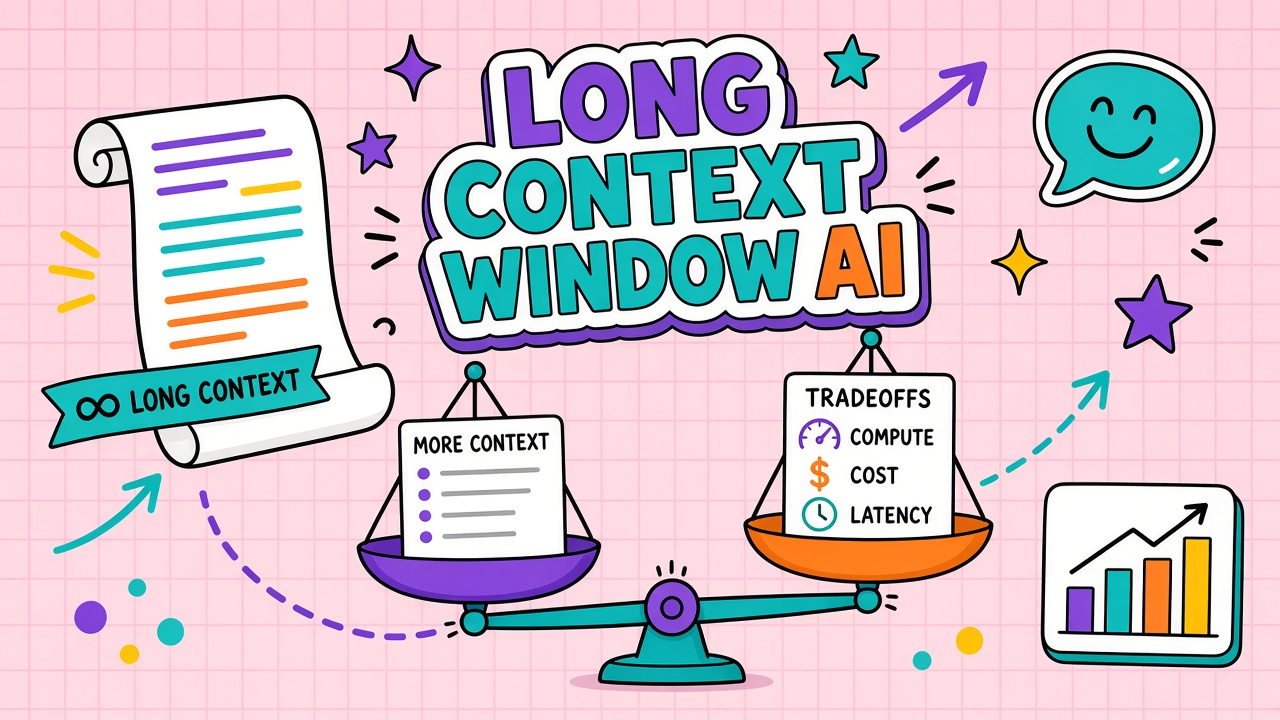
Long context windows in AI refer to models that accept far more tokens per request than the 4K to 32K limits common in 2023-era chatbots. Gemini, Claude, GPT-4 class models, and open-weight alternatives now advertise 128K, 200K, 1M, or larger windows. The capability gain is real: whole codebases, lengthy transcripts, and multi-document bundles can fit in a single pass. The tradeoffs are equally real: higher per-token cost, slower inference, uneven recall across token positions, and diminishing returns versus retrieval-augmented generation (RAG). This guide separates marketed context size from effective recall, maps which tasks benefit from long context, compares stuffing documents versus selective retrieval, and covers pricing and summarization pitfalls. Teams using AI marketing tools and AI code assistants should evaluate long-context tiers against real workloads, not headline specs alone.
Context Window vs Effective Recall: Size Is Not Comprehension
Context window size is the maximum tokens a model can process in one forward pass. Effective recall is how reliably the model uses information at arbitrary positions within that window. Research on long-context models documents a "lost in the middle" effect: facts placed in the center of very long prompts are retrieved less accurately than facts at the beginning or end, even when those facts are present in the input.
Advertised window size describes architectural capacity, not uniform attention quality. A 200K window does not mean the model weighs token 100,000 as strongly as token 500. Benchmarks from model providers and independent researchers show recall curves that flatten or dip in mid-context regions depending on model family and task type.
What affects effective recall
- Position of relevant text: Critical instructions and facts should sit near the start or end of long prompts.
- Task type: Needle-in-a-haystack retrieval tasks behave differently from holistic summarization.
- Distraction density: More irrelevant tokens compete for attention with the passages you care about.
- Model generation: Newer long-context architectures improve mid-window performance but do not eliminate tradeoffs.
Cost and Latency: How Long Context Scales
Long context requests cost more and often run slower than short ones. Transformer attention scales with sequence length; providers pass that compute cost through per-token pricing and queue latency. Some vendors charge premium rates above certain context thresholds even on the same model tier.
| Factor | Short context | Long context |
|---|---|---|
| Input token cost | Baseline per-token rate | Same or higher rate on more tokens; tiered pricing above thresholds |
| Time to first token | Lower on small prompts | Rises with prompt length; large uploads add preprocessing delay |
| Total job cost | Predictable for chat turns | One 500K-token call can exceed hundreds of short calls combined |
| Retry cost | Cheap to resend | Resubmitting full context on failure is expensive |
Batch and async APIs reduce perceived latency but do not reduce token charges. Budget long-context workflows with per-job cost caps and logging. A marketing team running AI marketing analysis over full campaign exports should model monthly spend at peak document sizes, not average chat length.
Tasks That Benefit From Long Context (and Tasks That Do Not)
Long context wins when the task requires reasoning over relationships spread across a contiguous body of text that retrieval might fragment. Long context loses when the task is a pinpoint lookup over a huge corpus or when selective evidence is enough.
Strong fits
- Whole-file code review: Understanding imports, types, and call graphs across a single large module.
- Contract cross-reference: Comparing clauses within one agreement where section order matters.
- Meeting transcript synthesis: Narrative summary of a multi-hour call when speaker threads interleave.
- Long creative continuity: Maintaining plot or character details across a full manuscript draft in one session.
Weak fits
- Enterprise search over millions of pages: Selective retrieval beats stuffing everything.
- Exact fact lookup: "What is error code X?" needs one paragraph, not the entire knowledge base.
- High-frequency chat: Resending 100K tokens of history every turn wastes budget; summarize or retrieve instead.
- Real-time UI: Users expect sub-second replies; million-token prompts rarely meet that bar.
RAG vs Stuffing Documents Into Context
Two architectures solve "the model needs more knowledge than fits in training." RAG retrieves relevant chunks at query time. Document stuffing places entire files or corpora directly in the prompt. Long context windows make stuffing feasible for larger bundles, but RAG often remains cheaper and more focused.
| Approach | Best when | Limitation |
|---|---|---|
| Full context stuffing | Corpus fits in window; cross-document reasoning is essential | Cost scales with total tokens every request; mid-context recall gaps |
| RAG retrieval | Corpus is large, dynamic, or permission-scoped per user | Retrieval misses break answers; chunk boundaries split tables and code |
| Hybrid | Retrieve candidates, then reason over a medium-sized merged context | More engineering complexity; two failure modes to monitor |
An AI code assistant analyzing a single repository file benefits from long context. An assistant searching across fifty microservices benefits from RAG plus targeted file reads. Match architecture to corpus size and query pattern, not to the largest window on the pricing page.
How to Choose a Context Tier When Comparing Tools
Product comparison pages list maximum context as a feature bullet. Evaluation should go deeper. Ask whether the tool resends full history on every turn, how PDFs and images convert to tokens, and whether a cheaper default model shares the same window as the premium tier. Some products gate long context behind enterprise plans while advertising the capability in general marketing.
Run a simple recall test before purchase: place a unique sentence in the middle of a long document, ask a question that requires that sentence, and repeat with the sentence at the start and end. Compare pass rates across tools and model tiers. This test takes an hour and prevents months of frustration on production workflows.
Summarization, Compression, and Context Management
Teams stretch budgets by compressing history: summarizing old turns, extracting key facts into a compact block, or sliding windows that drop middle messages. These techniques trade perfect recall for sustainable cost. Summarization introduces its own error mode: compressed summaries omit details the model needs later.
Practical pattern for long threads: keep verbatim recent messages, summarize everything older into a structured bullet block at the top, and restate non-negotiable constraints in the latest user message. For document workflows, pre-summarize sections independently, then run a final synthesis call over section summaries rather than raw text. Quality depends on whether the task tolerates lossy compression.
Long Context in Multi-Agent and Tool-Use Workflows
Agent systems accumulate tool outputs, sub-agent transcripts, and retrieved documents in a single thread. Context fills faster than users expect because JSON tool results are verbose. Long context windows help agents hold more history, but cost rises with every tool call appended. Prefer summarizing completed sub-tasks into compact state objects instead of keeping full raw traces in context unless debugging requires verbatim logs.
When comparing AI code assistants with agent modes, check whether the product summarizes file reads or loads entire repositories into context each session. Repository-aware agents that fetch files on demand often outperform brute-force context stuffing on large monorepos.
Frequently Asked Questions
What is the lost-in-the-middle problem?
Lost in the middle describes reduced model accuracy when relevant information sits in the central portion of a very long prompt. The model may answer correctly when the fact is near the start or end but fail when the same fact moves to the middle. Mitigate by repositioning critical content, using retrieval to shrink context, or splitting analysis into smaller chunks with a final merge step.
How does long-context pricing work?
Most providers charge per input and output token with standard rates up to a context limit. Some models add surcharges for prompts above 128K or similar breakpoints. Image and PDF uploads may convert to large text representations that consume context quickly. Check current price cards for your exact model ID; long-context tiers are not always the same product as the default chat model name.
Should I summarize or use full context?
Summarize when you need ongoing chat continuity or recurring analysis over documents that exceed budget. Use full context when fidelity to exact wording matters (legal, compliance, precise code diffs) and the document fits comfortably in window with room for the answer. Test both approaches on your eval set; summarization errors are often silent until a critical detail disappears.
Are million-token windows production-ready?
They are production-capable for defined workflows with cost controls and quality checks. They are not a universal upgrade for every chat product. Validate recall on your document types and lengths before migrating customer-facing features. Many teams use long context selectively for batch jobs while keeping interactive chat on shorter windows.
Do code assistants need the longest context window?
Not always. Single-file or single-PR review fits in moderate windows. Whole-repo refactors may need long context or agentic file browsing. Compare tools on whether they retrieve files dynamically versus uploading the entire repo each request. Dynamic retrieval often beats brute-force context on large codebases.
Using Long Context Deliberately
Long context windows unlock workflows that were impractical on 8K limits, but effective recall, cost, and latency do not scale linearly with advertised token capacity. Prefer RAG or hybrid retrieval when corpora are huge or frequently updated. Reserve full-context stuffing for tasks that need holistic reasoning over bounded, contiguous text. Test on your longest real inputs, log token spend per job, and place critical facts away from the middle of massive prompts. Browse AI marketing and AI code assistant tools on EliteAI.tools with context limits and pricing tiers side by side.