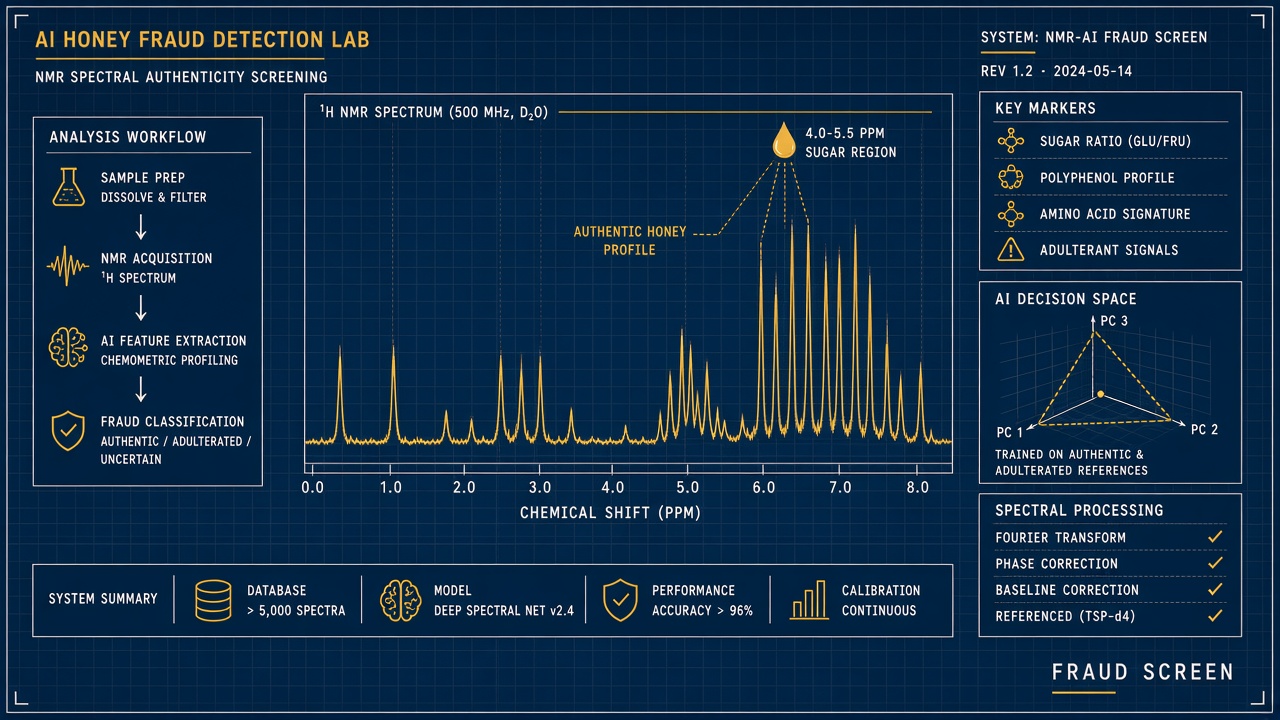
AI honey fraud detection applies supervised machine learning to nuclear magnetic resonance (NMR) spectra and stable-isotope profiles to flag adulteration with rice syrup, corn syrup, and beet invert sugar that evade conventional C4 sugar tests, protecting premium labels and import contracts. Laboratories combine Bruker FoodScreener NMR databases, time-domain NMR chemometrics, and logistic regression or gradient-boosting classifiers to identify adulterant type and concentration in hours rather than expert-by-expert spectral review. ML does not replace accredited lab chains or legal defensibility, but it scales screening when importers test hundreds of containers per season. Quality teams following AI research on spectroscopic ML or building AI research infrastructure for food authenticity should map which methods their target markets legally accept.
How Honey Adulteration Happens
Fraudsters dilute genuine honey with cheap plant syrups to increase volume while preserving apparent sweetness and viscosity, targeting export lots where per-kilogram prices exceed syrup costs by five to twenty times. Rice syrup, high-fructose corn syrup (HFCS), cane invert sugar, and beet syrups dominate intentional adulteration. Ultrafiltration and flavor masking further hide origin. Organized fraud follows analytical gaps: when regulators test only C4 plant sugars via stable isotope ratio mass spectrometry (IRMS), adulterators shift to C3-derived rice and beet syrups whose carbon isotope signatures overlap authentic honey from many floral sources.
U.S. FDA import sampling programs historically relied heavily on C4/IRMS screens. Industry guides note that violation rates under C4-only testing understate true adulteration because C3 syrups pass undetected. Premium retailers and Manuka certification schemes therefore require broader panels including NMR, pollen analysis, and trace marker tests.
C4 IRMS vs NMR Fingerprinting
C4 IRMS compares delta-13C of honey sugars versus protein fractions to detect corn and cane adulteration but remains blind to rice and beet syrups from C3 photosynthesis pathways. NMR profiling captures hundreds of signals from sugars, organic acids, amino acids, and fermentation markers in one acquisition. Authentic honey spectra match reference database entries; adulterated samples deviate in predictable subspaces even when the adulterant was unknown at method design time. Bruker FoodScreener platforms automate acquisition with minimal operator training, though instrument capital and growing reference libraries favor central lab hubs over every packing shed.
| Method | Detects well | Blind spots |
|---|---|---|
| C4 IRMS | HFCS, cane sugar | Rice, beet, inulin syrups |
| High-field 1H NMR | Broad adulterant screening | Database coverage, cost |
| TD-NMR + chemometrics | Rapid lot screening | Lower resolution than HF-NMR |
| LC-HRMS markers | Novel syrup markers | Per-marker method development |
Machine Learning on NMR Spectra
Supervised classifiers trained on labeled authentic and spiked honey spectra automate adulterant identification, accelerating throughput for non-NMR-specialist food chemists. A peer-reviewed study on Indian rapeseed honey adulterated with brown rice syrup, corn syrup, and jaggery syrup applied logistic regression, deep neural networks, and light gradient boosting machines (LGBM) to NMR feature vectors, discriminating syrup type at varying concentrations. Hierarchical TD-NMR workflows use DD-SIMCA one-class models for purity screening (100 percent specificity in reported adulterant detection), PLS-DA for adulterant class assignment above 97 percent accuracy, and PLS regression for quantification with RMSEV below 0.5 percent weight-for-weight.
Model governance requires representative authentic baselines across floral origins, harvest years, and storage conditions. Honey from acacia, clover, and heather occupy different spectral manifolds; importers should stratify training libraries by expected sourcing region or risk false flags on atypical but genuine lots. Regular retraining incorporates newly discovered syrup formulations as fraudsters adapt.
Stable Isotopes and Multi-Method Panels
Stable isotope ratio analysis (SIRA) of carbon, hydrogen, and oxygen complements NMR when laboratories need orthogonal evidence for litigation or customs appeals. Elemental analyzers coupled to isotope ratio mass spectrometers detect bulk sugar additions inconsistent with declared botanical origin. Nuclear magnetic resonance remains the workhorse for simultaneous untargeted screening; isotopes resolve disputes when NMR libraries lack a rare monofloral reference. Premium importers increasingly specify multi-method panels in purchase contracts, rejecting lots that fail any single tier.
Importer Lab Workflow
Typical importer workflows sample containers at port or bonded warehouse, chain-of-custody ship aliquots to ISO 17025 labs, run NMR plus confirmatory tests on fails, and quarantine lots pending results within 2 to 5 business days. High-throughput labs batch dozens of samples per FoodScreener autosampler run, pushing spectral matrices into ML pipelines that flag outliers for senior chemist review. Positive findings trigger retention of counter-samples, supplier notification, and potential customs detention under food fraud statutes. Negative results release lots to labeling and retail, though spot-check audits continue through the sales season.
Blockchain and ERP integrations hash lab certificates to lot IDs for retailer audits. AI classification confidence scores should accompany human sign-off in regulated markets; fully autonomous rejection without expert review invites legal challenge when borderline spectra fall outside training diversity.
Protecting Premium Labels and Manuka
Geographical indication and medical-grade honey labels (Manuka UMF, PDO European honeys) justify premium pricing and attract targeted fraud, making NMR-plus-ML screening economically rational even at dollars per kilogram test cost. New Zealand Manuka schemes combine marker compounds (methylglyoxal, leptosperin) with pollen and NMR profiling. European PDO enforcement relies on national reference collections. Retailers marketing "raw" or "single-origin" SKUs should contractually require adulteration panels beyond minimum regulatory screens, publishing transparency reports when supply chains pass aggregated testing.
Smaller beekeeper cooperatives benefit from pooled testing programs that amortize NMR slot time across member drums, using ML triage to test only suspicious spectral neighbors rather than every barrel at full confirmatory depth.
Case Study: Spiked vs Authentic Spectra
Laboratory spiking studies adulterate known authentic honeys with brown rice syrup, corn syrup, and jaggery at graded concentrations, then train classifiers to recover adulterant identity even when visual and taste panels cannot. Published NMR plus ML work on Indian rapeseed honey demonstrates that logistic regression, deep neural networks, and light gradient boosting machines all separate syrup types at concentrations relevant to commercial fraud, not merely extreme dilutions used for method validation. Importers replicate similar studies with their dominant sourcing origins so models recognize floral baselines they actually purchase.
Blind proficiency samples from international ring tests expose when libraries lack African or South American monofloral references. Labs should budget annual library expansion and retest borderline spectra after each harvest season when new syrup formulations appear in trade intelligence reports.
Limitations and Regulatory Acceptance
NMR ML methods depend on growing authentic reference databases, skilled maintenance of magnets and probes, and jurisdictional acceptance that varies: some customs agencies still recognize C4 IRMS alone. Novel syrups engineered to mimic NMR profiles may temporarily evade classifiers until libraries update. Labs should participate in proficiency testing rings and share anonymized fraud spectra through industry consortia. TD-NMR offers lower-cost entry for internal QC at packers but may not satisfy import authority methods validation without correlation studies against high-field reference data.
Retailer and Private-Label Programs
Grocery chains marketing premium honey SKUs contractually require adulteration panels exceeding minimum import law, using NMR ML triage to test every lot or risk-based sampling of high-margin lines. Failed lots trigger supplier corrective action plans, retroactive invoice adjustments, and delisting until independent lab clearance. Private-label buyers store spectral fingerprints of approved suppliers so sudden spectral drift flags upstream blending changes before consumer complaints arrive. Retail analytics correlate return rates and review sentiment with batch test IDs when quality incidents occur. Importers negotiating long-term supply agreements increasingly cap adulteration test failure rates in contracts, with automatic price penalties when ML-screened NMR outliers exceed agreed syrup-equivalent thresholds.
Geographical Origin and Floral Typing
NMR libraries simultaneously support adulteration screening and floral-origin classification when reference spectra exist for declared monofloral types such as Manuka, acacia, or heather. Origin mislabeling is a distinct fraud mode from syrup dilution: ML models trained only on adulterant detection may miss honey blended across regions while still passing purity screens. Importers should specify whether contracts require origin verification, adulteration panels, or both.
Lab Automation and Throughput
High-volume import labs batch dozens of honey aliquots per autosampler run, pushing spectral matrices into ML queues that flag outliers for senior chemist review within minutes of acquisition. Robotics and laboratory information management system hooks reduce hand-transcription errors when certificates must match customs entry numbers. Labs should maintain golden authentic reference sets refreshed each harvest season so classifiers do not drift when floral sources shift globally. Parallel C4 IRMS screens remain useful as a fast first pass even when NMR ML is the authoritative panel for rice syrup detection.
Frequently Asked Questions
Can AI detect rice syrup in honey?
Yes when trained on NMR or multi-method data. C4 IRMS alone often misses rice syrup. NMR plus supervised ML classifiers identify brown rice syrup adulteration in published spiking studies at multiple concentration levels.
How long do lab results take?
NMR profiling typically returns in 2 to 5 days including queue time at accredited labs. High-field instruments with automated screening shorten acquisition; ML classification adds minutes after spectra upload.
Is NMR accepted by regulators?
Acceptance is growing but uneven. EU and several retailer-led schemes embrace NMR databases; some national customs still default to C4 IRMS. Importers should verify method lists for each destination market.
Which ML algorithms are used?
Logistic regression, deep neural networks, light gradient boosting, PLS-DA, and one-class SIMCA variants appear in peer-reviewed honey authentication work. Choice depends on sample size and whether the task is classification, quantification, or anomaly detection.
Can small producers afford testing?
Cooperative pooling and TD-NMR screening lower per-unit cost. Premium label programs may subsidize testing for certified members. Budget generic honey SKUs rarely justify full NMR panels unless retailer contracts require them.
Where should I follow food fraud ML?
Journals include Food Chemistry and Journal of Food Science and Technology. For spectroscopic ML methods, browse AI research on chemometrics and anomaly detection in regulated industries.