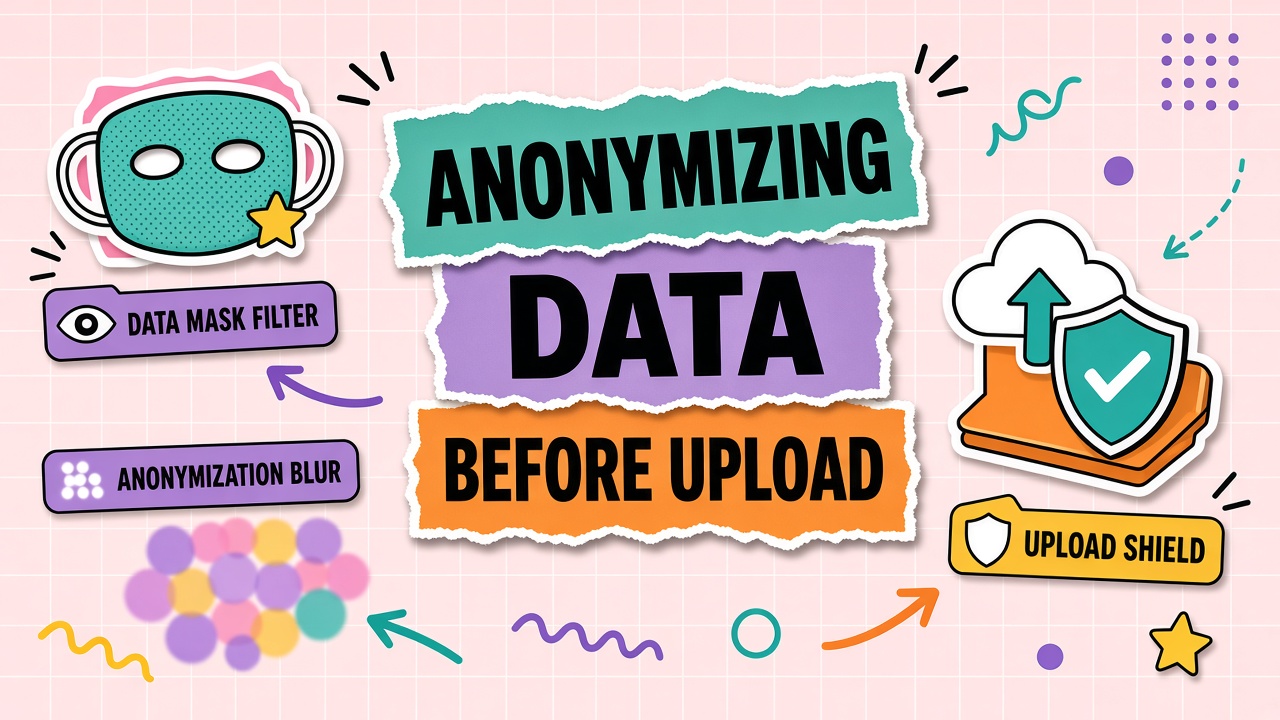
An analyst pastes a customer spreadsheet into a chat assistant to "clean it up." Names and emails are still in column B. The vendor's enterprise tier promises encryption, but the data already left your controlled environment. Anonymize data for AI tools before upload or paste when full DPA coverage is missing or when policy limits raw personal data in model context.
This guide covers identifier types, manual vs automated redaction, residual risk, and audit documentation for teams using private AI chatbots and automation platforms on sensitive drafts.
Define roles: who may classify residual risk, who approves upload after treatment, who audits technique application quarterly. Separation of duties prevents analysts from self-certifying risky uploads they created.
Free-text fields dominate re-identification risk: email signatures, meeting notes, legal citations with party names. Scanners tuned for structured PII miss prose; combine automated scan with spot human review on random rows from large exports.
Document when anonymization is insufficient and upload must not occur. Some datasets remain personal data regardless of masking; steering should pre-approve tier exceptions rather than leaving analysts to guess under deadline pressure.
Direct vs Indirect Identifiers
Direct identifiers single out a person: legal name, email, phone, government ID, device ID tied to an account. Indirect identifiers combine to re-identify: job title plus company plus city plus rare medical condition. AI models can infer links across quasi-identifiers in unstructured text.
- Direct: Remove or replace with tokens before upload
- Indirect: Generalize (age bands), aggregate (team-level stats), or suppress rare values
- Contextual: "Our largest client in Omaha" may identify one account; rewrite to generic scenarios
Images and PDFs carry hidden metadata (author field, EXIF GPS). Strip metadata before feeding private AI chatbot tools that extract text or describe visuals.
Manual Redaction vs Automated Tools
Manual redaction works for one-off documents: search for @, phone patterns, account numbers, replace with placeholders like [CUSTOMER_A]. Error-prone at scale but good for legal review of high-stakes files.
Automated tools apply NER (named entity recognition), regex libraries, and DLP scanners before data reaches the model. Integrate DLP at browser, proxy, or API gateway for automation platform. Validate detectors on your domain jargon; false negatives leak, false positives frustrate users.
| Technique | Best for | Limitation |
|---|---|---|
| Manual redaction | Single contracts, executive communications | Human miss rate, not scalable |
| Tokenization / pseudonymization | Reversible workflows needing join-back keys | Key storage becomes sensitive asset |
| Aggregation | Analytics questions on cohorts | Small sample sizes re-identify individuals |
| Synthetic data | Demos, training, prompt engineering | May not reflect real edge cases |
Residual Re-Identification Risk
Anonymization is a spectrum, not a binary. GDPR treats truly anonymous data as outside scope; pseudonymous data remains personal data. Large language models may reconstruct identity from writing style, rare event sequences, or cross-session context if users paste related documents over time.
Mitigations: k-anonymity checks on tabular exports, minimum cell size rules, ban uploads of full customer lists, use on-prem or VPC deployments for identifiable workloads instead of public chat tiers.
Documentation for Auditors
Auditors ask what controls prevent PII in AI tools. Maintain:
- Written standard operating procedure for anonymization before upload
- Tooling inventory (DLP, redaction scripts) and coverage map
- Sample logs of blocked uploads or redaction counts (no raw PII in logs)
- Training attestation for employees with access to sensitive data
- Exception register when full data was approved with legal sign-off
Pre-Upload Review Workflow
Define a four-eye review for high-sensitivity uploads even after automated scanning. Analyst runs DLP, second reviewer confirms residual risk tier before paste to approved tools. High-volume pipelines log scan results and reviewer IDs for auditor sampling.
Vendor-Side Residual Risk After Anonymization
Vendors may still log prompts, compute embeddings, or run safety classifiers on uploaded content. Anonymization reduces subject harm but may not remove processor obligations if content remains personal or pseudonymous. Pair techniques with DPAs and access tiers appropriate to the residual classification.
Role-Based Redaction Workflows
Analysts may see full data in the warehouse but only redacted excerpts should reach AI tools. Implement role-based export profiles: support tier one gets ticket summary without payment details, tier two gets more fields with justification logging.
Design teams using private AI chatbot tools should default to placeholder copy in mockups until legal approves real customer quotes for campaigns.
Testing redaction quality
Quarterly red-team: inject known fake PII into documents and verify DLP catches before upload. Measure false positive rate; tune rules so employees do not bypass DLP out of frustration.
Writing assistant guardrails
Browser extensions for AI writing should warn when clipboard content matches SSN or credit card patterns. Warnings alone are insufficient for classified data; block upload entirely.
Tooling Pipeline for Anonymization
Build repeatable pipelines: ingest, classify, transform, verify, approve, upload. Ad hoc spreadsheet edits do not scale and fail reproducibility tests auditors run. Pipeline logs include input hash, rule version, approver, and output classification.
Block direct browser upload to vendor web UIs when pipelines exist. Browser paths bypass DLP and anonymization controls teams invested in building. Network controls and SSO app restrictions steer users through approved paths only.
Working With Legal on Residual Risk
Legal should sign residual risk classification when uploads may still contain personal data after treatment. Analyst classification alone is insufficient for regulated tiers. Sign-off records include technique applied and intended tool tier.
When legal rejects upload despite analyst redaction, document rejection reason in training materials so teams learn boundary cases without repeating rejected patterns.
Frequently Asked Questions
Are aggregates always safe?
No. "One customer represents 80% of revenue" identifies them. Apply minimum group sizes and suppress outliers in reports sent to AI.
Does synthetic data eliminate risk?
Synthetic datasets reduce direct leakage but may still resemble real individuals if generated from too small a seed set. Document generation method and limitations.
What about code snippets with API keys?
Treat secrets like PII. Use secret scanners; never paste production credentials. Rotate keys if accidental upload occurs.
If the vendor is SOC 2 certified, do we still anonymize?
Certification does not remove purpose limitation or contract scope. Anonymization reduces impact if vendor breach or misconfiguration occurs.
Can we re-identify after AI output?
If you used reversible tokens, map outputs back only in secure systems with access controls. Destroy mapping tables when project ends.
Classification After Treatment
After anonymization or pseudonymization, record the residual classification in the data catalog. Teams mistakenly treat pseudonymized exports as "safe to paste anywhere" and upload them to vendors without DPAs. Classification drives tool tier selection and contract requirements.
Re-identification risk reviews should repeat when auxiliary public datasets change. A dataset safe last year may become linkable after a breach dumps related attributes. Schedule annual re-review for standing analytics sets.
Automation jobs that transform data before automation platform upload should version transformation rules like code. Silent rule changes alter risk tier without reviewers noticing.
Metrics for Anonymization Quality
Track false negative and false positive rates for automated PII detection on representative samples. High false negatives mean data leaks; high false positives mean analysts bypass scanners from fatigue. Tune rules quarterly with labeled evaluation sets.
Report metrics to steering so investment in tooling competes fairly against headcount for manual redaction. Metrics also justify blocking upload paths when scanners underperform.
Team Training on Anonymization
Annual security training should include a five-minute module on paste behavior with before/after examples. Show how easy re-identification is from three quasi-identifiers. Quiz on which tier of data requires enterprise VPC tools only.
Managers reinforce in 1:1s when DLP alerts fire. Repeated bypass attempts trigger coaching, not only technical blocks, because frustrated employees find new shadow paths.
When vendors offer on-upload redaction
Some enterprise AI platforms advertise automatic PII scrubbing on ingest. Validate with your own test payloads before relying on vendor claims. Run parallel manual review on a sample until false negative rate is acceptable for your data classes. Contract should state redaction scope and what happens when scrubbing fails (block vs warn).
Synthetic Data Alternative
When anonymization cannot reduce risk sufficiently, pivot to synthetic or public datasets for experimentation. Steering approval for real data upload should require documented why synthetic alternative failed feasibility review.
Synthetic datasets need their own quality checks so experiments remain representative enough to inform production decisions.
Train teams on difference between anonymization, pseudonymization, and redaction using firm examples. Vocabulary confusion leads to overconfidence in uploads that remain personal data under applicable law.
Steering should approve maximum data tiers per tool with anonymization requirements spelled out. Tier three uploads may be prohibited regardless of redaction when residual re-identification risk stays high.
Include anonymization requirements in acceptable use policy with examples of prohibited uploads. Policy without examples leaves teams guessing what "anonymized enough" means under deadline pressure.
Red team anonymized datasets periodically with linkage techniques your threat model assumes. Paper policies fail when re-identification succeeds on samples thought safe after treatment.
DLP alerts on paste to unapproved domains should include a link to the approved upload pipeline, not only block messages. Friction without alternatives drives shadow paths around controls.
Store before and after samples of anonymized datasets in secure archives auditors can sample. Samples prove technique consistency better than narrative claims alone.
Review anonymization rules when regulators publish new guidance on pseudonymization and re-identification thresholds.
Anonymize Early, Document Always
Anonymizing data before AI upload is a practical layer for writing and design workflows when policies restrict raw personal data in model context. Combine techniques to your risk level, assume residual re-identification is possible, and keep audit-ready documentation. When anonymization is not feasible, upgrade to enterprise hosting with DPAs instead of public paste bins.