Annual "AI transformation" projects stall while models, prompts, and vendor features change every quarter. Teams that wait for a big bang rollout wake up with outdated playbooks and frustrated practitioners who already found workarounds.
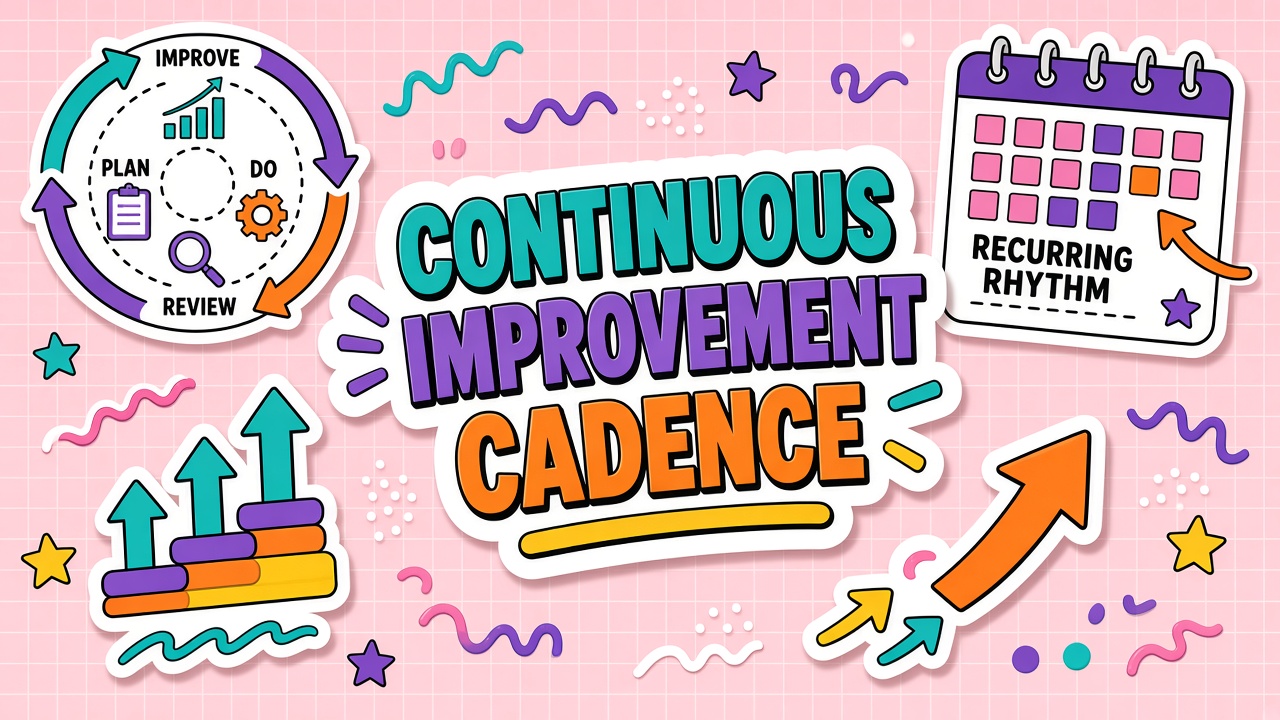
A continuous improvement cadence for AI-assisted workflows applies kaizen-style monthly cycles: collect feedback and evals, prioritize by impact, run small experiments with rollback, and share wins internally. This guide covers sourcing improvements from incidents and metrics, backlog format, and participation norms for teams using AI automation and AI chatbots in daily work.
Distinguish improvement debt from feature requests. Debt items restore baseline quality (fix regression, restore eval pass rate). Feature requests expand scope and belong in product roadmap, not the monthly kaizen queue. Mixing both inflates backlog and starves debt paydown.
Assign each backlog item a measurable success criterion before work starts. "Improve chatbot" fails; "reduce wrong-policy escalations from 4% to under 1% in tier-1 refunds" succeeds. Criteria map to automation metrics leaders already track.
Sources: Feedback, Evals, and Incidents
Improvement ideas should flow from observable signals, not only brainstorming sessions. Combine qualitative feedback from practitioners with quantitative eval scores and incident postmortems.
- User feedback: Short forms after workflow completion, office hours notes, support tickets tagged AI
- Eval runs: Scheduled prompt or output tests against golden datasets; track pass rate trends
- Incidents: Wrong answers sent to customers, policy violations, cost spikes, integration failures
- Vendor changelogs: Model updates that shift tone, latency, or tool-calling behavior
Centralize inputs in one backlog tool with fields for workflow name, data tier, owner, and severity. Without a single queue, the same prompt failure gets fixed three times in three departments.
Tag feedback items with workflow ID and tool version. When a vendor updates models, you need to filter backlog items that may already be resolved versus those that regressed. Without version tags, teams chase ghosts from last month's prompt library.
Incidents should link to eval gaps. If a wrong refund policy reached customers, add eval cases that would have caught the phrasing before the next chatbot release. Continuous improvement without eval updates repeats the same failure mode with new vocabulary.
Prioritize by Impact and Effort
Score each item on customer or employee impact (high, medium, low) and implementation effort (hours, days, weeks). Ship one to three small wins per month plus at most one larger experiment in flight.
| Priority | Example | Typical effort |
|---|---|---|
| Do first | Fix chatbot giving wrong refund policy after vendor update | Hours (prompt plus KB sync) |
| Schedule | Add eval set for new language in support replies | Days |
| Defer | Replace entire RAG stack for marginal retrieval gain | Weeks (needs pilot) |
Review the backlog in a monthly 45-minute ritual with workflow champions and the program admin. Escalate items that cross data boundaries or vendor contracts to the steering committee instead of patching locally.
Cap work in progress. Teams that start ten prompt experiments finish none. A visible WIP limit on the backlog board forces finish-or-drop decisions. Defer items with documented rationale so contributors see their idea was not ignored, only scheduled.
Small Experiments With Rollback
Treat each change as an experiment with a hypothesis, success metric, and rollback plan. Examples: A/B two prompt variants on internal-only traffic, add a human review gate for one queue, or swap models for a non-production sandbox workflow.
- Document baseline metric (accuracy proxy, handle time, escalation rate)
- Limit blast radius (one team, one language, one integration)
- Run for a fixed window (often two to four weeks)
- Compare to baseline; promote, iterate, or revert
- Archive prompt versions in version control, not chat history
Automation workflows need explicit kill switches when experiments touch live customer data. Prefer shadow mode or duplicate queues first.
Document rollback steps in the same ticket as the experiment. "Revert prompt v3 to v2 in repo tag X" beats panic-searching Slack during an incident. For automation workflows, keep a manual fallback runbook visible to operators when experiments fail open.
Share Wins in Internal Channels
Close the loop by publishing what changed and why. A short internal newsletter section or Slack digest builds trust that feedback matters. Include before and after metrics where available, link updated runbooks, and credit contributors.
Pair technical wins with policy reminders so teams do not interpret "we fixed the bot" as permission to upload restricted data. Reference approved tools from your chatbot catalog rather than naming shadow apps.
Improvement Backlog Format
Each backlog item should contain: title, workflow ID, source (feedback, eval, incident), impact score, effort estimate, owner, status, and links to prompts or tickets. Tag items by regulation tier so legal can filter high-risk experiments.
Retrospectives quarterly ask whether the cadence itself needs tuning: Are meetings too long? Is eval debt growing? Adjust meeting length or add async updates before adding more process.
Cadence Roles and Accountability
Name a cadence owner (often program admin) responsible for agenda, backlog hygiene, and publishing experiment results. Workflow champions own department-specific items but do not unilaterally change production prompts without recording version and rollback. Security reviews items that change data handling before promotion.
Monthly rhythm example: week one collect feedback and eval deltas; week two prioritize and assign; weeks three and four run experiments; last business day publish summary. Quarterly retrospectives ask whether the monthly meeting still fits or should split into async backlog grooming plus shorter live decision sessions.
Measuring Improvement Program Health
Track leading indicators: backlog age, experiment completion rate, eval pass rate trend, incident recurrence on same root cause. Lagging indicators include customer escalation rate and cost per successful workflow. A healthy program closes more items than it adds most months while eval coverage expands.
Compare teams using AI automation versus chatbots separately; blended metrics hide where improvement stalled. Share dashboards in steering committee packets so leaders see continuous improvement as operational discipline, not optional innovation theater.
Async contribution channels matter for distributed teams. A Slack form or portal field that captures workflow ID, screenshot, and severity beats long email threads. Program admin triages async items before the monthly meeting so live time focuses on decisions, not first reads.
Tie improvement themes to steering committee priorities: cost per transaction, quality incidents, and regulatory changes. When the committee sets a quarterly goal on eval coverage, the improvement backlog should visibly align so teams see governance and kaizen as one program.
Onboarding New Workflows Into the Cadence
Every new approved workflow enters the cadence with baseline metrics captured in week one. Without baselines, later wins are anecdotal. Assign a champion owner at launch and schedule the first eval regression one week after vendor model updates.
Sunset workflows explicitly when replaced. Orphan automations without owners accumulate silent drift until an incident exposes outdated prompts still running in production.
Annual Cadence Retrospective
Once per year, review whether monthly meetings still fit vendor velocity and team size. Fast-growing support teams may need biweekly eval reviews during peak season; stable internal workflows may shift to async backlog grooming with monthly decisions only. Change the cadence deliberately with steering approval, not by skipping meetings informally.
Archive closed backlog items with links to prompt versions and metrics. New champions should read last year's archive before proposing duplicate experiments. Institutional memory prevents repeating the same failed prompt structure with new branding.
Publish experiment result summaries even when experiments fail. Failed experiments with documented rollback teach teams more than silent reverts that look like instability without explanation.
Frequently Asked Questions
How do we get broad team participation?
Make submission frictionless (single form, Slack command), recognize contributors in the newsletter, and show closed-loop fixes within 30 days when possible. Champions in each department should bring two items from their floor each month.
Should we gamify improvements?
Light recognition works; competitive leaderboards on "AI hours saved" often encourage risky shortcuts. Gamify quality improvements and documented experiments instead of raw volume.
What if we lack good metrics yet?
Start with incident count and qualitative severity. Add eval pass rates as golden tasks are defined. Imperfect metrics beat waiting for a perfect dashboard that never ships.
How do vendor model updates fit the cadence?
Treat major vendor releases as standing agenda items. Run regression evals within one week of upgrade, with rollback to prior model version if scores drop beyond tolerance.
Cross-Team Improvement Reviews
Invite one adjacent department quarterly to the improvement review. Support learns from marketing prompt patterns; engineering learns from support incident clusters. Cross-pollination prevents siloed fixes that break downstream workflows.
Document dependencies between workflows. A prompt change in chatbot routing may require matching updates in CRM field automation. Dependency maps belong in the backlog item, not tribal knowledge.
Celebrate disciplined rollbacks as wins. Teams that revert quickly without blame build trust to experiment again. Hide failures and the cadence collapses into safe but stagnant prompts nobody dares change.
Handoff From Improvement to Standard Ops
When an experiment promotes to standard operation, transfer ownership from improvement backlog to workflow runbooks explicitly. Prompt versions move from experiment branches to production tags; on-call inherits monitoring thresholds tested during experiment. Without handoff, champions remain permanent firefighters while official runbooks stay stale.
Standard ops teams should attend one improvement review per quarter to absorb context. Siloed improvement programs lose alignment when champions rotate or leave. Documented handoffs preserve eval cases and rollback paths operations can execute without original experimenters.
Improve Monthly, Not Once a Year
Continuous improvement keeps AI workflows aligned with reality as tools change. Feed the backlog from feedback, evals, and incidents; prioritize ruthlessly; experiment small with rollback; and broadcast wins so adoption compounds. Teams running automation and chatbots should calendar the monthly ritual before the next vendor release breaks yesterday's prompts.