Vendor sales decks love big-bang imagery: every seat on day one, a company-wide announcement, confetti in the Slack channel. Operations reality is messier. Integrations slip, skeptics never get office hours, and leadership discovers data boundaries after hundreds of accounts exist.
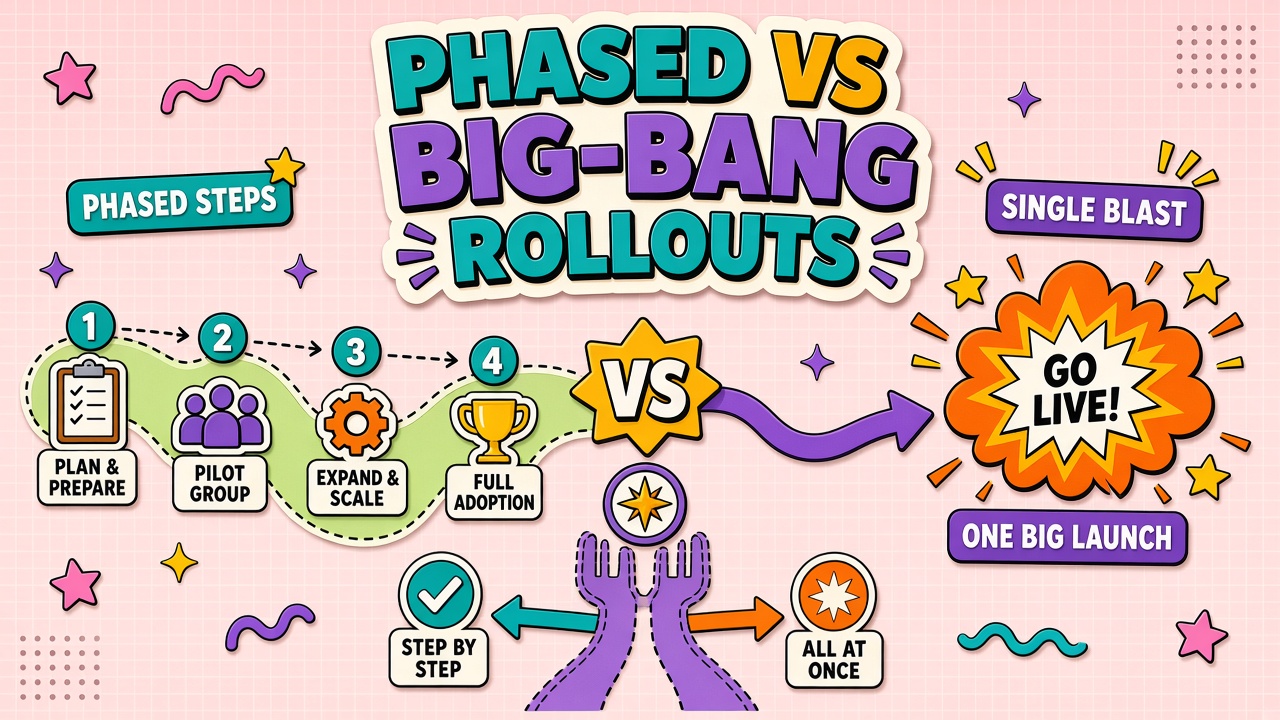
Choosing between a phased vs big-bang AI tool rollout depends on risk tier, team size, integration depth, and whether you can roll back without customer impact. This guide defines pilot, phased, and big-bang patterns, gives a decision tree by risk, and compares communication plans. Evaluate tools in AI chatbot tools and AI productivity tools after you pick a rollout strategy, not before.
Definitions: Pilot, Phased, Big-Bang
Shared vocabulary prevents arguments where both sides agree but use different words. These definitions assume workflow-first adoption: one named job, metrics, and a decision memo at each gate.
- Pilot: Two to ten participants, one workflow, fixed end date, adopt or reject decision.
- Phased rollout: Sequential expansion by team, region, or workflow after pilot success.
- Big-bang rollout: Broad access on a single launch date, often org-wide or division-wide.
| Pattern | Typical duration | Best when |
|---|---|---|
| Pilot | Two to four weeks | Unknown fit, new vendor, medium or high risk data |
| Phased | One to three quarters | Multiple workflows or regions, learning between waves |
| Big-bang | Launch day plus thirty-day stabilization | Low risk, strong SSO, replacement not addition |
When Phased Rollouts Reduce Risk and Cost
Phased rollouts win when each wave teaches something that changes the next wave: prompt templates, checkpoint lists, integration fixes, or training gaps. You pay less for unused seats early and catch failure modes before they reach customers.
Phased fit signals
- Customer-visible outputs even with human review.
- Multiple departments with different data tiers.
- Heavy change management: new SOPs, not just new login.
- Integration work still in progress at pilot end.
- Prior shelfware from tool-first purchases.
Phased wave template
- Wave 0: Pilot on one workflow with decision memo.
- Wave 1: Same workflow, adjacent team; reuse docs unchanged if metrics hold.
- Wave 2: Second workflow with new pilot metrics.
- Wave 3: Regional or language expansion with localization checklist.
- Gate: Executive readout only after two green waves, not after wave 0 hype.
| Risk tier | Recommended rollout | Minimum gate |
|---|---|---|
| High | Pilot, then phased by workflow only | Security sign-off each wave |
| Medium | Pilot, then phased by team | Metrics green two consecutive months |
| Low | Pilot optional; phased or big-bang OK | Documented rollback and support plan |
When Big-Bang Rollouts Are Justified
Big-bang launches work when the tool replaces an existing approved path with similar risk, SSO and admin are ready on day one, and support can handle a predictable spike. Chat replacements for an internal help bot with only public docs may qualify. Customer support draft assist rarely qualifies without phased waves.
Big-bang prerequisites checklist
- SSO, SCIM, and admin logging verified in staging.
- SOP and training materials published for all roles receiving access.
- Baseline metrics captured for every in-scope workflow.
- Rollback plan: disable access, revert SOP, communicate in under four hours.
- Support channel staffed for two weeks post-launch.
- Parallel old path available for forty-eight hours if replacement fails.
Big-bang is not "skip the pilot." It is "pilot completed, expansion compressed." Teams browsing AI chatbot replacements should still run a pilot on representative queries before flipping every internal channel at once.
Communication Plan Differences
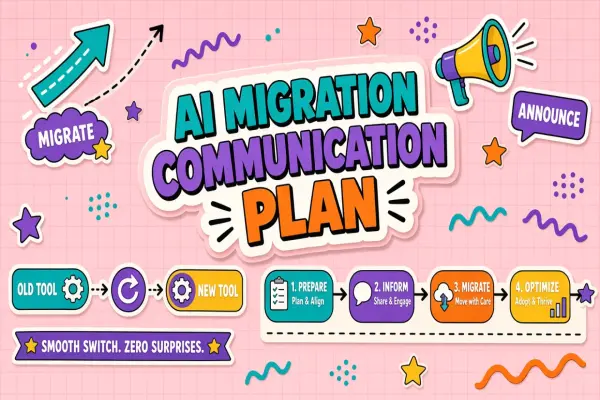
Phased rollouts communicate learning between waves. Big-bang communicates readiness and support paths on day one. Both need honest non-goals: which workflows are out of scope and which data types are prohibited.
| Element | Phased messaging | Big-bang messaging |
|---|---|---|
| Launch email | "You are in wave 2; here is what changed from wave 1" | "Access live today; start with workflow X only" |
| Training | Cohort sessions per wave | Self-serve plus live office hours week one |
| Metrics story | Share pilot memo highlights before expansion | Publish success metrics and review date day one |
| Failure communication | Pause next wave; fix root cause | Execute rollback plan; daily updates until stable |
Decision Tree: Choosing Your Strategy
Answer these questions in order. Stop at the first strong match. When two paths tie, default phased; big-bang carries higher rollback cost.
- Does output reach customers without review? Yes: phased minimum. No: continue.
- Is regulated or sensitive data in scope? Yes: pilot plus phased by workflow. No: continue.
- Is this replacing an approved tool one-to-one? Yes: big-bang possible after pilot. No: phased.
- Are integrations production-ready? No: phased until stable. Yes: continue.
- Is the org under fifty people with one workflow? Yes: pilot then big-bang OK. No: phased waves.
Phased vs Big-Bang Cost and Seat Planning
Seat math drives rollout mode as much as risk does. Phased rollouts let you align license count to measured penetration instead of guessing org-wide demand on day one.
| Planning question | Phased approach | Big-bang approach |
|---|---|---|
| Initial seats | Pilot cohort plus 10% buffer | All in-scope users on launch day |
| Renewal conversation | Expand after green metrics per wave | True-up at day thirty based on active workflow use |
| Shelfware risk | Lower early; visible per wave | Higher if training lags launch |
| Vendor discount pressure | May delay volume pricing until wave 2 | Easier to negotiate upfront volume |
Rollback, Parallel Tools, and Timing
Every rollout needs a rollback owner and a four-hour communication template. Parallel tools are acceptable during phased waves when migrating off shelfware; they are expensive during big-bang unless old path auto-expires. Avoid major launches during holiday freezes, fiscal close, or peak support seasons unless risk tier is low and rollback is tested.
Rollback checklist
- Disable SSO group or revoke API keys.
- Revert SOP links to manual or prior tool version.
- Notify affected teams with explicit "stop using" language.
- Archive prompts and export logs if policy requires.
- Schedule retrospective within five business days.
Productivity-wide platforms rolled out through AI productivity categories still need workflow-scoped rollback. Turning off one bad workflow should not require nuking unrelated teams.
Sample Ninety-Day Rollout Timeline
Use this phased timeline for a medium-risk workflow in a two-hundred-person division. Adjust wave size, not gates.
| Period | Activity | Gate |
|---|---|---|
| Days 1-14 | Pilot on one team; log tasks; mid-pilot sync | Decision memo: adopt, adjust, or reject |
| Days 15-45 | Wave 1: two adjacent teams; champion office hours | Penetration and quality stable vs pilot |
| Days 46-75 | Wave 2: second region; update SOP if inputs differ | Security spot-check on new data paths |
| Days 76-90 | Stabilization; monthly review cadence; seat true-up | Executive readout with outcome metrics |
Big-bang teams compress days 15-75 into a single launch only when pilot metrics, SSO, training, and rollback tests are complete. Never compress the pilot itself.
Frequently Asked Questions
Executives want big-bang for visibility. What do we do?
Offer a visible launch date for wave one with a published roadmap for later waves. Share pilot metrics in the executive readout. Visibility without evidence creates shelfware headlines, not sustainable adoption.
Can we run multiple pilots in parallel?
Yes with separate owners, metrics, and decision memos. Cap at two or three concurrent pilots in mid-size orgs so support and security can respond. Parallel pilots are not a big-bang rollout.
Phased feels too slow for competitive pressure. Options?
Compress wave size, not gates. Skip metrics and you compress failure into production. Accelerate by pre-building integrations and training during pilot week two, not by skipping pilot entirely.
Is launching before holidays ever OK?
Only for low-risk internal tools with minimal support burden and no customer path. Medium and high risk launches before holidays lack reviewers and escalate incidents slowly. Move to January or mid-quarter quiet windows.
How do we know we picked the right rollout mode?
Right mode means metrics green at each gate without emergency rollback. Wrong mode shows up as surprise data issues, unfollowed SOPs, or support queues that outlast week two. Retrospective compares predicted vs actual wave learning.
Stabilization Week Checklist (Post-Launch)
Whether phased or big-bang, the first seven days after each wave need the same stabilization discipline.
- Daily triage: Fifteen minutes on access, policy, and quality blockers with named owners.
- Usage vs penetration: Distinguish logins from completed workflow jobs.
- Support queue: Tag tickets by failure mode category for weekly pattern review.
- Executive update: Three bullets: green metrics, top blocker, next gate date.
- Rollback drill: Confirm disable path still works if vendor incident occurs.
Chat-heavy rollouts should monitor whether teams default to AI productivity shortcuts outside the approved workflow. Shadow use during stabilization predicts audit gaps before they scale.
Parallel Tool Sunset Rules
Running old and new tools in parallel is valid during phased migration. Set a sunset date on day one of each wave. Parallel paths without expiry become permanent duplicate spend and split metrics. Communicate sunset in the same message that grants new access.
Sunset criteria: new path meets penetration and quality gates for two consecutive review cycles, or old path fails security review and must close regardless of habit.
Document rollback owners in the same decision log as launch owners. Incidents happen on weekends; naming only weekday contacts turns stabilization into improvisation.
The Bottom Line
Default to pilot plus phased expansion for customer-facing, multi-team, or regulated workflows. Big-bang fits low-risk replacements with SSO ready, baselines captured, and rollback tested. Match communication to the mode: phased shares learning between waves; big-bang publishes support and metrics on day one. Pick strategy before shopping AI chatbot and productivity tools, then hold each gate to written metrics so speed never outruns safety.