Subcontractor project managers lose hours each week writing submittal cover letters, cross-referencing CSI specification sections, and drafting RFIs when drawings conflict with the project manual. Packages arrive late to the general contractor incomplete, review cycles stack up, and procurement slips on long-lead equipment.
An ai workflow construction submittals process parses spec section and drawing references, drafts transmittal cover letters with compliance statements, structures RFIs with question, impact, and proposed solution blocks, requires PM and engineer review before any external send, and logs every package in the project management system. AI accelerates document prep; licensed reviewers own what leaves your office. Compare drafting assistants via AI chatbot tools and AI translation options when spec language or manufacturer data arrives in multiple languages.
What Is a Construction Submittal AI Workflow?
A construction submittal AI workflow turns specification requirements and drawing references into draft transmittal cover letters and RFIs that PMs and engineers verify before routing to the general contractor. Submittals are product data, shop drawings, samples, and certifications sent for design-team review before fabrication or installation. RFIs resolve ambiguities in contract documents. AI connects both document types to the same spec context without skipping human review gates.
Industry practice follows Division 01 submittal procedures (often Section 01 33 00) plus Part 1 requirements in each technical specification section. Procore, Autodesk Construction Cloud, and similar platforms log review status, but someone still writes the cover letter prose and RFI questions. AI targets that drafting layer.
Parse Spec Section and Drawing References
The workflow starts by extracting submittal requirements from the spec book and linking each item to drawing sheet references, spec paragraphs, and responsible subcontractors. AI assists parsing; the PM confirms the submittal log matches the contract documents including active addenda.
- Read Division 01 for numbering format, review timelines, and required transmittal fields.
- Scan each technical section Part 1 for submittal types: product data, shop drawings, samples, test reports.
- Record CSI six-digit section, spec paragraph (e.g., 1.05.B.2), and submittal description verbatim.
- Link related drawing sheets from the architectural, structural, or MEP sets.
- Flag long-lead items and calculate submit-by dates from schedule float and review cycles.
- Note open RFIs or addendum items that block submittal preparation.
| Parsed field | Source document | AI assist role |
|---|---|---|
| Spec section | Project manual technical sections | Extract Part 1 submittal lists |
| Drawing reference | Sheet index and detail callouts | Cross-link spec items to sheets |
| Submittal type | Division 01 categories | Classify shop drawing vs product data |
| Addendum status | Latest addendum register | Flag superseded requirements |
Submittal Log Maintenance
The submittal log is the control document: every required item needs a responsible party, planned submit date, reviewer, status, and links to related RFIs or procurement activities. AI can populate draft log rows from spec parsing, but the PM validates against the construction schedule and long-lead flags before the log becomes the team source of truth.
Multilingual Manufacturer Data
When product data arrives in languages other than the project manual language, route excerpts through approved translation workflows before AI drafts compliance statements. AI translation tools can accelerate first-pass conversion, but engineers verify technical terms, ratings, and certifications against the English spec requirements before those statements appear on a transmittal cover letter.
Draft Cover Letter With Compliance Statements
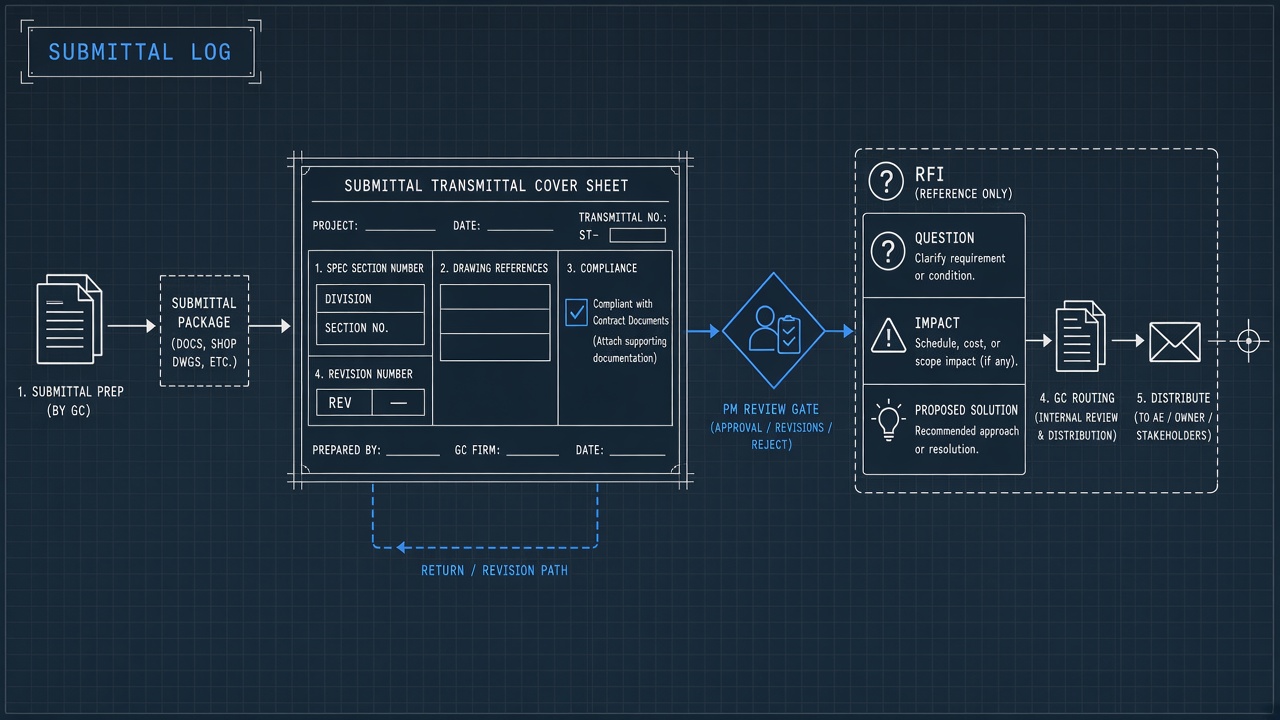
AI drafts the submittal transmittal cover letter with standardized compliance statements tied to the parsed spec section, submittal number, revision, and attached item list. The cover letter is a document-control record, not a substitute for design professional review. Draft language should mirror UFGS 01 33 00 style fields: project number, spec section, drawing references, submitter, requested action, and distribution list placeholders.
- Header block: project name, contract number, submittal ID, spec section title, revision.
- Submitted items table: description, manufacturer, quantity, intended location, attachment filenames.
- Compliance statement: cites spec paragraph and states conformity or documents requested deviation.
- Requested review action: approval, approval as noted, or information only per Division 01 codes.
- Certification line: submitter attestation that PM and engineer review completed internally.
Compliance statements must not claim approval that only the architect or engineer can grant. AI drafts should use conditional language: "Submitted for review per Section 01 33 00" rather than "Approved for installation." The PM edits tone to match your company's transmittal template.
Shop Drawings Versus Product Data
Shop drawing submittals need dimension and coordination language; product data submittals need performance spec cross-walks. AI prompts should branch by submittal type so a panelboard shop drawing cover letter references bus arrangement details while a valve product data letter cites pressure class and material statements from the manufacturer cut sheet.
RFI Structure: Question, Impact, Proposed Solution
When spec sections or drawings conflict, AI drafts RFIs using a three-part structure: clear question, schedule and cost impact, and proposed solution for design team consideration. RFIs are separate from submittal transmittals but often run concurrently on active jobs. Link each RFI to related submittal log rows.
- Question: State the conflict with spec section, drawing sheet, and detail reference.
- Impact: Describe procurement, installation, or inspection delay if unresolved by a date.
- Proposed solution: Offer a constructible option without assuming designer approval.
- Attach marked-up sketches or photos only after PM confirms they are current and legible.
- Route draft to project engineer before the GC receives the package.
| RFI section | Strong draft includes | Weak draft avoids |
|---|---|---|
| Question | Exact spec and sheet citations | Vague "please clarify" requests |
| Impact | Dated schedule activity at risk | Unsupported delay claims |
| Proposed solution | One preferred option plus alternate | Demanding designer pick from ten options |
Use a AI chatbot with your project manual indexed as context to draft RFI language, but never send chat output externally without engineer markup. RFIs become part of the contract record; casual tone or missing citations extend review cycles.
PM and Engineer Review Mandatory
Project managers and responsible engineers must review every AI-drafted submittal cover letter and RFI before the package routes to the general contractor or design team. This gate is non-negotiable for liability, completeness, and coordination with other trades. AI reduces typing time; it does not certify constructibility.
- PM checks transmittal completeness: attachments match the item list and filenames are current.
- Engineer verifies technical compliance statements against spec and manufacturer data.
- Both confirm addenda through the listed revision are incorporated.
- Coordination review flags conflicts with adjacent trades before external send.
- Sign-off recorded in the project management system with reviewer name and timestamp.
General Contractor Review Expectations
The GC often performs a completeness check before forwarding submittals to the architect or engineer of record. Incomplete packages bounce back and reset review clocks. Internal PM and engineer review should catch missing certifications, wrong spec sections, and unsigned transmittals so your firm does not consume the GC's patience or the schedule float.
Resubmittal Cycles and Revision Control
When reviewers return "revise and resubmit" disposition, AI can draft revision cover letters that cite returned comments and list changed attachments, but engineers must verify every correction. Division 01 often limits resubmittal cycles. Track revision numbers on the transmittal and in the PM log so procurement does not release fabrication on a superseded approval.
Log in Project Management System
Every submitted package and RFI logs in the project management system with status, dates, reviewers, and linked files so the team has a single audit trail. Procore and Autodesk Construction Cloud create timestamped entries when uploads complete. Your workflow should generate the transmittal PDF and upload in one step after internal sign-off.
- Create or update submittal log row with spec section and submittal number.
- Attach transmittal cover letter PDF plus shop drawings or product data bundle.
- Set status to submitted and record date sent to GC.
- Link related RFI numbers when the package depends on pending clarification.
- Update status on return: approved, approved as noted, revise and resubmit, or rejected.
- Notify procurement when status allows material release per contract language.
Email-only submittal routing without PM system logging creates disputes about send dates and returned comments. Combine AI-drafted PDFs with platform uploads so search, distribution lists, and audit trails stay intact.
Closeout and O&M Submittals
Closeout submittals follow the same AI drafting and review gates as shop drawings, with extra checks for warranty language, training requirements, and spare parts lists in Division 01 closeout sections. PMs should not treat O&M manuals as low-priority uploads at project end. Parse closeout requirements into the submittal log at job start so AI templates exist before punch list pressure arrives.
Coordination With Other Trades
Submittal cover letters for MEP and structural packages should reference coordination points with adjacent trades before the GC forwards them to the design team. AI can flag spec sections that mention interface requirements, but the project engineer confirms whether your shop drawing resolves clashes with ongoing work from other subcontractors. A complete transmittal reduces return comments that ask for dimensions already shown on another trade's approved drawing.
Weekly coordination meetings should review the submittal log status alongside the RFI log. When an RFI answer changes a product selection, update the draft cover letter compliance statement before resubmitting. Procurement should not order long-lead gear against a submittal still marked revise and resubmit unless the contract explicitly allows early purchase at risk.
Substitution Requests and Deviations
When a proposed product differs from the spec basis of design, the cover letter must document the substitution request with comparison data, not imply equivalence in a single compliance sentence. AI drafts can assemble manufacturer comparison tables from cut sheets, but engineers verify performance criteria match the spec paragraph cited on the transmittal. Link substitution packages to dedicated RFI numbers when the design team must approve a change before review can close.
Frequently Asked Questions
Does AI drafting change subcontractor liability on submittals?
AI drafting does not transfer design responsibility: the subcontractor remains liable for submitted content, and the transmittal cover letter must state that design professional review is required before installation. Train teams that AI-generated compliance language is a draft until the engineer signs. Keep internal review records if a dispute asks what your firm knew before fabrication started.
How should addenda affect AI-drafted submittals?
Every draft must reference the latest addendum register; AI context should include addendum PDFs active on the draft date, and engineers must confirm no superseded spec language appears in compliance statements. Re-parse affected spec sections when addenda land mid-job. Flag submittals in prep that now require different products or details before they reach the GC.
Can photo attachments support RFIs and submittals?
Site photos help RFIs show field conditions or coordination conflicts when they include date stamps, orientation labels, and references to drawing locations. PMs verify photos are current and do not expose unrelated areas of the site. Compress images for platform upload limits. AI can draft caption text from PM notes, but engineers confirm captions match what the photo shows before external distribution.
Should teams submit an RFI or a submittal when specs conflict?
When drawings and specifications conflict or requirements are ambiguous, submit an RFI first and hold the submittal until the design team clarifies. Guessing on product selection leads to revise-and-resubmit cycles and procurement rework. AI can draft both documents, but workflow order matters: resolve the RFI, update the submittal log, then draft the transmittal with clarified requirements.
Verified Packages Beat Faster Guesses
Construction teams win submittal cycles when spec sections and drawings parse into accurate logs, AI drafts cover letters and RFIs with clear structure, PMs and engineers review every external package, and the project management system holds the audit trail. Speed helps only when completeness and compliance statements survive the GC's first look.