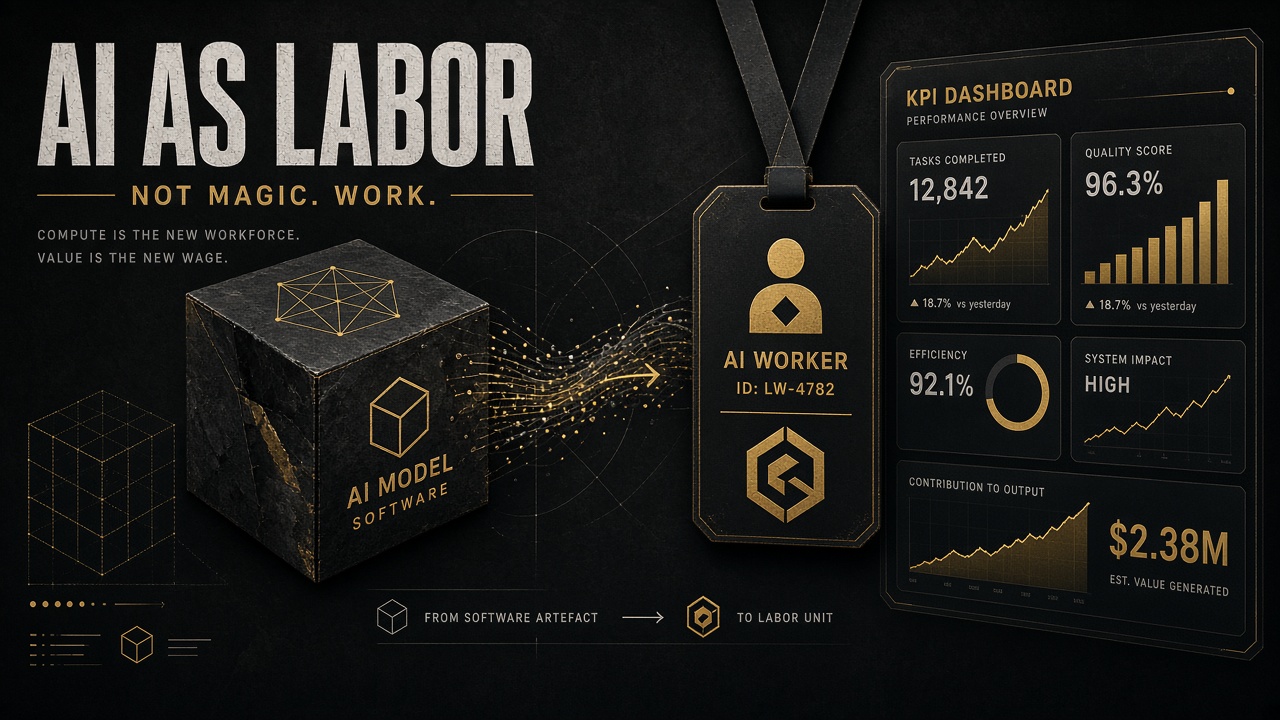
Enterprise buyers still evaluate AI agents like shrink-wrapped software: feature checklist, one-time integration, license per seat, move on. Vertical AI vendors that win in 2026 describe deployment differently: you are hiring a digital worker that needs onboarding, supervision, performance reviews, and workflow redesign when the role evolves. Contrary Capital's vertical AI playbook and field evidence from legal, healthcare, and logistics rollouts converge on the same lesson: integration and operating model beat raw model quality. This AI as labor class explainer contrasts software versus labor framing, maps the onboarding metaphor, defines monitoring KPIs, covers workflow redesign, and lists failure modes, with links to AI productivity patterns and AI automation infrastructure.
Software Versus Labor Framing
Traditional SaaS delivers deterministic features on demand; AI labor delivers probabilistic output that improves with context, feedback, and process fit, requiring ongoing management like a human team member. Software framing asks "Does it have API access and SSO?" Labor framing asks "Who trains it, who audits it, what happens when it is wrong, and how do we measure throughput per dollar?"
The distinction matters for budgeting and accountability. Software capex amortizes; labor opex includes supervision, retraining after policy changes, and escalation labor when confidence drops. CFOs who bucket AI as pure software often underfund the operating wrapper and blame the model when adoption stalls.
| Dimension | Software mental model | Labor mental model |
|---|---|---|
| Purchase | License, install, configure | Hire, onboard, assign manager |
| Performance | Uptime, latency SLAs | Quality, throughput, error cost |
| Failure | Bug ticket, patch release | Coaching, procedure update, pause role |
| Scaling | Add seats or servers | Clone role, split queues, add reviewers |
| Change | Version upgrade | Retrain, rewrite playbooks |
The Onboarding Metaphor
Deploying vertical AI like hiring means a structured onboarding program: role charter, systems access, shadow period, graded autonomy, and explicit graduation criteria before unsupervised production work. Skipping onboarding produces the same failure mode as a new hire left alone on day one with outdated SOPs.
- Role charter: Define tasks in scope, dollar authority, escalation paths, and prohibited actions (no external email, no payment approval above threshold).
- Systems access: Read-only CRM phase, then write with approval, mirroring human IT provisioning.
- Shadow mode: Agent proposes actions; human executes. Measure agreement rate and error cost.
- Graduated autonomy: Auto-execute low-risk tasks above confidence threshold; sample audits on the rest.
- Graduation review: Operations lead signs off when KPIs meet targets for four consecutive weeks.
Contrary's vertical AI thesis emphasizes that winners embed in workflow systems customers already run (practice management, ERP, ticketing), not standalone chat windows. Onboarding includes teaching the agent those systems' object models, not just uploading PDFs.
Playbooks and Standard Operating Procedures
Human hires receive SOPs; AI labor receives playbooks: decision trees, exemplar inputs and outputs, and exception catalogs. Playbooks version like HR policy. When billing rules change, update the playbook before expecting agent behavior to track automatically.
Monitoring and KPIs
AI labor KPIs mirror workforce analytics: tasks completed, rework rate, average handle time, escalation rate, customer satisfaction on agent-touched interactions, and fully loaded cost per outcome. Model accuracy alone misleads if escalations consume senior staff time.
- Task success rate (completed without human edit)
- Rework rate (human correction after agent action)
- Escalation rate and time to human pickup
- Cost per resolved case (inference + supervision + platform)
- Downstream quality (chargebacks, appeals, SLA breaches)
- Drift indicators (rising low-confidence scores week over week)
Review dashboards weekly in the first quarter, monthly after graduation. Tie incentives to outcome metrics, not vanity automation percentages. A claims agent that auto-closes 40% of files but doubles appeals is failing the labor test even if the model leaderboard looks fine.
The AI Manager Role
Assign a named human manager (often operations, not IT) accountable for agent performance reviews, playbook updates, and pause authority. Without ownership, agents drift unnoticed until a customer or regulator surfaces systemic errors.
Workflow Redesign, Not Bolt-On
Vertical AI creates value when teams redesign workflows around agent capabilities: queue splits, new handoff points, and removed duplicate human steps, not when agents are pasted onto unchanged processes. Legal intake that still requires paralegals to retype agent summaries into the case system saves almost no labor.
Redesign workshops should ask: Which decisions move earlier? Which approvals become sampling instead of 100% review? Which roles upskill to exception handling? AI productivity gains compound when humans stop doing work agents already did correctly.
Integration depth separates vertical winners from thin wrappers. APIs into source-of-truth systems, bi-directional sync, and idempotent writes matter more than marginal benchmark gains on general reasoning tests. Buyers should score vendors on time-to-first-production-outcome, not demo eloquence.
Why Integration Beats Model Quality Alone
In vertical markets, a slightly weaker model with deep workflow integration outperforms a frontier model in a copy-paste UI because context, tools, and guardrails live in the integration layer. A medical coding agent needs charge master hooks; a freight broker agent needs TMS rate tables. General intelligence without domain tools hallucinates confidently.
AI automation platforms that orchestrate tools, human approvals, and logging provide the labor management layer models lack natively. Procurement should evaluate orchestration and observability alongside model provider choice.
Failure Modes
Common failures when AI is bought as software: no manager, no shadow period, KPIs undefined, playbooks stale, integration read-only, escalations hidden, and vendor blame cycles when outcomes disappoint. Recognize these patterns early.
| Failure mode | Symptom | Labor fix |
|---|---|---|
| Pilot purgatory | Endless demo, no production queue | Graduation criteria + executive sponsor |
| Hidden labor tax | Seniors fix every agent output | Measure rework rate; tighten scope |
| Tool-less agent | Confident wrong answers | Require retrieval and write APIs |
| Policy drift | Agent follows outdated rules | Versioned playbooks + change triggers |
| Accountability gap | Nobody owns pausing agent | Named manager with kill switch |
Organizational Resistance
Staff may sabotage agents perceived as headcount threats; frame deployment as role redesign with visible escalation career paths, not replacement announcements. Labor framing helps: you are hiring assistance, reallocating tedious work, measuring together.
Procurement and Vendor Evaluation Under Labor Framing
RFPs should score vendors on operating model fit: onboarding timeline, named customer success engineer, playbook maintenance, escalation SLAs, and production references with measurable KPIs. Model benchmarks belong in an appendix, not as the primary selection criterion. Ask for case studies where the agent was paused or rolled back; vendors who cannot describe graceful failure modes have not operated as labor partners.
Contract structures mirror labor engagements: implementation fees for onboarding, usage-based fees tied to outcomes or tasks, and professional services for playbook authoring. Pure per-seat pricing often misaligns when one agent replaces ten human touches per case. Negotiate data portability and export of playbooks, logs, and training exemplars at termination so institutional knowledge does not walk out with the vendor.
Internal Capability Building
Enterprises that treat AI as labor invest in internal agent operations teams: playbook authors, integration engineers, and quality analysts who are not traditional software developers. Waiting for IT alone to "install AI" repeats software-framing failure. Hybrid centers of excellence pair domain experts with orchestration engineers who maintain the management layer models do not provide.
Retraining and Role Evolution
Like employees, AI labor needs retraining when regulations, product catalogs, or customer policies change; version playbooks and schedule re-shadow periods after major updates. Annual compliance training for humans has a parallel: regression tests on golden cases after playbook bumps. When an agent's task scope expands (from intake only to intake plus scheduling), treat it as a promotion with new graduation criteria, not a silent config toggle.
Sunsetting agents matters too. When a workflow moves back to humans or a new model generation replaces the old, document knowledge transfer: which exceptions the old agent handled well, which playbooks failed, and what escalation data to preserve. Organizations that only onboard never offboard accumulate zombie automations nobody trusts.
Vertical AI Playbook Summary
Contrary's vertical AI playbook argues markets with fragmented software, high labor spend, and repeatable decisions reward agents deployed as managed labor with deep system integration. Winners spend engineering on connectors, audit logs, and human-in-the-loop UX. Losers reskin chatbots and wonder why churn exceeds expansion.
Buyers should ask vendors: Who manages the agent on your side during onboarding? What KPIs define success? How do playbooks update? What happens in shadow mode? Answers reveal labor maturity more than model name-dropping.
Frequently Asked Questions
Is AI literally a labor class for accounting?
Metaphorically for operations design; legally and financially, consult your auditors on capitalization versus opex treatment. The labor frame guides management practices even when ledger categories differ.
Does labor framing mean replacing headcount?
Often it means handling volume growth without linear hiring, or redeploying staff to exceptions and relationships. Outcomes depend on redesign quality, not vendor promises.
Does this apply to small businesses?
Yes at smaller scale: owner as manager, shorter shadow period, narrower task scope. A solo plumber's voice booking agent still needs playbook updates when pricing changes.
Should IT or operations own AI agents?
Operations owns outcomes and playbooks; IT owns access, integration, and security. Joint steering prevents agents orphaned between departments.
When is software framing still correct?
Deterministic automation (ETL, rigid rules engines) remains software. Probabilistic agents touching customer-facing or financial decisions fit labor framing.
How should unions and staff councils engage on agent deployment?
Early consultation on role redesign, retraining offers, and which tasks remain human-only reduces resistance and surfaces workflow insights procurement misses. Labor framing supports collaborative design rather than surprise rollout.
How do multi-agent teams fit the labor metaphor?
Multi-agent systems resemble departments: a researcher agent, a writer agent, and a checker agent need handoff protocols like human teams. Manage the department, not only individual agents. Department KPIs include end-to-end outcome quality, not per-agent vanity metrics.
How do we measure ROI under labor framing?
Compare fully loaded cost per outcome before and after, including supervision and rework, not license fees alone. Include error cost (refunds, penalties) in the denominator.
Board and Executive Communication
Executives should hear AI updates in labor terms: roles deployed, tasks automated, rework rate, and exception headcount planned, not model version numbers alone. Board slides that list GPT releases without operating metrics mis-set expectations. Compare cost per outcome to offshore BPO or contractor baselines when vertical AI replaces labor arbitrage plays. Honest reporting includes paused agents and rolled-back pilots; they prove governance maturity.
Conclusion
AI as a labor class explains why vertical deployments look like hiring: onboarding, managers, KPIs, playbooks, and workflow redesign matter more than installing another app. Integration with systems of record beats marginal model gains. Avoid failure modes by shadowing first, measuring rework, and assigning accountability. Whether you buy or build, pair AI productivity goals with governed AI automation infrastructure. The organizations that treat agents as managed workers scale; those that treat them as magic software renewals churn.