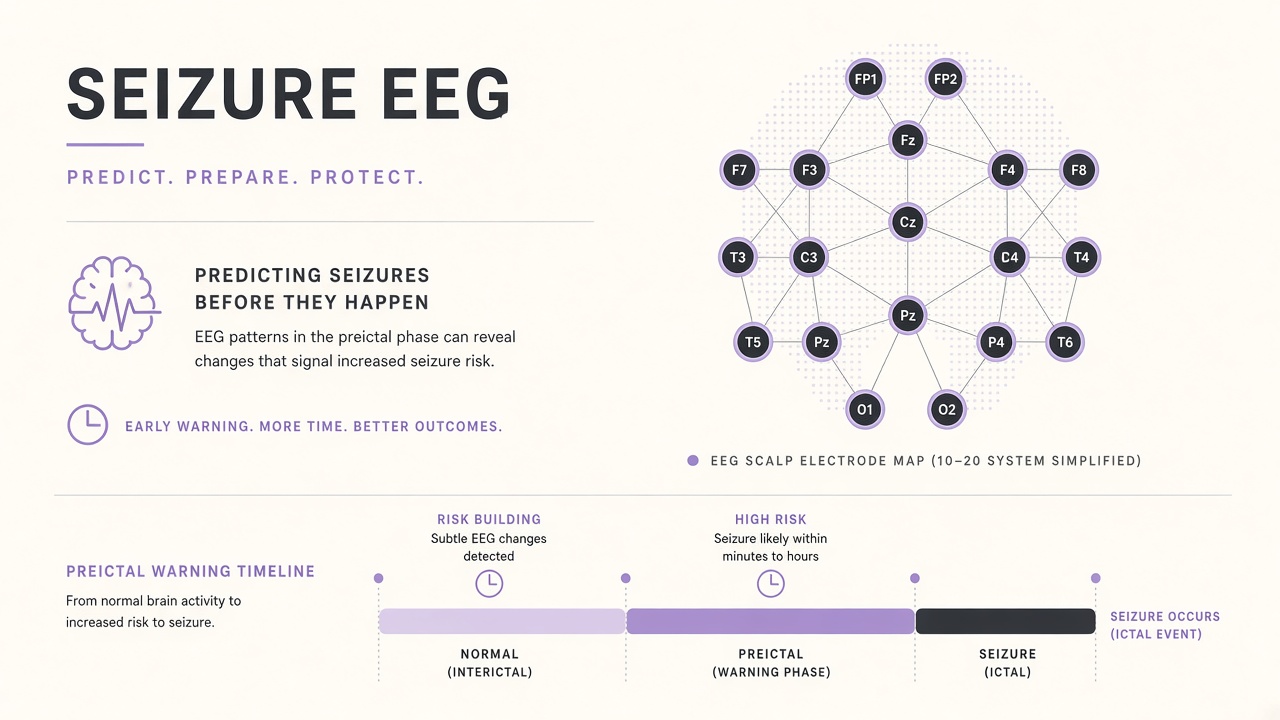
Epilepsy seizure prediction AI analyzes electroencephalogram (EEG) time series for preictal patterns that may precede clinical seizures, then triggers alerts when statistical thresholds are met. Hospital-grade scalp and intracranial recordings dominate published benchmarks, while wearable EEG headbands now enter prospective feasibility trials. Reported sensitivities can exceed ninety percent in patient-specific retrospective studies, yet false alarm rates often remain high enough that experts question everyday usability. Prediction is distinct from detection (recognizing ongoing seizure activity) and from diagnosis. No consumer algorithm should be treated as a substitute for emergency protocols or neurologist care. Product teams exploring AI chatbot interfaces for health must separate research metrics from regulated clinical workflows.
Prediction vs Detection vs Forecasting in Epilepsy AI
Seizure detection classifies EEG segments where electrographic or clinical seizure activity is already present; seizure prediction estimates elevated risk before observable onset within a defined horizon. Detection supports monitoring units and wearable alarms after seizures start. Prediction aims to give minutes or hours of warning so patients can reach safety, take rescue medication per care plans, or log interventions. Forecasting sometimes describes longer-horizon probability trends across days, which may inform lifestyle planning but carries even weaker validation than short-horizon prediction.
Confusing these tasks leads to dangerous product marketing. A model tuned for rapid ictal detection will fire during movement artifacts that resemble seizure rhythms. A prediction model optimized for academic sensitivity may alarm dozens of times per day, training patients to ignore warnings. Clear definitions of prediction horizon, seizure onset criteria, and refractory periods (cooldown after an alarm or seizure) are prerequisites for comparing studies.
The Epilepsia-era "seizure prediction characteristics" framework emphasized plotting sensitivity against false prediction rate rather than quoting accuracy alone. That perspective remains relevant: a system with ninety-nine percent window-level accuracy can still be clinically useless if alarms occur every few minutes during sleep.
EEG Signals and the Preictal Hypothesis
Preictal states are hypothesized transient changes in neuronal dynamics minutes to hours before seizures, visible in spectral power shifts, connectivity graphs, or nonlinear features extracted from multichannel EEG. Not every patient exhibits reproducible preictal signatures across all seizure types. Intracranial EEG offers higher signal-to-noise ratio near epileptogenic zones but requires surgery. Scalp EEG is non-invasive yet contaminated by muscle, eye, and electrode motion artifacts, especially in wearable form factors with fewer channels.
Deep learning models (convolutional and recurrent hybrids) frequently outperform hand-crafted features on retrospective hospital datasets, according to a 2025 systematic review of real-time EEG prediction literature. Reported accuracies above ninety-five percent appear often, but those figures usually reflect patient-specific training on limited recordings, not prospective home use. External validation across hospitals and device types remains rare, which the same review flags as the primary barrier to clinical translation.
| EEG source | Advantage for AI | Limitation for prediction |
|---|---|---|
| Intracranial (iEEG) | Localized high-fidelity rhythms | Invasive; short monitoring windows in practice |
| Scalp clinical EEG | Rich channel montages in EMU | Not wearable; controlled environment bias |
| Wearable scalp EEG | Ambulatory long-term capture | Few channels, artifacts, battery limits |
False Alarm Rates and Clinical Reality
False alarm burden, not peak sensitivity, determines whether epilepsy seizure prediction AI can be tolerated in daily life. A Frontiers in Neuroscience study applying Learn Then Test calibration to deep learning outputs on public EEG records cut false alarm rates by about ninety-three percent on average but missed four of nine seizures in a six-patient test subset. Patient-specific intracranial models with multi-cluster seizure typing reported false positive rates near 0.62 per day after k-of-N persistence rules, down from more than one per day without clustering and far below raw window-level rates of four to eleven alarms daily.
The mjn-SERAS patient-independent pilot on video-EEG reported sensitivity near ninety-five percent with roughly 0.55 false positives per twenty-four hours, alongside ten false negatives in held-out seizures. Wearable-focused artifact filtering research showed standalone seizure detectors on limited channels could emit about twenty-three false positives per hour before artifact classifiers reduced burden by up to ninety-six percent, underscoring that movement and electrode noise dominate wearable failure modes.
Epileptologists have long noted that excessive false warnings cause alarm fatigue: patients disable devices, caregivers stop trusting notifications, and true positives arrive too late to change outcomes. Any product requirement should specify maximum acceptable false alarms per twenty-four hours of wakefulness, seizure-free time, and mandatory refractory intervals, not accuracy alone.
| Study or system | Reported sensitivity (context) | False alarm burden |
|---|---|---|
| mjn-SERAS pilot (video-EEG) | ~94.7% on split test seizures | ~0.55 false positives per 24 h |
| iEEG multi-cluster + k-of-N | Up to ~98.5% mean in clustered model | ~0.62 false positives per day after rules |
| Learn Then Test calibration | Missed 4 of 9 seizures post-calibration | ~93% reduction vs raw model alarms |
| Wearable artifact pipeline | ~57 to 65% without artifact gate | ~22.9 to 1.0 false positives per hour |
Patient-Specific vs Population Models
Most published epilepsy seizure prediction AI systems train separate models per patient because inter-individual EEG baselines and seizure types vary more than inter-seizure noise within a single recorder. Patient-specific pipelines need an initial monitoring period to capture seizures and interictal background before alarms arm. Patient-independent models generalize to new users faster but usually sacrifice sensitivity or increase false alarms. A 2025 systematic review found validation predominantly patient-specific, only three studies adopting patient-independent schemes, and none reporting cross-dataset external validation.
Multi-cluster approaches group seizures by spectral or spatial similarity, training submodels per cluster to address heterogeneous seizure types in one person. Combined with voting rules that require sustained preictal classification before alerting, clustering can reduce false positives while preserving sensitivity for well-represented seizure classes. Rare seizure morphologies may still go unpredicted until enough examples accumulate, a cold-start problem wearable trials must disclose in consent forms.
Wearable EEG Trials and the Prospective Evidence Gap
Prospective home studies of seizure prediction remain scarce relative to retrospective EMU benchmarks, creating a gap between conference abstracts and deployable patient products. ClinicalTrials.gov registry NCT06978842 describes a multicenter non-interventional pilot where participants wear a comfortable EEG headband for weeks while a personalized algorithm tests real-time prediction with explicit false alarm endpoints. Such trials extend retrospective deep learning work into real-world motion, sleep, and medication adherence without changing prescribed treatments. Results were not available at the time of this writing; recruiting status underscores that the field is still in feasibility, not clearance, for broad prediction claims.
Wearable hardware constraints (channel count, dry electrodes, onboard compute) push teams toward efficient models and aggressive artifact rejection. A parallel ultra-low-power seizure detector study targeted hundreds of hours of battery life by coupling gradient-boosted trees with artifact classifiers. Prediction adds the harder temporal labeling problem of defining when preictal states begin relative to clinical or electrographic onset annotated by experts who may disagree on boundaries.
Alarm Policies and Human Factors
Clinical viability depends on alarm policies: prediction horizon length, k-of-N consecutive positive windows, refractory periods, and caregiver escalation paths. Short horizons increase the chance warnings arrive early enough to act but also raise false positives when preictal signatures flicker. Long horizons smooth noise yet may alert so far in advance that patients cannot link warnings to eventual seizures, undermining trust. k-of-N rules demand several consecutive positive classifications before sounding, trading latency for stability. Refractory periods suppress repeated alarms after a seizure or false trigger, preventing alarm storms during postictal exhaustion.
Human factors engineering must define what patients should do when warned: move to a safe position, notify a caregiver, take prescribed rescue therapy, or simply log the event for neurologist review. Without care-team alignment, prediction notifications increase anxiety without improving safety. Pediatric and cognitively impaired populations need tailored workflows that do not assume independent action after every vibration.
Regulatory and Ethical Boundaries
Seizure prediction software that claims to prevent injury or guide medication changes may be regulated as a medical device in major markets, requiring clinical evidence beyond offline AUROC scores. Detection devices with cleared ictal alarms already set precedent for EEG signal processing as SaMD, but prediction carries higher risk if users defer emergency care because a silent day implied safety. Liability, cybersecurity of cloud-trained personalized models, and equitable access to neurologist interpretation all affect rollout. Research ethics boards scrutinize whether false alarms induce hazardous behaviors, such as unnecessary emergency department visits.
Transparency about uncertainty matters. Presenting "ninety-nine percent accurate" models without defining the denominator (windows, seizures, or patients) misleads lay readers. Responsible materials report sensitivity, false alarms per twenty-four hours, prediction horizon, and population studied (focal versus generalized epilepsy, medication-resistant cohorts, adults only).
How Builders Structure Prediction Pipelines
Production epilepsy seizure prediction AI typically chains EEG acquisition, artifact rejection, sliding-window feature extraction or deep embeddings, patient-specific calibration, risk calibration, and alarm logic with logging for neurologist audit. Cloud training on historical EMU segments is common; edge inference reduces latency for real-time warnings. Learn Then Test and similar conformal methods tune thresholds on held-out calibration sets to honor user-specified false alarm budgets, explicitly trading missed seizures for quieter devices. Ensemble models and knowledge-graph-informed suppressors attempt to drop event-level false alarms while preserving seizure sensitivity in recent preprints on hospital datasets.
Continuous learning after deployment is tempting but risky without safeguards against concept drift from medication changes or progressive epilepsy. Locked models with periodic clinician-supervised retraining sessions align better with current regulatory expectations. Logging predicted risk timelines alongside ground-truth seizures (when they occur) supports post-market surveillance and honest patient-facing performance summaries.
What Clinicians and Patients Should Ask Vendors
Before adopting any epilepsy seizure prediction AI, stakeholders should request prospective false alarm rates per twenty-four hours, seizure types represented in training, and documented actions patients should take after alerts. Ask whether validation was patient-specific only, whether wearable artifacts were included, and how many seizures per user are required before enabling prediction. Confirm data retention, sharing with epilepsy centers, and what happens when the device is off-head during showers or sports. Compare detection-only products if prediction evidence is immature: timely ictal alerts still help caregivers respond even without preictal warning.
Neurology teams may prefer exporting prediction timelines into EMU review software rather than real-time patient pushes until feasibility trials conclude. Patients with infrequent seizures face the longest cold-start periods; setting expectations prevents frustration when the system remains in learning mode for months.
Frequently Asked Questions
Is seizure prediction proven to work at home?
Not broadly. Retrospective hospital EEG studies show encouraging patient-specific results, but large prospective home trials with published outcomes remain limited. Wearable feasibility studies are underway; consumers should treat prediction as investigational unless a regulator-cleared indication explicitly covers their device and use case.
Why do false alarms dominate the conversation?
Preictal patterns overlap with normal state changes, medication effects, sleep stages, and motion artifacts. Sensitive models fire often; specific models miss seizures. Clinical utility sits at a narrow operating point that requires calibration per patient and strict alarm persistence rules.
How is prediction different from seizure detection?
Detection identifies ongoing seizure activity in EEG or behavioral surrogates. Prediction estimates future risk before onset within a horizon. Hardware may be similar, but labels, evaluation metrics, and regulatory claims differ. Mixing the terms obscures product capability.
Can wearable EEG match hospital cap performance?
Wearables trade channel density and signal quality for comfort and duration. Artifact rates rise, and spatial localization weakens. Prediction on wearables may still be feasible for some focal epilepsies after artifact-aware modeling, but expecting parity with invasive iEEG in all patients is unrealistic.
How long does personalization take?
Patient-specific systems often need multiple recorded seizures and many hours of interictal baseline, sometimes across weeks of monitoring. Duration depends on seizure frequency, medication stability, and protocol thresholds. Infrequent seizure patterns prolong calibration.
Should patients change emergency plans if they use prediction AI?
No. Standard seizure action plans, rescue medications prescribed by neurologists, and emergency services for prolonged or clustered seizures remain essential. Prediction tools may supplement safety planning when validated and clinician-guided; they do not replace it.
Conclusion: Promising Science, Unfinished Clinical Translation
Epilepsy seizure prediction AI demonstrates that preictal structure exists for some patients in controlled recordings, and modern deep learning can exploit those patterns with high retrospective sensitivity. The clinical reality is dominated by false alarm economics, patient-specific training burdens, wearable artifact noise, and a shortage of prospective home validation praised in Epilepsia-line frameworks decades ago yet still incompletely solved. Builders should report false alarms per twenty-four hours alongside sensitivity, publish external validation, and pair algorithms with humane alarm policies. Readers comparing health AI narratives can explore the EliteAI.tools blog for adjacent topics and review how AI chatbot products handle high-stakes information differently from regulated neurotechnology.
Medical disclaimer: This article is educational and does not constitute medical advice, diagnosis, or treatment. People with epilepsy should follow personalized plans from their neurologist and emergency guidelines.