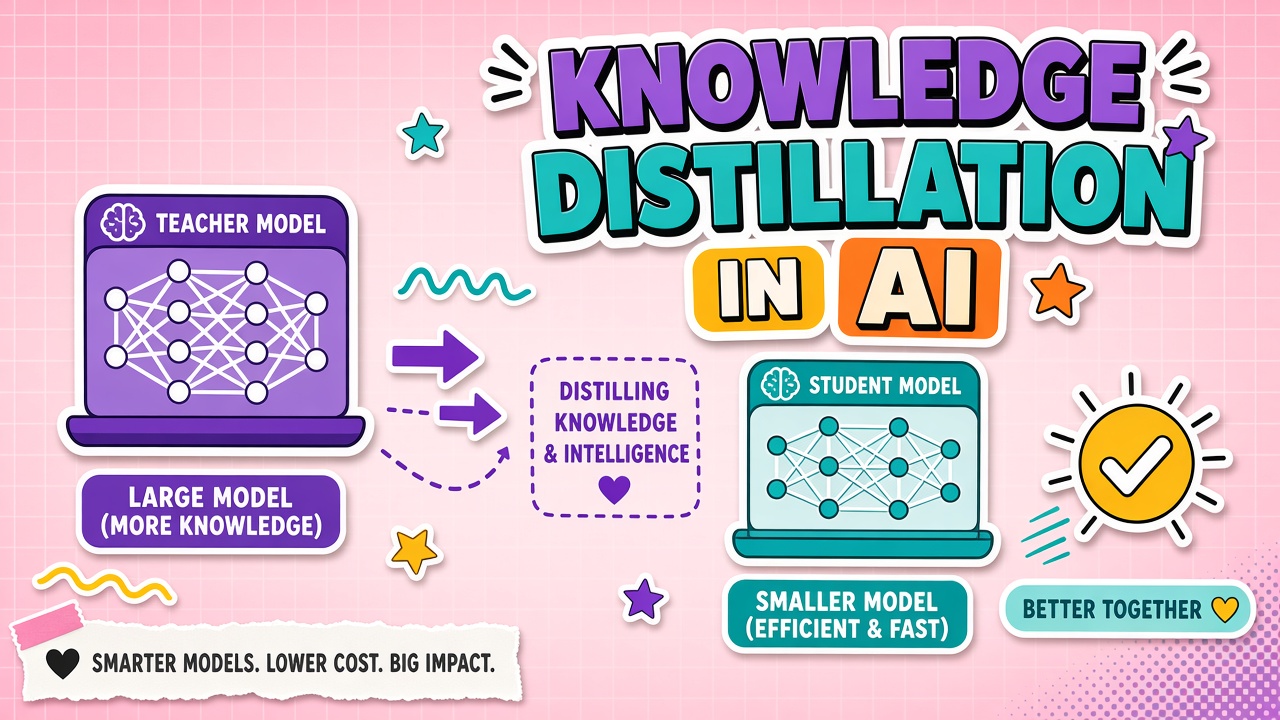
The flagship model nails your eval set. The "lite" tier on the pricing page stumbles on the same prompts. Sales calls the smaller option "the same AI, faster." Your team discovers the gap during a pilot, not during the demo. That gap often traces to knowledge distillation: a deliberate compression tradeoff, not a billing accident.
Knowledge distillation is a training method where a compact student model learns to reproduce the behavior of a larger teacher model on target tasks. OpenAI, Google, Meta, and Anthropic ship lite, flash, and mini tiers that frequently rely on distillation or related compression techniques. This guide explains teacher-student training and loss functions, why vendors offer lite tiers, where capability gaps appear, how to test smaller models before committing, and privacy implications for on-device deployment. Teams choosing AI chatbot and AI API products should evaluate lite models on their own data, not on flagship demos alone.
Teacher, Student, and the Distillation Loss
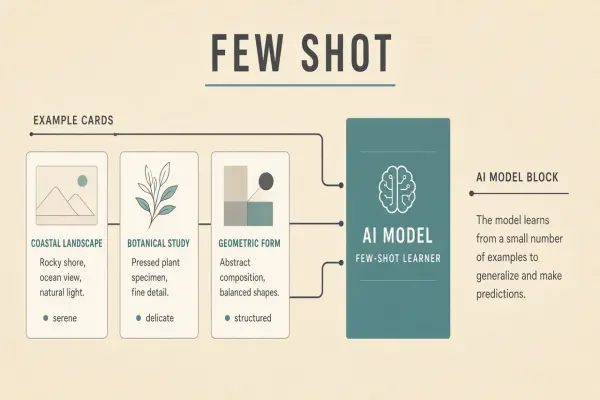
Knowledge distillation starts with a capable teacher model that produces logits or soft probability distributions over tokens (or labels) for a training dataset. A smaller student model trains on two signals: the standard task loss against ground truth labels and a distillation loss that penalizes divergence from the teacher's outputs. The student learns not only correct answers but the teacher's uncertainty patterns and decision boundaries.
"Soft targets" carry richer information than hard labels alone. When the teacher assigns 70 percent probability to one token and 20 percent to a close alternative, the student learns nuanced preferences that improve generalization within the student's capacity limits.
How distillation training typically works
- Select tasks and data: Prompts, documents, or labeled examples representative of production use.
- Generate teacher outputs: Run the large model to produce logits, completions, or rankings.
- Train the student: Optimize combined loss: task accuracy plus alignment with teacher distributions.
- Evaluate and iterate: Compare student vs teacher on held-out eval sets across task types.
Related techniques often bundled with distillation
- Quantization: Lower numeric precision (INT8, INT4) for faster inference and smaller memory.
- Pruning: Remove weights or attention heads with minimal impact on target metrics.
- Architecture search: Design smaller architectures matched to deployment hardware.
Vendor "lite" tiers may combine distillation with quantization. The pricing page name does not tell you which techniques were applied. Ask for model cards and eval disclosures when accuracy is contractual.
What the distillation loss actually optimizes
The combined training objective typically blends a hard-label loss (cross-entropy against ground truth tokens) with a soft-label loss (KL divergence or cross-entropy against teacher probability distributions). Temperature scaling on teacher logits softens peaks so the student learns relative rankings among plausible tokens, not only the single top choice. Hyperparameters here affect how aggressively the student compresses: higher temperature on teacher outputs can improve student generalization on in-distribution tasks while blurring fine distinctions the teacher makes on edge cases.
Why Vendors Ship Lite Tiers
Lite models exist because inference cost, latency, and deployment constraints scale with model size. A distilled student can serve high-volume, low-margin workloads (classification, routing, summarization of short text) at a fraction of the GPU cost. API providers pass some savings through lower per-token pricing. On-device products need models that fit phone memory and battery budgets.
Apple Intelligence, Google Gemini Nano, and similar on-device offerings lean on compressed models that often trace back to distillation or architectural shrinkage of cloud teachers. The value proposition is privacy-sensitive inference without round trips to data centers. Capability ceilings are lower, but latency and offline availability improve. Enterprise buyers should not assume on-device students match cloud teacher quality on complex reasoning benchmarks.
| Driver | Full-size model | Distilled lite tier |
|---|---|---|
| Inference cost | Higher per token | Lower per token, higher margin at scale |
| Latency | Slower on same hardware | Faster responses for interactive UX |
| On-device deployment | Often impractical | Fits mobile and edge constraints |
| Reasoning depth | Stronger on complex multi-step tasks | May degrade on rare or compositional prompts |
Choosing Chatbot and API Tiers With Distillation in Mind
AI chatbot products often default new users to lite models for cost control while showcasing flagship quality in marketing demos. API dashboards expose model IDs with names like "mini," "flash," or "haiku" that map to distilled students. Before routing production traffic, map each SKU to your task mix: routing and classification tolerate more compression than open-ended customer support.
API providers publish separate rate limits and pricing per tier. A 10x cost reduction on the lite model is worthless if your escalation rate to the teacher model exceeds the savings. Instrument which prompts fail on the student and whether failures are acceptable (retry on teacher) or catastrophic (wrong refund amount).
Where Capability Gaps Show Up
Distillation preserves performance on tasks well represented in training data. Gaps appear on long-tail inputs, multi-step reasoning, tool use, code generation across uncommon libraries, and languages with less teacher coverage. The student compresses what the teacher demonstrated, not everything the teacher could theoretically do.
Common regression areas
- Complex reasoning chains: Math, planning, and multi-hop questions that require depth.
- Nuanced instruction following: Many constraints in one prompt.
- Rare domain vocabulary: Medical, legal, or internal jargon underrepresented in distillation data.
- Structured output reliability: JSON and schema adherence at high complexity.
- Safety and refusal behavior: Edge cases where teacher caution does not transfer cleanly.
| Task type | Lite tier fit | Escalation signal |
|---|---|---|
| Intent classification | Strong | Low confidence score |
| Short summarization | Strong to moderate | Hallucinated entities in summary |
| Multi-tool agent loops | Weak | Wrong tool selection rate spikes |
| Legal or medical Q&A | Weak | Missing caveats the teacher includes |
Routing architectures mitigate gaps by sending hard prompts to the teacher and easy prompts to the student. Managed APIs sometimes implement this automatically. Self-serve tier selection puts the routing burden on your application logic.
On-device students vs cloud lite SKUs
Cloud API lite models and on-device distilled models serve different constraints. API lites optimize cost per token in vendor data centers. On-device students optimize memory, battery, and offline use. The same brand name on both does not mean equivalent capability. Privacy-sensitive workflows may accept on-device gaps; customer-facing support bots usually cannot.
Fine-tuning after distillation is a common enterprise path: train a teacher on proprietary data, distill a student for deployment, then quantize for edge. Each step trades capability for efficiency. If you lack ML ops capacity, buying vendor lite tiers with rigorous eval is simpler than running custom distillation pipelines.
How to Test Lite Models Before Production
Do not rely on vendor marketing benchmarks alone. Build an eval set from your real prompts, including failure cases from the flagship tier. Run both models with identical system prompts, temperature, and tool configurations where applicable.
- Stratify by task type: Support, extraction, generation, classification, and tool-calling buckets.
- Score separately: Accuracy, format validity, latency, and cost per successful task.
- Include adversarial prompts: Ambiguous, long, and multilingual inputs.
- Define fallback rules: When to escalate from lite to full model based on confidence or task labels.
- Re-test after vendor updates: Lite checkpoints change silently on some platforms.
- Track cost per successful outcome: Include escalation rate in total cost, not only lite-tier token price.
- Compare on-device vs cloud lite: Mobile-deployed students may use additional quantization beyond API lite SKUs.
Document results in a simple scorecard: task category, lite pass rate, teacher pass rate, acceptable gap threshold, and decision (route lite only, hybrid route, or teacher required). Procurement teams can then negotiate SLAs against measured gaps instead of marketing claims about "same intelligence, faster."
Search knowledge distillation AI resources for academic background, but purchase decisions should rest on your eval metrics, not paper titles.
Frequently Asked Questions
Is knowledge distillation the same as fine-tuning?
Fine-tuning adapts a model (any size) to your data. Distillation specifically trains a smaller student to mimic a larger teacher. You can fine-tune a student after distillation, or distill after fine-tuning a teacher. The goals differ: fine-tuning targets task fit; distillation targets size and speed with bounded capability loss.
Does distillation help on-device privacy?
Smaller models enable local inference, which keeps prompts on device and off cloud logs. Distillation does not encrypt data or guarantee privacy by itself. You still need secure storage, update channels, and clear data handling policies. On-device deployment trades cloud visibility for device compromise risk if models store sensitive patterns.
Should you fine-tune the lite tier instead of the flagship?
Fine-tuning the lite tier is cheaper per training and inference cycle when the distilled model already covers most of your task. If eval shows large reasoning gaps, fine-tune or route through the teacher first, then consider distilling a custom student if you control the training pipeline.
Are lite tiers always distilled from the same vendor's flagship?
Not always. Some lite models are independently trained smaller architectures aligned on similar data mixes. Model cards and release notes indicate teacher-student relationships when vendors disclose them. Ask explicitly during enterprise procurement.
When is paying for the full model worth it?
Pay for the flagship when tasks require deep reasoning, high-stakes factual accuracy, complex tool orchestration, or when lite eval failure rates exceed your acceptable error budget even with human review.
Can enterprises run custom distillation on proprietary teachers?
Organizations with ML infrastructure can fine-tune a teacher on private data, then distill a student for deployment at the edge or in cost-sensitive API paths. Cloud vendors increasingly offer distillation-as-a-service or guidance for creating custom smaller models from your fine-tuned teachers. Budget for data labeling, GPU training time, and ongoing eval when the teacher updates.
Smaller Models With Open Eyes
Capability gaps are predictable, not random. Students struggle most where teacher behavior depends on long context, rare tokens, or compositional reasoning that was underrepresented in distillation training data. Mapping your prompt distribution to those categories before purchase prevents expensive mid-contract tier upgrades.
Knowledge distillation AI is the reason lite tiers exist at every major API provider. The technique is sound engineering for cost and deployment constraints, not deceptive marketing by itself. Problems arise when buyers expect flagship reasoning from student SKUs without running their own eval or designing escalation paths.
Knowledge distillation compresses a teacher model's behavior into a faster, cheaper student. Lite API tiers and on-device assistants depend on this tradeoff. Before standardizing on a chatbot or API lite SKU, run your own eval set, document capability gaps, and design escalation to larger models where needed. Distillation is engineering, not magic: the student knows what the teacher was trained to demonstrate, and your job is to verify that coverage matches production reality. Compare flagship and lite SKUs side by side on EliteAI.tools listings, then confirm with your own eval before routing customer traffic or signing annual API commits based on demo-tier model IDs alone.