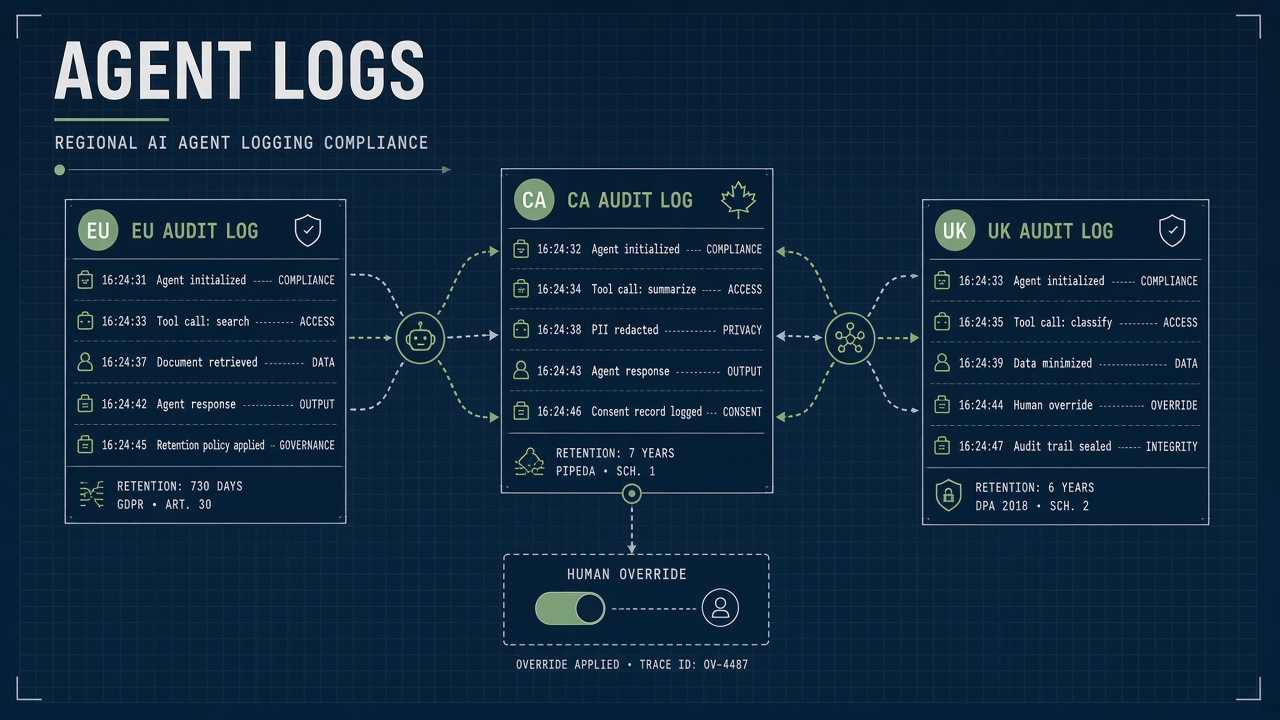
Enterprise AI agents that chain tool calls, browse APIs, and execute workflows without a human in every loop create a new compliance surface: trace logs. Regulators in the EU, California, and the UK do not share one global logging statute, but each jurisdiction now expects deployers to reconstruct what an agent did, who approved high-risk actions, and when humans overrode automated decisions. The EU AI Act Articles 12, 19, and 26 set the most explicit technical bar for high-risk systems. Colorado's ADMT Act focuses on adverse-outcome documentation rather than agent trace schemas. UK regulators embed accountability through data protection, financial conduct, and emerging ICO guidance on automated decision-making.
This guide compares agent logging requirements in 2026 across regions, maps AI agent audit logs to legal duties, and offers implementation patterns for teams building on AI code agents and orchestration platforms. Use it alongside AI governance resources when designing cross-border agent deployments.
EU Agent Logging Themes Under the AI Act
Article 12 requires high-risk AI systems to technically allow automatic event recording over the system lifetime, with logs sufficient to trace functioning, identify risk situations, and support post-market monitoring. For agents classified as high-risk under Annex III, logs must capture session start and end times, reference data checked, inputs that produced outputs, and identities of humans who verified results under Article 14(5).
Providers design logging capability under Article 12. Deployers retain automatically generated logs under their control for at least six months under Article 26(6), unless sector law or GDPR requires shorter or longer retention. Financial institutions may integrate agent logs into existing recordkeeping regimes. The Digital Omnibus baseline defers standalone Annex III high-risk duties to December 2, 2027, but Article 50 transparency and GPAI provider obligations became enforceable on August 2, 2026. Agent teams should not wait for the 2027 high-risk date to implement structured traces if agents already influence consequential EU decisions.
| EU duty | Article | Agent logging implication |
|---|---|---|
| Automatic record-keeping | Article 12 | Tool calls, prompts, outputs, anomalies without manual reconstruction |
| Provider log retention | Article 19 | Vendor must retain provider-side logs at least six months |
| Deployer log retention | Article 26(6) | Operator keeps logs under deployer control; contract must define access |
| Human oversight | Article 14 | Log human verifiers and override events with timestamps |
Draft standards prEN 18229-1 and ISO/IEC DIS 24970 address AI logging formats but were not finalized as of mid-2026. Enterprises should implement JSON structured logs with correlation IDs across agent steps, immutable storage, and per-user attribution now. Agent traceability law in Brussels emphasizes that SaaS dashboards alone do not satisfy deployer duties if the vendor can delete or restrict export.
California Agent Duties for Audit Trails
California does not impose EU-style automatic agent logging on all enterprise deployments, but ADMT, companion chatbot, and privacy laws create documentation duties that function as audit trails for consequential decisions. SB 26-189 (the Colorado-style ADMT framework does not apply to California; California's own bills differ) and companion safety legislation signed in 2026 focus on consumer-facing harms rather than internal agent orchestration.
California's Chatbot Safety Act and related 2026 measures require disclosure when users interact with automated systems and impose duties on developers of companion chatbots that pose safety risks. For enterprise agents affecting California residents, the California Privacy Rights Act and proposed AI transparency bills expect deployers to explain automated decision logic and maintain records supporting consumer correction and human review requests. SB 813 and AB 1405, advanced in the 2026 legislative session, push deployers of high-impact AI toward impact documentation and safety testing that implicitly requires operational logs.
California agent duties for logging map to three practical themes: pre-use notice when ADMT influences consequential decisions, post-adverse outcome disclosures within statutory windows, and retention of compliance records demonstrating human review pathways. Agent teams serving California consumers should log which model version ran, which tools executed, and whether a human approved outputs before they reached the user. Human override records AI teams store should include operator identity, override reason code, and the automated recommendation the human rejected.
UK Sector Guidance on Agent Traceability
The UK has no horizontal agent logging statute, but ICO, FCA, and sector regulators expect accountability records when AI systems make or materially influence decisions about individuals. The ICO's statutory AI and automated decision-making code, mandated by SI 2026/425, will clarify logging and explanation duties for UK GDPR compliance. Until the code finalizes, ICO guidance on explainability and the right to contest automated decisions requires deployers to retain enough information to reconstruct agent behavior.
Financial services firms deploying trading or customer-service agents fall under FCA Consumer Duty and model risk management expectations. Logs should tie agent actions to accountable individuals and escalation paths. AISI frontier evaluations inform policy but do not create private-sector logging rules; they do signal that agentic cyber misuse is a government priority, pushing security teams to retain tool-call traces for incident response.
UK sector guidance on agent traceability converges on: documented human-in-the-loop checkpoints for high-impact workflows, retention aligned to UK GDPR purpose limitation, and audit trails available to regulators on request. Cross-border firms should not assume EU Article 12 schemas satisfy ICO expectations without mapping to UK data subject rights.
Technical Implementation Patterns for Agent Logs
Production agent logging should capture session identity, model and tool versions, each tool invocation with inputs and outputs, policy decisions, human approvals, errors, and kill-switch activations in structured, tamper-evident storage. Define the controlled log boundary in vendor contracts before the first incident.
- Correlation IDs: Assign one trace ID per user request spanning all agent steps.
- Immutable storage: Write logs to append-only buckets or WORM-compliant archives.
- Human override events: Record operator ID, timestamp, prior agent output hash, and override action.
- Retention tiers: Default six-month EU floor with legal-hold extensions for investigations.
- Privacy minimization: Hash or tokenize PII in logs while preserving reconstructability.
- Vendor handoff: Contractually require log export APIs and deletion prohibitions during audits.
OpenTelemetry-style spans work well for multi-step agents. Separate debug logs from compliance logs: regulators care about decision paths, not every tokenizer call. Alert when agents invoke tools outside approved allowlists. Quarterly drills should prove a compliance officer can reconstruct a contested decision from logs alone within hours, not weeks.
Frequently Asked Questions
How long must EU deployers keep agent logs?
Article 26(6) sets a minimum of six months for automatically generated logs under deployer control, with longer periods when the intended purpose or sector rules require them. GDPR may limit personal data retention even when six months is the AI Act floor.
Does California require automatic agent logging?
California has no direct equivalent to EU Article 12 for all agents. Documentation duties under privacy, companion chatbot, and emerging AI safety bills still require records that support consumer review and adverse outcome disclosures when agents influence consequential decisions.
What should human override records include?
Store the automated recommendation, the human decision, operator identity, timestamp, reason code, and any policy rule triggered. Override records should link to the same correlation ID as the underlying agent session.
Can we rely on our agent vendor's dashboard for compliance?
Only if contracts guarantee deployer control, export rights, retention periods, and access during investigations. EU Article 26(6) places retention duties on deployers, not vendors alone.
What logging do UK regulators expect for agents?
Enough information to explain and contest automated decisions under UK GDPR, plus sector-specific records for regulated industries. ICO's forthcoming statutory AI code will add detail; interim ICO guidance already expects meaningful accountability documentation.