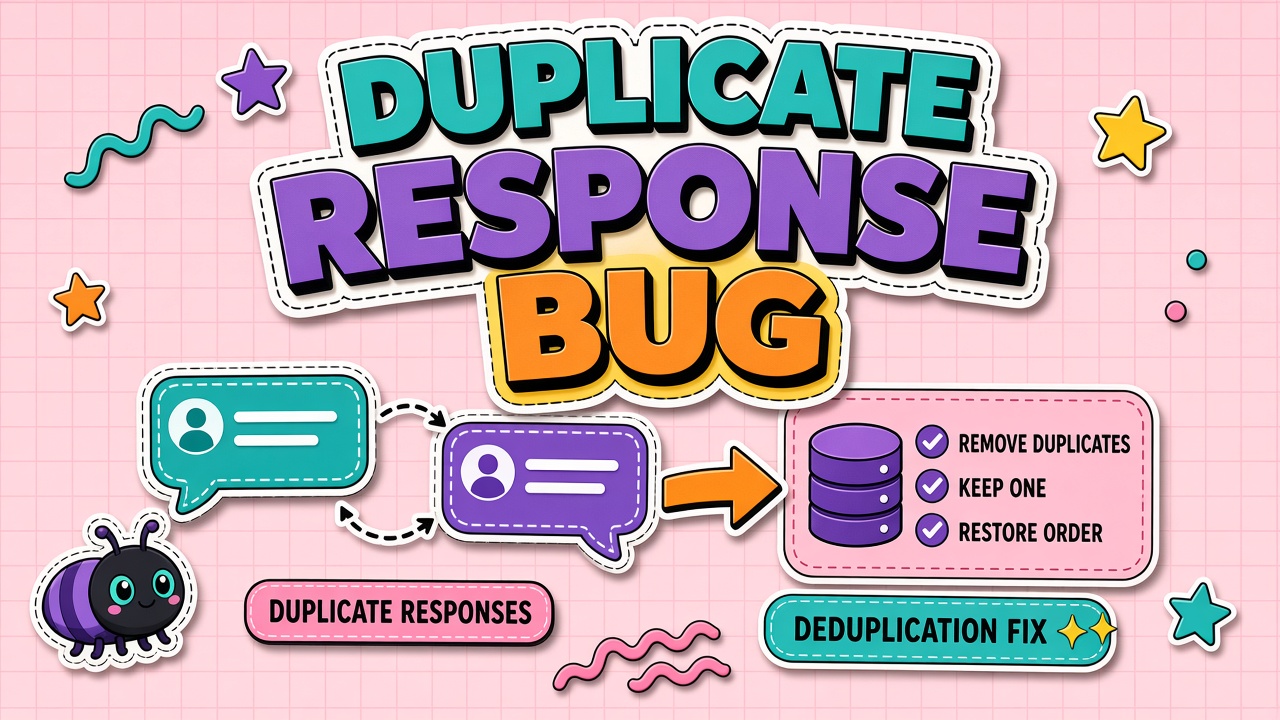
Support agents see two identical AI drafts on one ticket. Customers receive duplicate chat replies. CRM notes show the same summary twice with different timestamps. These are integration bugs, not model creativity. When duplicate AI responses integration issues appear, trace the request path for double submits, retries without idempotency, and webhook delivery storms.
This troubleshooting guide covers common causes, idempotency patterns, webhook verification, and UI debouncing. Teams building AI automation and AI research workflows through CRMs, ticketing, and no-code connectors hit this class of bug often after go-live traffic increases.
Testing Idempotency Before Production Traffic
Automated tests should fire duplicate requests with same idempotency key and assert single model call mock. Test webhook replay with identical event ID and assert second delivery no-ops. Load test double-click simulation on generate endpoint. Chaos test: kill worker mid-job and verify queue does not duplicate CRM write on retry.
Manual QA checklist: double-click generate, refresh during pending, replay webhook from vendor console, run Zap twice on same record ID. Each scenario should yield one customer-visible artifact.
Common Causes: Double-Click, Retry Storms
Most duplicates originate from the client or middleware sending the same logical request twice. Double-clicks on "Generate" buttons, mobile tap duplicates, form resubmits on slow networks, and automated retry policies without deduplication all produce twin API calls. Each call may succeed independently; the model happily returns similar text twice.
- Double-click: User triggers two in-flight requests before UI disables button.
- Retry on timeout: Client assumes failure, resends while first request still running.
- Webhook retries: Provider redelivers same event; handler creates second record.
- Queue workers: At-least-once delivery processes job twice after crash.
- Parallel integrations: Zapier and native plugin both react to same trigger.
Correlate duplicates by timestamp and request metadata. If two responses arrive within one to three seconds with identical prompts, suspect double submit. If second copy arrives minutes later with same webhook event ID, suspect retry handling. Log correlation IDs at edge, API gateway, worker, and webhook handler.
The AI double response bug often worsens after latency increases: users click again, automation platforms retry aggressively, and load balancers replay POSTs. Fix UX and idempotency together; faster responses alone do not cure retry storms.
Idempotency Keys and Dedup Stores
Send an idempotency key with every user-initiated generation request. Key should be deterministic per logical action: hash of user ID, ticket ID, action type, and client-generated nonce stored at click time. Server checks dedup store before calling model; if key seen within TTL window, return cached result or in-progress status.
| Layer | Mechanism | TTL guidance |
|---|---|---|
| HTTP API | Idempotency-Key header | 24h for user actions |
| Webhook handler | Store event ID uniquely | 7d or vendor retry window |
| Queue job | Unique job ID constraint | Until job completes |
Dedup store can be Redis, database unique index, or vendor-native idempotency if available. On duplicate key, return HTTP 409 with link to original resource, or 200 with same body as first success. Never call the model twice for the same key unless user explicitly requests regeneration with a new key.
For idempotency AI API calls, pass vendor idempotency headers where supported in addition to your application key. Stack both layers when external API spend is material. TTL must exceed maximum client retry horizon.
Webhook Signature Verification
Verify webhook signatures before side effects, then dedupe by event ID. Unsigned or incorrectly verified handlers may process replays as new work. Store processed event IDs in a table with unique constraint; insert before enqueueing async job so race duplicates fail fast.
- Reject requests failing HMAC or timestamp skew checks.
- Parse stable event ID from payload; reject if missing.
- Insert event ID in transaction; on conflict, ack webhook and exit.
- Enqueue job only after successful insert.
- Make downstream CRM write idempotent using external ID field.
Duplicate AI webhook deliveries are normal at-least-once behavior, not vendor bugs. Handlers must be safe under redelivery. Returning non-2xx to "prevent duplicates" causes more retries and makes storms worse. Acknowledge after durable dedup record, not after full pipeline success, unless vendor supports explicit failure retry you control.
UI Debouncing Patterns
Disable submit control on first click and show in-progress state immediately. Debounce alone is
insufficient; users wait and click again. Pattern: on click, set local pending flag, disable button,
show spinner, issue request with client nonce as idempotency key. Re-enable only on terminal success or explicit error.
Prevent double submission on browser back and refresh: use POST-redirect-GET for form flows or check session for recent completion token. Mobile: enlarge tap target but keep single-flight guard. Keyboard shortcuts need same guard as button clicks.
For embedded widgets in CRMs, coordinate with platform events. Some hosts fire both "save" and "automate" hooks; consolidate to one AI trigger per user action. Document which integration owns generation when multiple plugins are installed.
Automation Platforms and Parallel Paths
Automation stacks often duplicate triggers during testing and production overlap. A native "AI summarize ticket" button plus a Zapier zap on "ticket updated" yields two summaries. Maintain integration registry: one owner per trigger type. Disable test zaps when go-live.
Research assistants that log outputs to wiki and Slack may write twice if each destination has separate webhook without shared idempotency key. Centralize generation in one service; fan out read-only copies after single model call.
Integration Patterns for Safety
Pattern A: client generates UUID per user click; server stores idempotency key in Redis with TTL. Pattern B: webhook consumer writes event ID to dedup table before side effects. Pattern C: CRM upsert keyed on ticket ID plus generation batch ID instead of blind insert. Pattern D: UI disables submit until in-flight completes. Combine patterns at boundaries, not only one layer.
Duplicate ai responses integration bugs return after major refactors if idempotency not in definition of done. Add integration test that fires duplicate request and expects single CRM row.
Operational Checklist
Assign a single owner for monthly refresh. Publish assumptions where finance and engineering both edit. Tie forecast or policy changes to ticket IDs. Review variance before month close, not after invoice payment. Run tabletop exercises when vendors announce pricing or deprecations. Keep archived exports for audit comparison quarter over quarter.
Document decisions in plain language any new hire can follow. Operational discipline matters as much as spreadsheet formulas or contract clauses. Teams that treat AI spend as unplannable noise get unplannable invoices. Teams that treat spend as a managed metric catch drift early and negotiate from data.
Cross-Functional Alignment
Platform owns technical tags and caps. Finance owns forecast and chargeback posting. Procurement owns contract language. Product owns workflow rollout dates that drive usage. Security owns trial data classification. Weekly five-minute sync during rollout quarters prevents each function optimizing locally while global spend drifts. Alignment is boring work that prevents exciting overage surprises.
Common Mistakes to Avoid
Mistake one: single org-wide average hiding squad spikes. Mistake two: ignoring human review labor in ROI or unit economics. Mistake three: annual commit sized on peak pilot week. Mistake four: alerts configured without owners. Mistake five: sunset without migration support. Mistake six: treating free tier as production. Mistake seven: streaming timeouts fixed by disabling streams without root cause. Mistake eight: duplicate responses patched in UI only while webhooks still double-write. Avoiding these patterns saves more than marginal token discounts.
Implementation Timeline
Week one: assign owners and export baseline data from vendor admin or application logs. Week two: draft spreadsheet, policy, or runbook sections relevant to your pillar. Week three: pilot with one squad and fix tagging or alert noise. Week four: publish org-wide with office hours. Month two: first variance or true-up review and adjust assumptions. Month three: executive summary with decisions made from metrics, not only spend totals.
Skipping the pilot week creates alert fatigue and mistrust in chargeback numbers. Investing four weeks upfront pays back when finance, security, and engineering reference the same artifacts instead of rebuilding from scratch each quarter. Treat this as operational infrastructure parallel to the AI features themselves.
Observability: Detecting Duplicate Rate in Production
Metric: duplicate output rate = second responses with same idempotency key or same webhook event within TTL divided by total generations. Alert when rate exceeds 0.1% after deploy. Dashboard by integration partner shows whether Zapier, native plugin, or mobile app regressed.
Frequently Asked Questions
How fix duplicates in Zapier or Make?
Add storage step keyed by trigger ID before AI action. Skip if key exists. Use built-in dedupe where available. Avoid parallel zaps on overlapping triggers. For high-volume tickets, batch or throttle so one open event does not re-fire on every field edit.
What should custom apps log for postmortems?
Log idempotency key, user ID, ticket ID, request start and end, model request ID from vendor, webhook event ID, and worker job ID. With those six fields, duplicates reveal which layer replayed. Redact prompt content in logs if sensitive.
How allow intentional regenerate without blocking duplicates?
Issue new idempotency key on explicit "Regenerate" action, never reuse click nonce. UI copy should distinguish "Retry failed request" (same key) from "Generate again" (new key). Store both outputs if audit requires history.
CRM shows duplicate notes with different IDs. Is that idempotency failure?
Usually yes at write layer. CRM APIs often support external ID or dedupe field. Upsert on that field instead of blind create. Pair with webhook event dedup upstream so you never reach two create calls for one generation.
The Bottom Line
Duplicate AI responses in integrated apps are preventable with idempotency keys, webhook dedup, and disciplined UI single-flight guards. Treat every generation as a transaction with a unique key, safe retries, and ack-after-dedup webhook handling. Whether workflows run through automation platforms or custom research tools, the invariant is the same: one user intent maps to one model invocation unless they explicitly ask otherwise.
Review this guide quarterly against your vendor admin console and finance exports. Interfaces change; caps move; new premium toggles appear inside familiar SKUs. A quarterly thirty-minute review keeps policy, forecast, and contract language aligned with what the product actually bills. Assign the review to a named role, not a mailing list.
When in doubt, measure for two weeks before committing annually or sunsetting a vendor. Short measurement windows beat long debates. Export logs, tag them, compute the metric or variance, then decide. Data ends internal stalemates that otherwise consume more payroll than the AI line item under discussion.