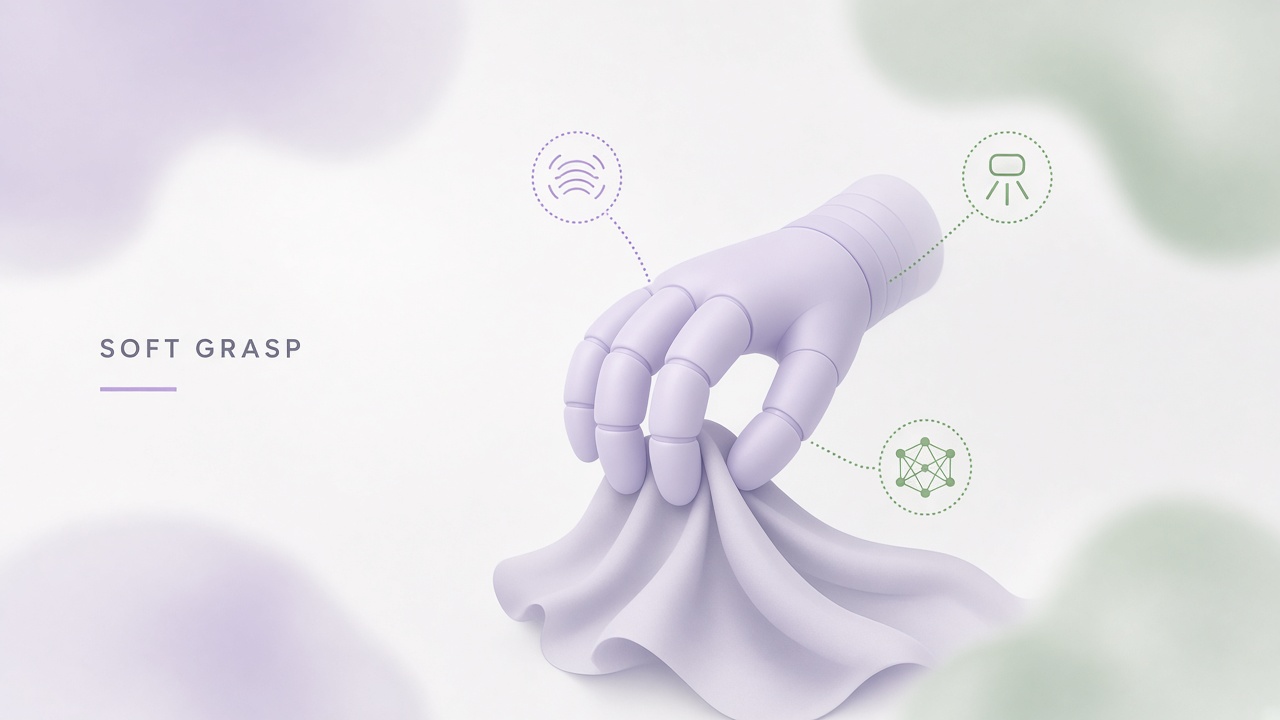
Rigid parallel-jaw grippers excel on boxes and cylinders but crush berries, tear fabric, and slip on wet produce. Deformable objects change shape under contact, so force paths shift faster than analytic models can track. Soft robot grasping deformable objects pairs compliant hardware (pneumatic fingers, fabric actuators, hybrid rigid-soft end-effectors) with AI that learns from touch, vision, and simulation. Research from MIT, TU Berlin's RBO Hand team, Berkeley MSC labs, and others now reports singulating thin textiles, folding cloth, and manipulating ropes using reinforcement learning, diffusion policies, and differentiable physics with human demonstrations.
Food processing, garment logistics, and assistive robotics teams evaluating automation should treat soft grasping as a coupled materials-and-AI problem, not a gripper swap alone. Related operator-facing AI topics appear under AI chatbot tags; see the EliteAI.tools blog index for additional embodied AI explainers.
What Soft Robot Grasping Deformable Objects Means in Plain Language
Soft robot grasping deformable objects is the use of compliant end-effectors plus learning-based control to establish and maintain stable contact on items whose shape, stiffness, and friction change during manipulation without requiring a full finite-element model at runtime. Compliance absorbs pose error: a soft finger conforms to curved produce instead of demanding millimeter-accurate jaw alignment. AI supplies the strategy: when to close, how hard to squeeze, when to regrasp after slip, and how to unfold fabric without snagging.
Deformable manipulation spans regimes. Granular and fluid items flow; thin sheets buckle; cables and ropes extend under tension. Soft hardware helps in contact-rich tasks where rigid fingers need exact models. Learning helps where physics is partially observable. Together they target "imprecise dexterity": robust behavior without micrometer control.
| Object class | Deformation behavior | Why soft plus AI helps |
|---|---|---|
| Thin textiles | Buckling, wrinkling, low bending stiffness | Passive compliance, tactile slip cues, RL exploration |
| Food produce | Variable stiffness, fragile skin | Force limiting, shape-adaptive envelopes |
| Cables and rope | Extension, twisting, self-occlusion | Dual-arm coordination, physics-informed planning |
| Bags and pouches | Contents shift, grasp point moves | Multisensory feedback, regrasp policies |
Intrinsic compliance versus active control
Soft robots trade precise position control for safe, adaptive contact; AI closes the loop with sensing because open-loop squeezing fails when object stiffness varies. The RBO Hand 3 platform uses 16 pneumatic degrees of actuation with modular fingers and palm spreading, achieving full Kapandji thumb opposition scores and all 33 GRASP taxonomy types in published evaluations. Compliance alone does not pick a crumpled shirt from a pile; learned policies interpret tactile and depth signals to choose grasps.
Kapandji scores and grasp taxonomy coverage
RBO Hand 3 evaluations include Kapandji thumb opposition tests and realization of all 33 grasp types in the comprehensive GRASP taxonomy, demonstrating that soft pneumatic hands can match human grasp diversity in controlled settings. Taxonomy coverage does not guarantee success on crumpled laundry in a bin, but it validates hardware dexterity headroom before investing in learning pipelines. Teams selecting soft end-effectors should ask vendors for maintenance intervals on pneumatic valves and finger modules, not only grasp type checklists.
Industry vertical examples
Grocery e-commerce struggles with produce bruising and bagged item shift; soft compliance plus force-capped RL targets lower damage rates than steel jaws. Apparel returns processing must unfold and inspect garments without snags; multisensory soft hand demos on suit fabric and sheet music pages illustrate motion primitives relevant to folding stations. Cable harness assembly benefits from dual-arm deformable linear object research but requires tighter cycle times than academic benchmarks typically report.
How the Underlying AI Pipeline Works
Modern pipelines combine data collection (teleoperation or self-supervised trials), representation learning (skill latents or diffusion models), and optional physics refinement (differentiable simulators or trajectory optimization). No single recipe wins every deformable task; teams mix imitation, RL, and model-based refinement depending on contact complexity and data budget.
Demonstrations and skill abstraction
DexDeform (MIT-affiliated) collects roughly ten human teleoperation demos per task variant, trains a skill model to abstract action sequences, plans in imagination toward novel goals, then refines trajectories with differentiable physics before finetuning. The framework addresses contact-mode explosion when multi-finger hands interact with deformables. Skill latents compress short-horizon actions so long-horizon folding or wrapping becomes searchable.
Model-free RL with multisensory soft hands
A 2024 multisensory soft hand study learns thin deformable object manipulation from raw vision, tactile, and force-torque data without explicit object models. Hierarchical double-loop RL decouples action spaces for learning efficiency. Tasks include displaying suit fabric and turning sheet music pages, behaviors prior rigid systems struggled to reproduce. Self-supervised real-world training demonstrates that simulation is not always mandatory when compliance reduces sim-to-real gap.
Diffusion policies and trajectory optimization
D-Cubed trains a latent diffusion model on task-agnostic play data, then applies gradient-free guided sampling (Cross-Entropy Method inside reverse diffusion) to optimize long-horizon dexterous deformable tasks such as folding, flipping, wrapping, and rope manipulation. Berkeley MSC research emphasizes physics-grounded dexterous manipulation and scalable simulation for deformable linear objects in constrained 3D environments. These approaches trade sample efficiency for flexibility when analytic gradients through contact are unreliable.
| Method family | Data needs | Strength | Risk |
|---|---|---|---|
| DexDeform (demos plus diff. physics) | Small human demo sets | Goal generalization on six dexterous tasks | Sim fidelity limits transfer |
| Multisensory soft hand RL | Self-supervised real trials | Thin textile tasks in real robots | Training time, wear on soft actuators |
| D-Cubed diffusion optimization | Play dataset, task cost at inference | Long-horizon deformable skills | Compute at planning time |
| RBO Hand 3 platform | Hardware lab setup | Reproducible soft dexterity benchmark | Pneumatic infrastructure required |
Typical workflow steps
- Characterize object classes (stiffness range, hygiene, cycle time) and safety limits on contact force.
- Select soft end-effector (underactuated hand, soft gripper, hybrid) with tactile and force sensing.
- Collect teleoperation demos or scripted exploration data for initial policy or skill model.
- Train in simulation with differentiable or particle-based deformable models when available; otherwise real RL.
- Validate slip detection and regrasp behavior on held-out object instances and lighting conditions.
- Deploy with monitoring for punctures, contamination, and actuator fatigue; log failures for continual learning.
Real Deployments and Published Evidence
Most cited results remain research deployments on laboratory platforms, but tasks now mirror industrial pain points such as garment handling, food singulation, and cable routing. DexDeform reports six challenging dexterous deformable tasks with generalization to goals unseen in initial demos. The multisensory soft hand paper demonstrates real-robot policies on textile display and page-turning beyond prior literature. RBO Hand 3 evaluations show comprehensive grasp taxonomy coverage, supporting its role as a standard soft manipulation research platform.
Warehouse automation vendors increasingly use soft suction cups and compliant fingers in pick cells, though many production systems still rely on engineered heuristics rather than published DexDeform-class pipelines. Amazon Vulcan Pick addresses deformable fabric pod shelves with integrated perception and motion control, illustrating industrial need even when academic benchmarks focus on dual-arm cloth folding. The gap between lab folding and shift-long grocery picking remains wide but narrowing along sensing and learning axes.
Berkeley MSC research lines
Berkeley's Model-Based Systems and Control group pursues physics-grounded dexterous manipulation, soft robot interfaces, and robot learning with multimodal reasoning. Published work on deformable linear object manipulation in constrained 3D environments and unified dexterous grasp synthesis (HUGS) complements soft hardware platforms. These research threads share a principle: robot intelligence should respect contact physics rather than treating grasps as open-loop waypoints.
Simulation modalities for deformables
Particle-based methods, mass-spring models, and finite-element approximations each trade accuracy for speed. Differentiable simulators enable gradient-based refinement in DexDeform but simplify friction and self-collision. Teams often train coarse policies in sim then fine-tune with real tactile data on soft hands where sim mismatch appears as slip or over-squeeze. Documenting which object instances appeared in training versus deployment helps auditors assess generalization claims.
Limits, Risks, and Ethical Guardrails
Soft actuators wear faster than steel jaws; learned policies overfit to training textiles or produce batches; food and medical use cases demand contamination controls beyond robotics conference demos. Differentiable simulators simplify contact modes and may optimism transfer. Model-free RL on real food consumes product and risks unsanitary trial-and-error unless confined to simulators or sacrificial stock.
- Hygiene: Washdown-compatible soft materials lag research prototypes; verify FDA or HACCP alignment for food contact.
- Durability: Pneumatic lines and fabric actuators need replacement schedules; downtime affects ROI.
- Safety: Compliant hands reduce pinch injury severity but do not eliminate risk near human coworkers.
- Labor: Automating garment and produce handling affects low-wage roles; transition planning is an ethical obligation.
- Environmental: Soft polymer end-effectors add consumables; life-cycle assessment rarely appears in papers.
Responsible reporting separates sim benchmark gains from shift-long success rates, documents force limits for fragile goods, and avoids marketing language that implies human-level dexterity from a single controlled demo clip.
Who Should Use This and Who Should Wait
Robotics R&D groups in food, apparel, and logistics with repetitive deformable handling pain points should pilot soft grippers plus learned policies on narrow SKUs now, starting with teleoperation data collection. Facilities needing only rigid carton picks should stay with proven vacuum and jaw tools until deformable SKUs exceed manual cost thresholds.
| Audience | Recommendation | Caveat |
|---|---|---|
| Food processing pilot line | Soft gripper plus force limits plus vision | Validate sanitation and failure recovery |
| Apparel fulfillment | Explore textile RL demos; measure pick rate vs humans | SKU variety stresses generalization |
| University lab | Adopt RBO Hand 3 or multisensory soft hand baselines | Budget pneumatic and tactile maintenance |
| General box warehouse | Wait; rigid automation remains cost-effective | Soft AI adds complexity without benefit on rigid SKUs |
Frequently Asked Questions
How accurate is soft robot grasping of deformable objects?
Accuracy is task and object specific; papers report high success on benchmark folding or textile tasks but rarely publish industrial uptime metrics across seasonal produce variation. Require vendor or internal pilots on your exact materials before scaling capital spend.
Is soft grasping AI regulated for food or medical use?
Food contact surfaces and medical devices face sector-specific rules; research soft hands are not certified by default. Integrators must map materials, cleaning procedures, and risk analysis to applicable standards, not assume academic hardware transfers unchanged.
How much training data do deformable grasp policies need?
DexDeform starts from about ten teleoperation demos per variant plus simulation refinement; multisensory RL uses self-supervised real trials; D-Cubed leverages task-agnostic play data plus inference-time optimization. Data efficiency improves with compliance and sensing but remains higher than rigid pick-and-place on fixed CAD models.
Can deformable grasping be trained in simulation only?
Differentiable and particle simulators help for cloth and rope in research settings, but sim-to-real gaps persist for fine textiles and variable food stiffness. Many successful soft hand results mix real tactile feedback with limited sim pretraining.
When are rigid grippers still better?
Standardized rigid packages with known dimensions favor fast vacuum or jaw tools with simpler control and higher cycle rates. Soft AI grasping earns its cost on irregular, fragile, or deformable items where rigid failure rates dominate labor expense.
Is tactile sensing mandatory for deformable grasping?
Published high-performance systems on thin deformables rely on tactile or force-torque feedback for slip and contact state; vision alone struggles under occlusion and specular packaging. Budget tactile integration early rather than retrofitting after vision-only failures.
Sensing stack in published systems
RBO research integrates liquid-metal strain sensing, piezoresistive tactile skins, and acoustic contact sensing through soft fingers. Multisensory RL work fuses depth cameras with slip modules driven by tactile and force-torque streams. Without touch, vision-only deformable grasping fails on occlusion and transparent packaging. Production teams should budget for tactile maintenance (wear, calibration) not only GPU training.
Continual learning and drift
Seasonal produce stiffness, new fabric blends, and worn soft actuators shift contact dynamics after initial training. Continual learning pipelines log slip events and human corrections to refresh policies without full redeployment downtime. Without drift monitoring, grasp success creeps down over weeks until operators revert to manual handling. Define retraining triggers (success rate thresholds, actuator cycle counts) before pilot launch.
Conclusion
Soft robot grasping deformable objects merges compliant hardware with AI pipelines that learn from demonstrations, exploration, and physics-aware refinement. DexDeform, multisensory soft hand RL, D-Cubed diffusion optimization, and platforms like RBO Hand 3 advance tasks from folding cloth to handling thin sheets in real environments. Industrial adoption trails research but aligns with warehouse fabric pods and food singulation needs. Teams should pilot on narrow SKU lanes with hygiene and durability plans, measure shift-level success not sim scores alone, and retain rigid tooling where deformable complexity does not justify soft AI overhead.