What is Placekey?
Placekey serves as a universal identifier designed for any physical place. Its primary goal is to streamline the process of sharing and joining location-based data across different organizations and datasets by providing a standardized key. This system addresses common challenges associated with inconsistent or ambiguous address information, making it easier to work with geospatial data accurately.
The identifier employs a unique 'What@Where' structure. The 'Where' component leverages Uber's open-source H3 geospatial indexing system, using the latitude and longitude of a place's centroid to encode its precise location within a specific hexagon. The 'What' component adds further context, resulting in a comprehensive key that facilitates the integration of diverse data sources for enhanced analysis and insights regarding physical locations.
Features
- Universal Place Identifier: Creates a unique ID (Placekey) for any physical location.
- What@Where Format: Combines descriptive ('What') and geospatial ('Where') elements for comprehensive identification.
- Geospatial Identification (Where Part): Utilizes Uber's H3 grid system based on centroid coordinates for precise location encoding.
- Address Matching Solution: Resolves inconsistencies in address data across different sources.
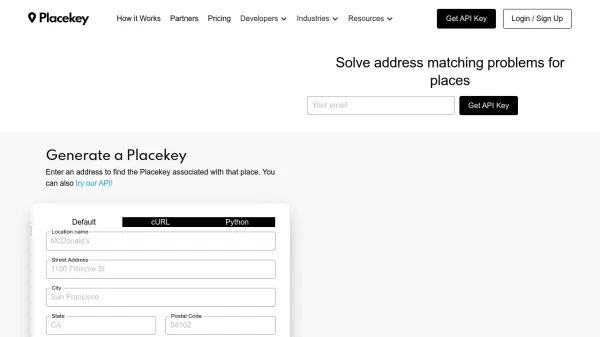
- API Access: Allows programmatic generation and lookup of Placekeys for scalable integration.
- Bulk Processing (Paid Plans): Supports bulk uploads and matching against public files for large datasets.
Use Cases
- Integrating disparate location datasets.
- Enhancing geospatial analysis accuracy.
- Standardizing address data across systems.
- Facilitating cross-organizational location data sharing.
- Powering location-aware applications and services.
- Improving data quality for real estate platforms.
- Analyzing point-of-interest (POI) data.
FAQs
-
What is Placekey?
Placekey is a universal identifier for any physical place, designed to facilitate easy data sharing and joining across organizations by solving address matching problems. -
How is the 'Where' part of a Placekey generated?
The 'Where' part is based on Uber's open-source H3 grid system. It uses the latitude and longitude of a place's centroid to determine a specific hexagon in the physical world, and the 'Where' part is the encoding of that hexagon. -
Can I generate Placekeys in bulk?
Yes, bulk upload and matching functionality is available on the paid Silver, Gold, and Enterprise plans. -
What is the lookup limit for the free plan?
The free plan allows up to 10,000 Placekey lookups per day.