Organizations treat AI chat sessions as disposable conversations while regulators and enterprise customers treat them as records. When legal, audit, or privacy teams ask what an AI system produced, who approved it, and whether personal data was deleted on request, scattered chat exports and vendor dashboards fail. A defensible retention policy for AI outputs closes that gap before a data subject request or litigation hold exposes the gap.
An AI output records retention policy defines how long prompts, model responses, human edits, and operational logs are stored, who owns each record class, and how deletion or legal hold overrides apply. This guide covers compliance and platform teams operating AI code assistant tools and broader AI coding workflows under GDPR Article 5(1)(e) storage limitation, SOX Section 802 audit record rules, and HIPAA Security Rule documentation requirements. The goal is operational evidence, not a policy PDF nobody implements.
Record types: prompts, outputs, edits, logs
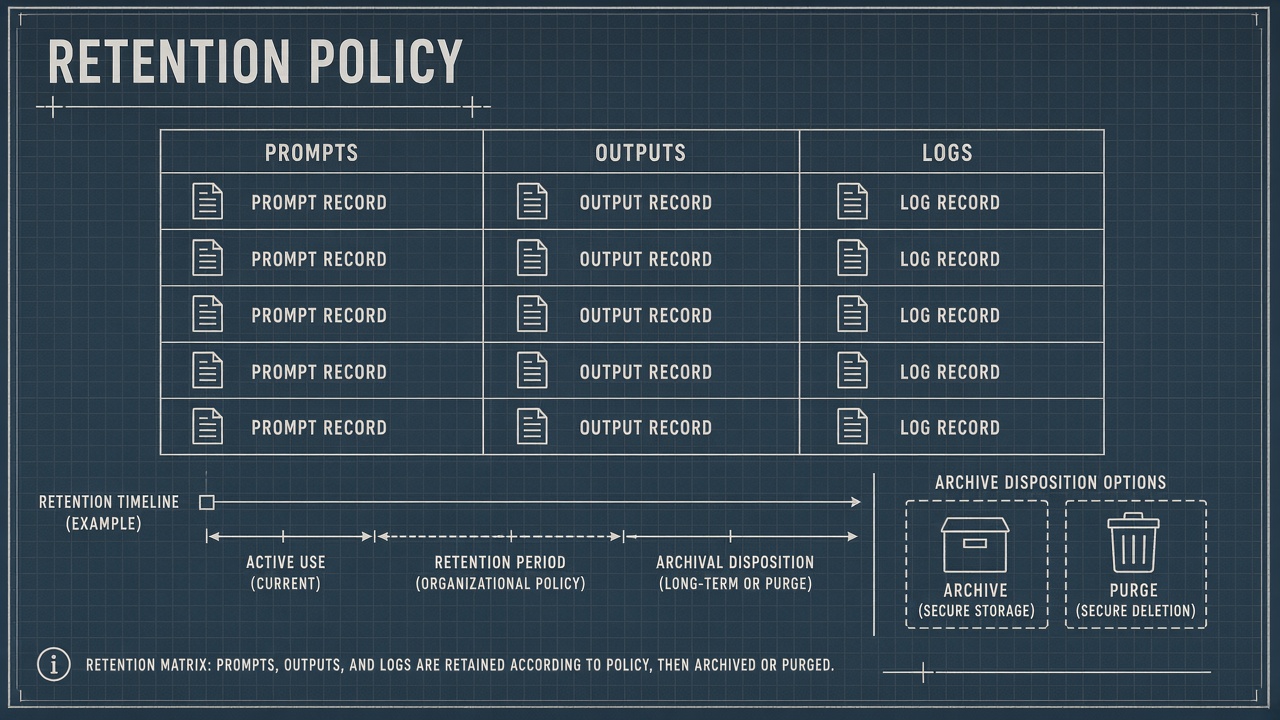
AI retention policies must classify at minimum four record types: prompts (inputs), outputs (model responses), edits (human modifications), and logs (system and audit events), each with distinct owners and retention periods. Treating only the final deliverable as a record misses the chain of custody auditors expect and makes Article 17 GDPR erasure requests impossible to fulfill across derived copies.
| Record type | Examples | Typical owner | Retention driver |
|---|---|---|---|
| Prompts | User messages, system prompts, RAG context chunks, uploaded files | Product or platform engineering | Privacy minimization; often shortest period |
| Outputs | Generated text, code, images, summaries, recommendations | Business process owner | Business record schedule or regulated artifact rules |
| Edits | Human accept/reject, redlines, override notes, approval stamps | Domain supervisor or compliance reviewer | Demonstrates human oversight under EU AI Act Article 14 |
| Logs | Inference events, access decisions, model version, token metadata | Security or IT operations | Audit controls; longest period in many regimes |
Prompts and Input Artifacts
Raw prompt logging should be off by default; when enabled for debugging, use redaction, short retention, encryption, and explicit purpose tags tied to a data inventory entry. Prompts frequently contain personal data, trade secrets, and credentials pasted by users. GDPR Article 5(1)(c) data minimization favors storing prompt fingerprints or hashed identifiers rather than full text when audit needs can be met through metadata alone.
Outputs and Derived Artifacts
Model outputs become business records when they influence decisions, customer communications, code merged to production, or financial reporting. A draft email never sent may expire quickly; a AI code assistant suggestion merged into a release branch inherits the software change retention schedule. Tag outputs with workflow state (draft, approved, published, superseded) so automated expiry does not delete evidence still under review.
Human Edits and Oversight Trail
Human edit records must capture reviewer identity, timestamp, action (accept, reject, modify), and rationale when the AI output affects regulated or high-risk decisions. EU AI Act deployer obligations under Article 26 expect documented human oversight. Storing only the final approved version without the edit trail fails both governance reviews and post-incident reconstruction.
Operational and Audit Logs
Separate content-heavy logs from minimal operational metadata: content logs expire quickly while metadata logs (user ID, model version, latency, authorization outcome) may persist for years under SOX or HIPAA rules. Append-only or WORM storage satisfies tamper-evident expectations for audit logs. Never store full prompts in application observability platforms that lack retention controls aligned with privacy policy.
Retention periods by regulation
Apply the longest applicable retention period per record class across GDPR storage limitation, SOX seven-year audit record rules, and HIPAA six-year documentation requirements, mapped to your data inventory by jurisdiction and industry. AI-specific records rarely have standalone statutes; they inherit schedules from the underlying business process and data category.
| Regulation | Core requirement | Typical AI record period | Notes for AI teams |
|---|---|---|---|
| GDPR | Article 5(1)(e): no longer than necessary; Article 17 erasure on request | Purpose-based, often 30 to 90 days for interaction data | Document necessity; automate expiry; map all derivatives |
| SOX / SEC Rule 2-06 | Seven years after audit or review conclusion for relevant records | Seven years for financial AI outputs and audit logs | Immutable logs; index for regulatory retrieval |
| HIPAA | 45 CFR 164.530(j): six years from creation or last effective date | Six to seven years for ePHI audit and policy documentation | Log inference events with PHI fingerprints, not raw clinical text in observability |
| EU AI Act | Article 12 logging for high-risk systems; Article 19 record keeping | Aligned to system risk tier and national authority guidance | Automatic logging where technically feasible; human-readable format |
GDPR Storage Limitation and Erasure
GDPR requires defined retention periods per processing purpose, automatic deletion at expiry, and Article 17 erasure workflows that reach prompts, outputs, embeddings, caches, and vendor subprocessors without undue delay. Indefinite retention because data might be useful later is generally indefensible. Privacy impact assessments should list each AI record class, legal basis, period, and deletion mechanism. Cryptographic erasure (destroying per-subject keys) helps when append-only audit logs must remain tamper-evident but personal identifiers can be separated.
SOX and Financial AI Outputs
When AI assists financial close commentary, audit sampling, or internal controls testing, retain outputs, supporting prompts metadata, and reviewer edits for seven years under SOX Section 802 and SEC Rule 2-06. Electronic records including email, chat exports, and model-generated analyses containing financial data qualify. Storage must prevent unauthorized alteration; mutable database tables without integrity controls fail examiner expectations regardless of documented policy.
HIPAA and Clinical AI Assistants
HIPAA-covered entities must retain Security Rule documentation and audit controls evidence for six years while logging every ePHI access and AI inference event with authenticated user, model version, and human override actions. NIST SP 800-66 guidance treats audit logs as activities subject to the six-year floor. Separate HIPAA-grade audit storage from general application logs; clinical AI outputs displayed to users require rendering and override events in the retention scope.
Cross-Regulation Matrix Implementation
Build a retention matrix that lists each AI use case, record types produced, applicable regulations, and the longest period governing that intersection; automate enforcement in storage tiers rather than manual calendar reminders. A marketing chatbot on public data may use 90-day expiry; an HR screening assistant may require multi-year retention of decision logs. Review the matrix quarterly when new AI coding or automation tools enter production.
Deletion Workflows and Certificates
Deletion workflows must enumerate every storage location (primary database, vector index, object storage, caches, vendor tenant, backups), execute hard delete or irreversible redaction, verify zero residual retrieval, and issue a certificate of destruction to the requester. UI-only deletion that leaves backend copies violates GDPR erasure expectations and enterprise customer DPAs.
- Authenticate requester and validate legal basis (DSAR, contract termination, retention expiry).
- Place tombstone or deletion hold to block new embeddings or summaries from deleted sources.
- Enumerate assets by subject ID or conversation ID across all systems in the data inventory.
- Delete or cryptographically erase eligible records; redact where full delete breaks tamper-evident audit requirements.
- Propagate deletion requests to AI vendors with zero-retention or enterprise data processing agreements.
- Verify completion via automated queries (vector similarity test, cache miss, log audit).
- Issue deletion certificate documenting scope, date, systems covered, and any lawful exceptions.
Deletion Certificates
A deletion certificate states what was deleted, what was retained under exception (legal hold, backup rotation, anonymized audit metadata), verification method, and responsible officer signature. Templates should avoid overclaiming: do not certify model weights were retrained unless that occurred. Certificates become audit evidence during regulatory inquiries and customer security reviews.
Vendor and Subprocessor Deletion
Contract clauses must require subprocessors to confirm deletion within defined SLAs and provide evidence API or support ticket closure IDs traceable to your workflow. Enterprise tiers of major model providers offer zero data retention options; consumer accounts may train on inputs by default. Map vendor retention in your AI tool inventory before production deployment.
Backup and Replica Handling
Document backup deletion policy: block restoration of deleted subjects, expire immutable backups on normal rotation, and reapply tombstones after disaster recovery drills. GDPR supervisory authorities accept delayed backup erasure when documented and bounded, but indefinite retention in cold archives without policy fails Article 5(1)(e) assessments.
Legal Hold Exceptions
Legal hold suspends automated retention expiry for identified record sets when litigation, regulatory investigation, or internal misconduct review is reasonably anticipated; holds override deletion workflows but must not expand scope beyond counsel's preservation notice. AI records on hold include prompts, outputs, edits, and logs linked to matter custodians, not entire platform backups unless required.
- Integrate hold flags with retention jobs so expiry skips held records without disabling global deletion.
- Tag holds with matter ID, issuing counsel, date, and affected user or system identifiers.
- Notify AI platform owners when hold prevents model retraining data purges or index compaction.
- Release hold only through written counsel authorization; log release and resume normal retention clock.
- Preserve chain of custody when exporting chat threads for e-discovery; hash exports and store access logs.
Hold Versus Erasure Conflicts
When a data subject erasure request conflicts with active legal hold, pause erasure for held records, document the legal basis for refusal under GDPR Article 17(3), and delete non-held copies where possible. Transparency to the requester must describe what remains and why without revealing privileged investigation details. Privacy and legal teams jointly approve the response template.
Regulatory Preservation Orders
Regulatory inquiries may impose preservation obligations beyond standard legal hold; map affected AI systems in your inventory and suspend vendor auto-deletion features that would purge evidence. EU AI Act serious incident reporting under Article 73 may require log preservation before root cause analysis completes. Document preservation actions in the same GRC system tracking traditional enterprise holds.
Retention Operations and Enforcement
Operate retention through automated lifecycle rules in each storage tier, quarterly attestation by record owners, and integration with your AI tool inventory so every system carries a retention class identifier. Manual spreadsheet tracking fails once more than a handful of AI integrations process personal or regulated data.
Lifecycle Automation
Configure object storage expiry, database partition drops, vector index TTL, and log archival transitions with alerts when jobs fail. Failed deletion jobs are a common GDPR enforcement finding. Run monthly reports listing records past retention date still present in production systems.
Records Management Integration
Align AI output classes with enterprise records management taxonomy (official record, working copy, transient cache) so legal records teams apply consistent disposition authority. Not every chat message is a record; classification at creation time reduces over-retention costs and under-retention risk simultaneously.
Frequently Asked Questions
How long should we retain records from AI chat tools?
Retain AI chat tool records based on processing purpose and regulation, not vendor default history: internal productivity chats often use 30 to 90 days, while customer-facing or regulated chats follow business record schedules up to seven years. Enterprise chat tools may offer admin retention controls; consumer tiers may retain indefinitely on vendor servers outside your policy. Export threads that influence decisions into your records system before chat expiry. Log metadata (user, timestamp, model, token counts) separately from full transcript content when minimization allows.
Do retention rules apply to embeddings and vector indexes?
Yes: embeddings derived from personal or confidential content are subject to the same retention and erasure obligations as source documents; delete vector records by source ID metadata when retention expires or erasure is requested. GDPR Article 17 compliance requires mapping chunks to individuals or documents. Re-index after source deletion to prevent stale retrieval. Treat embedding stores as first-class entries in deletion workflows, not optional caches.
How do AI code assistant outputs fit retention schedules?
Code suggestions merged into version control inherit repository retention; unmerged suggestions in chat logs follow shorter developer productivity schedules unless they contain secrets or regulated logic. Scan retained code outputs for credentials before expiry. Link approved pull requests to chat session IDs for audit reconstruction when investigating security incidents.
What is the minimum log retention for AI audits?
Minimum AI audit log retention equals the longest applicable regulatory period for that system, commonly six years for HIPAA environments and seven years for SOX-covered financial processes, with hot storage for recent months and cold archive thereafter. Logs must be tamper-evident and retrievable on regulator request. Content-free metadata often outlives full prompt storage; document both periods in your policy.
Privacy Impact and Retention
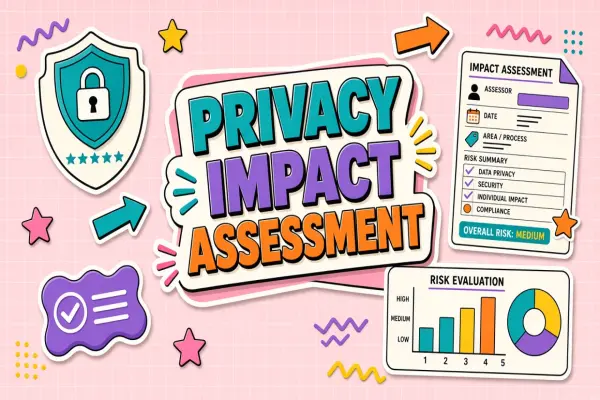
Data protection impact assessments should list each AI record type, retention period, legal basis, deletion mechanism, and subprocessors storing copies. Privacy teams sign off when retention periods align with minimization. Mismatches between privacy notice statements and actual retention durations are common enforcement targets. Update notices when AI logging expands.
Subject Access Requests
Article 15 access requests must include AI-generated content about the data subject when stored, plus meaningful information about logic involved where required. Operationalize SAR workflows that query prompt, output, and edit stores by subject identifier. Response timelines apply to AI records the same as CRM or email archives.
Shadow AI and Unmanaged Tools
Retention policy must address shadow AI: personal chat accounts, browser extensions, and pilot tools without enterprise retention controls create records your policy never captures. Discovery programs should either block unmanageable tools or fast-track enterprise tiers with export APIs. Each discovered shadow tool needs a retention decision: remediate, approve with controls, or ban with documented rationale.
Multi-Modal Outputs
Image, audio, and video AI outputs require the same retention classification as text: store generated media in object storage with lifecycle rules linked to source prompts and approval metadata. Thumbnails and CDN caches are easy to forget during deletion workflows; enumerate them in the data inventory.
Implementation Roadmap
Month one: inventory AI systems and record types; month two: publish retention matrix and wire automated expiry; month three: test deletion workflow and legal hold integration; ongoing: quarterly review and certificate template updates. Start with highest-risk systems processing personal, financial, or health data. Do not wait for perfect tooling; governed manual process beats silent over-retention.
Year one milestone: zero production high-risk AI systems without documented export path and retention class tags; deletion dry-run completed successfully at least twice with legal and privacy observers. Mature programs publish internal retention dashboards showing overdue expirations trending toward zero.
Defensible Retention, Complete Deletion
AI output records retention succeeds when prompts, outputs, edits, and logs each carry defined periods aligned to GDPR, SOX, and HIPAA where applicable, deletion workflows reach embeddings and vendors with verifiable certificates, and legal hold exceptions are documented without blocking all privacy rights. Compliance and platform teams own retention as infrastructure, not as a footnote in the acceptable use policy.