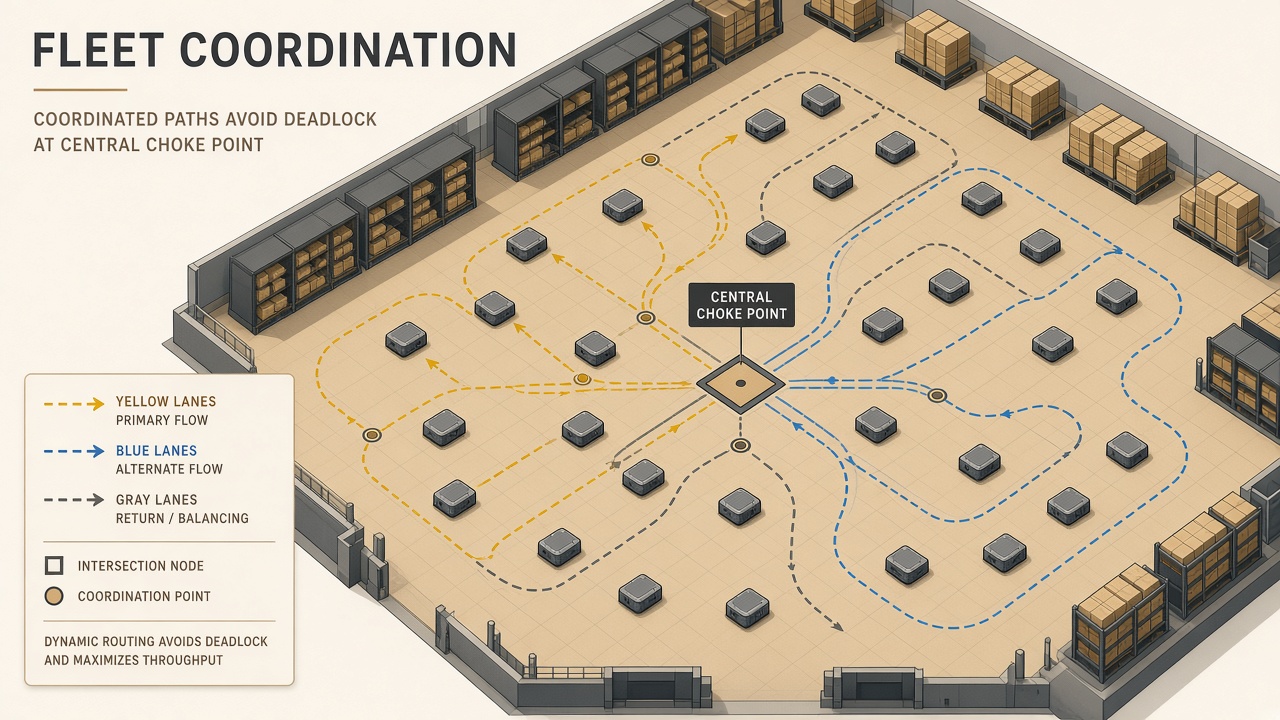
AI warehouse AMR fleet coordination assigns tasks, reserves spatiotemporal paths, and prevents deadlocks when dozens to hundreds of autonomous mobile robots share narrow aisles, elevators, and pick stations in e-commerce fulfillment centers. Vendors such as 6 River Systems (Ocado Group), Locus Robotics, Geek+, and in-house Amazon Robotics stacks combine warehouse management system (WMS) order allocation with multi-agent path finding (MAPF) solvers that reason about who moves when. Research published in 2024 and 2025 adds dynamic priority scheduling, bio-inspired traffic weights, and nonstop intersection zones. Teams studying AI research on multi-robot planning or AI research infrastructure for logistics should treat traffic rules as first-class software, not an afterthought to individual robot navigation.
AMR Growth in E-Commerce Fulfillment
E-commerce parcel growth and labor turnover pushed retailers from fixed conveyor sortation toward flexible AMR fleets that re-route when SKU mix or peak season shifts demand patterns. Goods-to-person systems (Ocado-style grids, AutoStore cubes) pair thousands of small robots with centralized orchestration. Person-to-goods AMRs (Locus, 6 River Chuck) meet pickers in aisles, cutting walk time. Both architectures hit coordination cliffs past roughly 50 to 100 simultaneous movers in shared corridors without explicit MAPF layers.
Peak events (Black Friday, grocery promo weeks) stress coordination more than steady-state throughput: order release bursts spawn competing paths to the same forward pick locations. Modern WMS modules throttle order release, batch picks by zone, and stagger AMR dispatch to smooth demand on the traffic graph. Without throttling, even optimal path planners see exponential conflict resolution cost.
Micro-fulfillment centers inside urban stores compress the problem into tighter footprints where ten AMRs can saturate aisles designed for shoppers after hours. Daytime mixed-mode operation may disable autonomous zones entirely, requiring fleet software to hot-swap traffic graphs between day and night layouts stored as versioned configuration profiles.
Mixed fleets (fork AMRs, unit-load bots, human-operated pallet jacks) add heterogeneity. Human-robot zones with speed limits, audible warnings, and geofenced autonomous-only aisles are standard in published safety guidelines even when not always visible in marketing demos.
Centralized vs Decentralized Traffic Control
Centralized fleet managers assign global paths and reservations from a single traffic server; decentralized schemes let each robot negotiate locally with neighbors, trading optimality for scalability and fault tolerance. Centralized control (typical in large Ocado or Amazon installations) maintains a world model of occupied cells, elevator queues, and battery states. Robots receive edge sequences with time windows; violations trigger replanning. Decentralized token-passing or priority inheritance works in smaller sites with simpler layouts but can deadlock in symmetric choke points without global awareness.
Hybrid architectures centralize choke points (elevators, sorters, inbound docks) while allowing local obstacle avoidance via onboard lidar between waypoints. Edge autonomy handles unexpected boxes or humans; the fleet server handles strategic deconfliction. Latency budgets matter: 100 ms round-trip to cloud may be fine for minute-scale tasks but marginal for tight intersection timing at 2 m/s.
On-premise fleet servers remain common in retailers wary of cloud dependency during peak: a local traffic controller maintains reservations even if WAN links flap, syncing state to cloud analytics asynchronously. Disaster recovery drills should verify robots enter safe stop modes when fleet servers fail rather than continuing with stale reservations that assume cleared intersections.
| Control style | Strength | Risk |
|---|---|---|
| Centralized MAPF server | Global deadlock prevention, audit logs | Single point of failure, compute at scale |
| Decentralized negotiation | Graceful degradation, lower server load | Symmetric deadlock without rules |
| Hybrid choke-point central | Balances scale and reactivity | Integration complexity |
Deadlock Prevention Algorithms
Deadlock prevention in warehouse MAPF uses path reservation, dynamic priority boosts, temporary parking grids, and nonstop intersection tiles so robots never mutually block in narrow aisles. A 2024 IEEE study on nonstop areas defines critical intersection zones where stopping is forbidden; robots extend reservations through the entire crossing so cross-traffic never waits behind a paused AMR. Trimming excess nonstop tiles improved throughput up to 12.27 percent in simulation while achieving 100 percent deadlock prevention.
Dynamic Path Block algorithms for massive AGV fleets reserve edges when a robot commits to a route, forcing others to replan around blocked segments in real time, validated in Applied Materials AutoMod simulations with physical turning constraints. A 2025 ICNSC paper uses historical path data to predict conflicts before they occur, redirecting robots to temporary wait cells when narrow passages would otherwise circular-wait.
Safe Interval Path Planning (SIPP) paired with reverse resumable A* (RRA*) appears in 2025 warehouse logistics research: upper layers adjust priorities in sliding temporal windows while lower layers find collision-free intervals. Bio-inspired ant-colony edge weighting (MDPI Applied Sciences, 2025) proactively penalizes congested cells, improving throughput up to 10 percent versus unconstrained navigation in Gazebo simulations.
Optimal MAPF solvers (CBS, ECBS) guarantee completeness on small maps but explode computationally past a few dozen agents in dense graphs. Production warehouses therefore use bounded-horizon replanning every one to two seconds with heuristic priority rules rather than global optimality proofs. Measure p95 replan latency under peak load; spikes above 500 ms correlate with visible convoying at aisle mouths in operator interviews.
Amazon Robotics and symbiotic systems vendors rarely publish internal traffic algorithms, but patent filings describe zone controllers and token-based intersection locks analogous to academic nonstop-area research. When benchmarking third-party AMR software, request deadlock incident counts per million robot-hours from reference customers, not vendor slide decks alone.
Elevator and Choke Point Scheduling
Elevators, dock doors, and sortation induct points act as serialized resources: fleet software queues AMR requests, batches compatible loads, and enforces one-way flow to avoid opposing traffic in single-lane ramps. Multi-floor fulfillment adds vertical choke points. Best practice assigns elevator time slots with buffer zones on each floor so robots do not queue in the shaft doorway. Priority rules elevate robots carrying hot orders or nearing battery critical thresholds, but starvation avoidance periodically boosts low-priority agents stuck behind high-priority waves.
Induction and decant stations benefit from virtual convoying: only N robots allowed inside a radius of the scanner to prevent lidar mutual occlusion and WMS scan collisions. When a robot fails mid-choke, recovery policies clear the zone via alternate escape routes mapped during facility digital twin commissioning.
WMS Task Allocation Integration
WMS task allocation decides which order lines become pick missions; fleet coordination decides which robot executes which mission path without collision, requiring bidirectional APIs for order priority, robot state, and exception handling. Standard integration patterns expose REST or MQTT topics: WMS publishes pick tasks with SKU location and deadline; fleet manager acknowledges assignment and reports completion, battery, and block reasons. Rejection flows return tasks to the pool when no robot can reach the aisle within SLA, triggering wave replanning upstream.
6 River Chuck robots receive work from cloud-hosted fulfillment software aligned with Shopify and major WMS connectors. Ocado Smart Platform orchestrates thousands of grid bots with proprietary WMS coupling. When evaluating vendors, ask for MAPF replan latency under peak order injection, not just picks per hour in demo videos.
Exception paths deserve first-class API design: when a pick face is empty, robots should release reservations immediately and report SKUs to WMS for inventory adjustment rather than blocking intersections while awaiting human confirmation. Stale reservations are a leading cause of phantom congestion in live deployments audited by third-party integrators.
Simulation-in-the-loop using digital twins (NVIDIA Isaac, vendor-specific tools) validates traffic rules before go-live. Historical pick path heatmaps identify candidate nonstop zones and one-way aisle conversions cheaper than adding compute for heavier MAPF solvers.
Ocado-style cube storage coordinates thousands of grid robots with centralized cell reservation; each bot moves one grid square at a time with zero overlap tolerance. Person-to-goods fleets (6 River Chuck, Locus Origin) optimize picker meet points instead, trading grid capital expense for flexible aisle retrofit. Both need WMS wave release discipline: dumping an entire promotional SKU wave without zone staggering creates artificial deadlock at forward pick faces even with perfect MAPF.
Battery swap scheduling intersects traffic control: low-state robots routed to chargers must not block emergency egress or inbound trailer doors. Fleet managers assign charging as lowest-priority tasks unless SOC drops below critical thresholds, at which point priority inversion preempts routine picks. Charging station count follows queuing theory on peak concurrent low-battery events, not average daily mileage alone.
Human-robot collaborative zones use floor markings, light curtains, and speed caps (often 0.5 to 1.0 m/s near pickers). AMR lidar detects pedestrians but does not replace training for pickers wearing hoods or pushing wide carts that extend beyond expected silhouettes. Mixed fleets with manual pallet jacks require cultural rules: humans yield at blind corners, robots announce turns with directional sound.
Frequently Asked Questions
How many AMRs before coordination matters?
Shared single-lane aisles show congestion past roughly 15 to 20 simultaneous movers; wide cross-dock layouts tolerate more. Model your facility graph, not industry averages.
Are humans and AMRs mixed safely?
Vendors implement lidar slowdown zones, flashing beacons, and separate pedestrian corridors. Training and signage remain essential; robots do not replace site safety culture.
What is MAPF in plain language?
Multi-agent path finding computes collision-free routes for many robots at once, often with time reservations, instead of each robot planning selfishly and backing up when blocked.
Can mixed-vendor fleets share one traffic server?
Rare in practice. Neutral traffic layers exist in research but commercial deployments usually standardize on one vendor stack per site or hard-separate zones by OEM.
Do reinforcement learning traffic controllers deploy in production?
RL appears in papers for adaptive priority tuning; rule-based reservation and nonstop zones remain more predictable for safety certification. Pilot RL as advisory before giving it override authority.
How fast do AMRs move under coordination?
Effective speed drops below max chassis rating when intersections throttle flow. Measure order-to-ship latency, not peak m/s, when tuning traffic rules.
Where to read warehouse robotics research?
IEEE and MDPI logistics journals publish MAPF advances yearly. For broader multi-agent AI context, browse AI research on planning and embodied coordination.
How do mixed human-robot zones work?
Facilities geofence slow-speed corridors near pick stations, require AMRs to pause when lidar detects pedestrians in marked zones, and train staff on right-of-way rules at blind intersections. Technology alone does not eliminate the need for floor markings and daily safety briefings during peak season hiring.