What is Mugato?
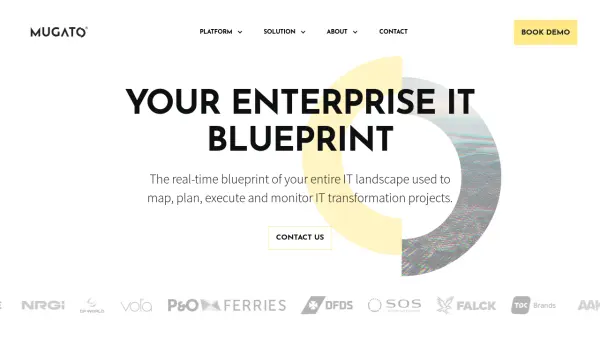
Mugato is an AI-powered IT infrastructure discovery and service dependency mapping platform that delivers a real-time, agentless blueprint of your entire IT environment. It automatically identifies all IT, IoT, OT, and public cloud devices, applications, and interactions—including unmanaged and shadow IT—eliminating blind spots. With continuous collection of relations, processes, and resource usage, Mugato provides minute-granularity temporal data for change tracking and baselines.
Its next-generation dependency mapping uses behavioral analytics and causal AI to define application services without relying on static libraries. Mugato’s fully automated service dependency mapping (SDM) clusters services into business services, bridging observability and enterprise architecture. The decision intelligence engine generates prescriptive guidance with step-by-step transformation waves, enabling users to de-risk projects, reduce costs, and increase efficiency.
Features
- Agentless Discovery: Automatically identifies all IT, IoT, OT, and public cloud devices and applications without installing agents.
- Continuous Collection: Captures relations, processes, and resource usage with minute-granularity temporal data for before-and-after insights.
- Next-Generation Dependency Mapping: Uses behavioral analytics and causal AI to define application services without static libraries.
- Fully Automated SDM: Clusters application services into business services bridging observability and enterprise architecture.
- Decision Intelligence: Generates prescriptive guidance with step-by-step transformation waves for planning and execution.
- Real-Time Updates: Provides a live view with a maximum 30-minute delay and delta syncs every 30 minutes.
- Zero Manual Tasks: Fully automated mapping from servers to application services without manual workload.
- Zero Touch: No measurable impact on network performance.
Use Cases
- Data center migration: Plan and execute seamless migrations with real-time dependency mapping.
- Microsegmentation: Identify and map all communication flows to implement zero-trust policies.
- Cost optimization: Detect zombie servers and underutilized resources to reduce infrastructure costs.
- Technical debt management: Gain visibility into undocumented connections and outdated systems.
- Disaster recovery: Define minimal viable company operations and critical path dependencies.
- Cloud transformation: Map dependencies to safely migrate applications to public or private cloud.
- Compliance and security: Uncover shadow IT and exposed connections to strengthen security posture.
- Change management: Assess impact of changes before implementation to avoid cascading failures.
FAQs
-
How does Mugato discover devices and applications without agents?
Mugato uses agentless discovery via common APIs and protocols such as WMI (Windows), SSH (Linux/UNIX), DNS, LDAP, and NMAP. It performs discovery lookups every 24 hours and delta syncs every 30 minutes to find new devices, servers, and changes without installing any software on endpoints. -
What operating systems does Mugato support?
Mugato covers all major operating systems, including Windows and Linux/UNIX servers, as well as any network-connected devices such as printers, routers, IoT devices, and more. -
How long does it take to set up Mugato?
Installation takes about 30 minutes. After installation, Mugato processes and computes data for approximately two weeks. Manual workload is minimal, typically two hours per 500 servers for initial fine-tuning. -
How often is the IT inventory updated?
Full inventory discoveries run every 24 hours, with delta syncs every 30 minutes to maintain a near-real-time view. All data points are temporal and can be reviewed back in time with minute-level granularity. -
What types of IT infrastructure can Mugato map?
Mugato maps all types of IT infrastructure: physical or virtual servers, on-premises or cloud deployments (public or private), across any architecture. It also discovers unknown devices like printers, load balancers, storage devices, routers, wireless access points, game consoles, IoT devices, and surveillance equipment.