What is l1m?
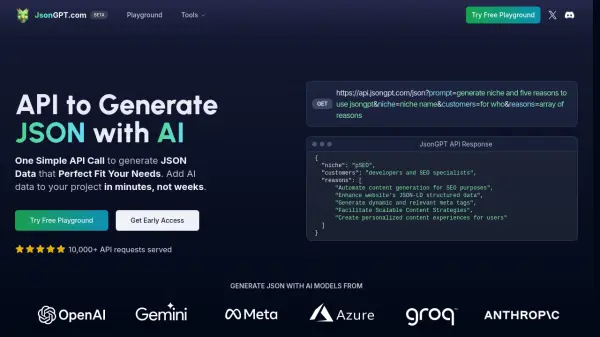
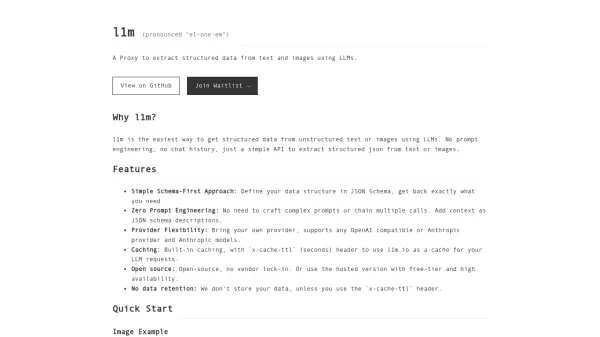
l1m (pronounced "el-one-em") serves as an intermediary API designed to streamline the extraction of structured data from unstructured text and images through the use of Large Language Models (LLMs). Its primary advantage lies in simplifying this process by eliminating the need for complex prompt engineering or managing chat histories. Users interact with a straightforward API, providing their unstructured input (text or image) alongside a JSON schema that defines the desired output structure.
The tool emphasizes ease of use and flexibility. It operates on a schema-first approach, ensuring the output precisely matches the user-defined JSON schema. l1m supports various LLM providers, including any OpenAI compatible or Anthropic provider, allowing users to integrate their preferred models. It also offers built-in caching capabilities controlled via headers and is available both as an open-source solution and a managed hosted version, ensuring no vendor lock-in and catering to different deployment needs. Data privacy is considered, as the service does not retain user data unless caching is explicitly activated.
Features
- Simple Schema-First Approach: Define data structure in JSON Schema to get precisely formatted output.
- Zero Prompt Engineering: Eliminates the need for complex prompts; context is added via schema descriptions.
- Provider Flexibility: Supports any OpenAI compatible or Anthropic LLM provider and models.
- Built-in Caching: Offers optional request caching using the `x-cache-ttl` header.
- Open Source: Available as an open-source tool or a managed hosted version.
- No Data Retention: User data is not stored unless caching is enabled.
Use Cases
- Extracting structured data (e.g., items, prices) from images like menus or invoices.
- Parsing specific information (e.g., dates, names, locations) from blocks of text.
- Converting natural language descriptions into structured JSON objects.
- Implementing automated data entry from unstructured sources.
- Routing user requests based on content by extracting intent or keywords.
- Integrating structured data extraction with local LLMs like Ollama.