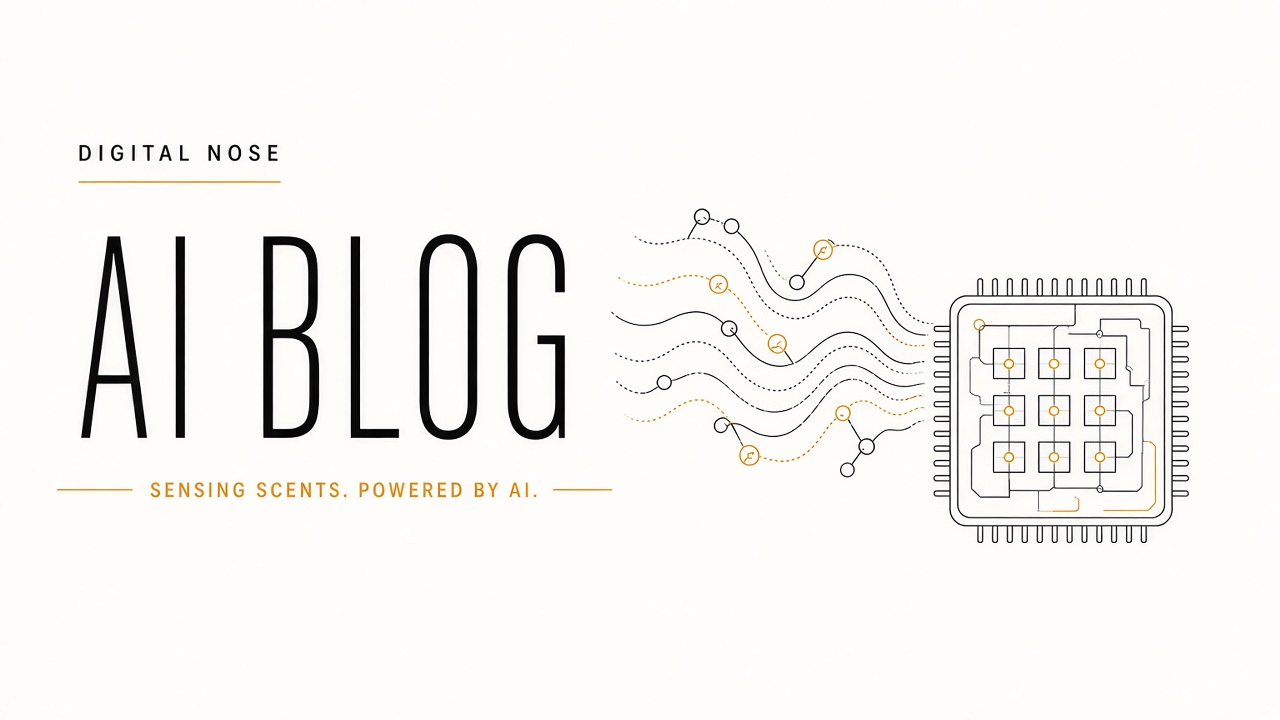
A quality inspector opens a shipping container of fruit and smells something off, but cannot name the compound or decide whether the lot must be rejected. A digital nose AI system pulls air across an array of gas sensors, records how each channel responds, and runs a classifier trained on labeled samples to flag spoilage, adulteration, or contamination in seconds. The hardware mimics biological olfaction: no single sensor identifies every molecule; the pattern across the array carries the information. Machine learning turns those patterns into decisions for food safety lines, environmental monitoring, and experimental breath screening in hospitals. Teams evaluating automation often compare e-nose workflows with AI chatbot assistants that draft SOPs but cannot replace calibrated instruments. More research explainers live on the blog index.
What Digital Nose AI Means
A digital nose (electronic nose or e-nose) is an instrument that uses a sensor array, signal conditioning, and pattern recognition software to classify or quantify odors, and digital nose AI refers to the machine learning layer that maps sensor fingerprints to labels. Unlike gas chromatography mass spectrometry, most e-noses trade chemical specificity for speed, lower cost, and inline deployment. Each sensor is deliberately cross-sensitive: tin dioxide, zinc oxide, and related metal oxide semiconductors change resistance when exposed to volatile organic compounds (VOCs), but none report a full molecular formula alone.
The AI problem is supervised or semi-supervised classification on high-dimensional time series: baseline drift, humidity, temperature, and sensor aging all shift raw readings. Production systems baseline-correct signals, extract features (steady-state resistance, rise time, area under curve), reduce dimensionality, then apply models from linear discriminant analysis to random forests and neural networks. Success depends more on consistent sampling geometry and retraining discipline than on exotic model architecture.
Sensor Arrays and Metal Oxide Hardware
Commercial e-noses most often use chemiresistive metal oxide semiconductor (MOS) sensors, sometimes mixed with conducting polymers, quartz crystal microbalances, or optical channels for richer fingerprints. MOS materials include SnO₂ doped with catalytic metals (palladium, platinum), ZnO, CuO, In₂O₃, WO₃, and TiO₂. Operating temperature, catalyst choice, and film morphology tune sensitivity profiles so channels respond differently to the same VOC mix.
Research arrays built by electrospinning nanofibers (SnO₂, CuO, In₂O₃, ZnO) demonstrate how nanostructured surfaces boost sensitivity to breath-related VOCs at room or modest elevated temperatures. Arrays may contain four to thirty-two channels; more channels can improve separability but increase calibration and drift maintenance. Packaging must control airflow, humidity, and temperature because MOS sensors are notoriously humidity sensitive without compensation algorithms.
| Sensor type | Response mechanism | Typical tradeoff |
|---|---|---|
| MOS (SnO₂, ZnO, etc.) | Resistance change on VOC adsorption | Fast, low cost; humidity and heat management |
| Conducting polymers | Swelling/conductivity shifts | Room temp options; stability varies |
| MOF-coated sensors | Porous selective layers | Better selectivity; manufacturing complexity |
| Optical / colorimetric | Dye arrays reacting to headspace | Disposable cartridges; batch calibration |
AI Pipeline: From Signal to Label
The digital nose AI pipeline captures multichannel sensor trajectories, preprocesses them, extracts features, trains a classifier on labeled odors, and deploys with drift monitoring and periodic recalibration. Preprocessing includes baseline subtraction, normalization to reference gas, humidity compensation, and alignment of sampling windows (for example five to sixty seconds after exposure). Feature extraction may use hand-crafted statistics or end-to-end deep learning on raw curves; industrial systems often keep interpretable features for regulatory documentation.
Classical workflows apply principal component analysis (PCA) for visualization and dimensionality reduction, then linear discriminant analysis (LDA), support vector machines (SVMs), k-nearest neighbors, or random forests. Deep models (1D CNNs, LSTMs) can learn features directly when training data are abundant and labeling is trustworthy. Ensemble methods and probabilistic outputs help operators reject low-confidence decisions instead of forcing a wrong class on borderline samples.
Training data and validation
E-nose models are only as good as the odor library collected under production-like conditions. Labs must capture inter-batch variation, seasonal fruit differences, packaging materials, and background air. Hold-out validation on new production days catches overfitting to a single week of samples. For medical breath studies, confounders include diet, smoking, and comorbidities; classifiers trained on small cohorts rarely generalize without external validation sites.
Food Quality and Safety Deployments
MOS-based e-noses appear in food freshness grading, spoilage detection, adulteration screening, and process monitoring for meat, fish, dairy, grains, beverages, olive oil, nuts, and produce. Reviews document applications distinguishing ripe versus overripe fruit, detecting microbial spoilage volatiles, and flagging off-odors in packaged goods faster than periodic chromatography lab tests. Inline systems sample headspace above conveyor belts or storage bins, triggering reject gates when the classifier exceeds a spoilage score threshold.
Reported classification accuracies above eighty-five percent appear in controlled studies for specific product lines, but real plants must handle mixed SKUs, cleaning chemical residues, and temperature swings. Successful deployments pair e-noses with human sensory panels for dispute resolution and maintain golden reference samples for weekly recalibration. E-noses complement rather than replace legal metrology when regulations specify chromatography methods.
| Application | Target signal | Deployment note |
|---|---|---|
| Meat and fish freshness | Biogenic amines, sulfur volatiles | Cold chain consistency critical |
| Olive oil authenticity | Adulteration headspace profile | Geographic origin claims need legal review |
| Grain storage | Mold and mite VOC signatures | Ventilation affects baseline |
| Beverage QC | Off-flavor batches | Pair with lab GC for disputes |
Medical Breath and Clinical Research
Medical e-nose research analyzes exhaled breath VOC fingerprints as a non-invasive screen for lung cancer, chronic obstructive pulmonary disease (COPD), and other conditions where metabolism shifts gas composition. MOS arrays are attractive because they respond quickly and cost less than full spectrometry suites, but clinical adoption demands rigorous trials, standardized breath collection ( Tedlar bags, thermal desorption, controlled exhalation pressure ), and multi-site validation. Published reviews emphasize promise alongside limitations: sensor drift, humidity, overlapping comorbidities, and inability to name individual biomarkers without orthogonal chemistry.
Regulatory paths treat breath classifiers as medical devices when claims include diagnosis or triage. Research prototypes must not be marketed as hospital-ready without clearance. Hospitals experimenting with digital nose AI should document IRB approval, comparator tests (spirometry, imaging), and explicit uncertainty messaging for patients. Positive lab AUC values on dozens of subjects do not equal population screening performance.
Environmental and industrial uses
Beyond food and medicine, e-noses monitor indoor air quality, detect leaks in industrial plants, and support agricultural ripeness sorting. The same AI stack applies: array response, feature pipeline, classifier, drift watch. Environmental deployments battle outdoor humidity and interfering pollutants; industrial sites add safety certification for explosive atmospheres when sensors operate hot.
Limits, Risks, and Ethical Guardrails
Digital nose AI fails quietly when sensors drift, humidity spikes, or training data omit a new contaminant; operators may trust a green light that reflects model overconfidence, not safety. MOS sensors need periodic baseline checks and replacement schedules. Black-box deep models complicate root cause analysis after a false negative on a spoiled shipment. Medical false positives cause unnecessary anxiety and follow-up costs; false negatives delay treatment.
Ethical guardrails include transparent limits of detection, human override for borderline scores, and refusal to infer protected attributes (ethnicity, disability) from breath patterns without scientific and legal justification. Food buyers should not use e-nose adulteration scores as sole evidence in supplier termination without confirmatory lab analysis. Document sensor firmware versions and model hashes when decisions affect health or contract penalties.
- Humidity and temperature compensation must be validated per site
- Sensor aging requires scheduled recalibration or replacement
- Cross-sensitive arrays cannot identify unknown VOCs without retraining
- Small medical cohorts overfit; demand external replication
- Consumer "phone smell" apps lack controlled sampling and remain toys
Who Should Adopt Digital Nose AI
Food manufacturers with repeatable headspace sampling, environmental teams monitoring known VOC classes, and research hospitals running IRB-approved breath studies are good fits today; general practitioners and consumers should wait for cleared devices. Quality teams gain most when e-noses sit on a single product line with stable packaging and frequent labeled samples for retraining. Multi-SKU plants need either multiple models or robust transfer learning pipelines, which many vendors undersell.
Procurement should ask vendors for drift specs, humidity range, mean time between calibration, and on-site validation results on the buyer's matrix, not only published paper accuracies. Integrators comparing AI chatbot documentation tools should still require instrument traceability; chat drafts cannot substitute calibration logs. Start with pilot lines, parallel human sensory or lab testing, and explicit rollback if false alarm rates disrupt operations.
Pairing E-Nose with Lab Analytics
Mature quality programs treat digital nose AI as a front-line screener and chromatography or mass spectrometry as the referee for disputed lots. When the classifier flags an anomaly, a retained sample moves to the lab for compound identification, root cause analysis, and supplier feedback. This two-tier design keeps line speed while preserving legal defensibility. Document the chain from sensor score to lab report ID so audits trace decisions without relying on black-box probabilities alone.
Implementation Checklist
- Define decision: pass/fail, grade bucket, or anomaly score only.
- Match sensor chemistry to target VOC class (MOS vs polymer vs MOF).
- Build labeled library across seasons, suppliers, and failure modes.
- Split train/validation by production day, not random rows.
- Deploy humidity and temperature probes tied to classifier inputs.
- Schedule recalibration and log model version with each batch record.
- Keep chromatography or human panel path for disputed calls.
Frequently Asked Questions
How is a digital nose different from GC-MS?
Gas chromatography mass spectrometry identifies and quantifies specific compounds with high specificity but needs lab time, skilled operators, and cost per sample. E-noses classify odor patterns quickly and cheaply but rarely spell out every molecule. Many plants use e-noses for continuous screening and GC-MS for confirmatory testing when the e-nose flags an anomaly.
Why are metal oxide sensors so common in e-noses?
MOS sensors are mature, inexpensive, and respond to a wide range of VOCs when heated, making them ideal for cross-sensitive arrays. SnO₂ with catalytic dopants dominates commercial offerings. Tradeoffs include power for heating elements, humidity sensitivity, and gradual baseline drift that demands maintenance.
Can digital nose AI guarantee food safety?
No single sensor system guarantees safety. E-noses reduce risk by catching spoilage trends early when validated on the same product and packaging. Regulations may still require microbial tests or specified analytical methods. Treat e-nose output as one layer in a HACCP-style program, not a universal certificate.
Is breath diagnosis with e-noses clinically proven?
Peer-reviewed studies report encouraging classification metrics for some diseases, but few e-nose breath products are widely cleared for standalone diagnosis. Evidence quality varies by cohort size, confounder control, and external validation. Patients should follow clinician-ordered tests, not consumer breath gadgets marketed with overstated AI claims.
How do teams handle sensor drift?
Drift mitigation combines periodic exposure to reference gases, adaptive baselines, scheduled sensor replacement, and retraining when production conditions shift. Software-only fixes without hardware maintenance fail in months. Log drift metrics and trigger alerts when baseline variance exceeds control limits.
Which machine learning model works best?
Random forests and SVMs remain strong baselines on hand-crafted features for small to medium datasets. Deep learning helps when thousands of labeled curves exist and labeling noise is low. Model choice matters less than representative training data, rigorous validation splits, and operational monitoring after deployment.
Conclusion
Digital nose AI combines cross-sensitive sensor arrays (especially metal oxide semiconductors) with signal processing and classifiers to flag food spoilage, monitor industrial air, and explore breath-based medical screens. The approach trades molecular specificity for speed and inline deployment, which suits quality control when teams invest in calibration, drift management, and confirmatory testing. Adopt e-noses where sampling is controlled and labels are abundant; wait on clinical or legal claims until devices and models pass validation suited to the risk level. More AI research topics are on the blog index.