What is COMSOL Multiphysics?
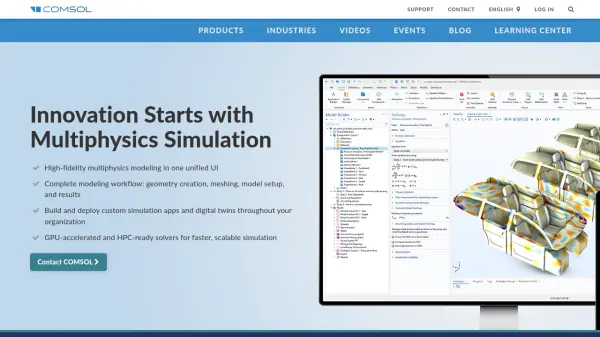
COMSOL Multiphysics® is a sophisticated simulation software platform that enables engineers and researchers to create physics-based models and simulation applications. The software provides a unified user interface that remains consistent across different engineering applications and physics phenomena, facilitating a complete modeling workflow from geometry creation and meshing to model setup and results analysis.
The platform supports the combination of multiple physics in any order for realistic simulations of real-world phenomena. With add-on modules for specialized functionality in electromagnetics, structural mechanics, acoustics, fluid flow, heat transfer, and chemical engineering, users can interface directly with CAD and other third-party software through LiveLink™ products. The software also includes tools for building custom simulation applications and deploying them throughout organizations using COMSOL Compiler™ and COMSOL Server™.
Features
- Unified Interface: Consistent user experience across all engineering applications and physics phenomena
- Complete Workflow: End-to-end modeling from geometry creation to results analysis
- Multiphysics Capabilities: Combine multiple physics in any order for realistic simulations
- Specialized Modules: Add-on functionality for electromagnetics, structural mechanics, acoustics, fluid flow, heat transfer, and chemical engineering
- Application Development: Tools to build custom simulation apps with Application Builder
- Deployment Options: Compile standalone apps with COMSOL Compiler and distribute via COMSOL Server
- GPU Acceleration: High-performance computing ready solvers for faster simulations
- CAD Integration: Interface directly with CAD software through LiveLink products
Use Cases
- Electric vehicle battery design optimization
- Acoustic device development and testing
- Structural dynamics analysis for engineering components
- Fluid flow simulation in industrial processes
- Heat transfer modeling in thermal systems
- Chemical engineering process simulation
- Electromagnetic device design and analysis
- Manufacturing process optimization through simulation
FAQs
-
What engineering disciplines does COMSOL Multiphysics support?
The software supports electromagnetics, structural mechanics, acoustics, fluid flow, heat transfer, and chemical engineering through specialized add-on modules. -
Can I create custom simulation applications with this software?
Yes, the Application Builder provides tools to build custom simulation apps that can be deployed throughout your organization. -
How does COMSOL handle integration with other software?
LiveLink products enable direct interface with CAD and other third-party software for seamless workflow integration. -
What deployment options are available for simulation apps?
Apps can be compiled into standalone executables with COMSOL Compiler or distributed via web browser using COMSOL Server. -
Does the software support high-performance computing?
Yes, it includes GPU-accelerated and HPC-ready solvers for faster, scalable simulations.