OpenAI called for mandatory national AI safety requirements on September 9, 2026, the same week California Governor Gavin Newsom signed SB 813, AB 1405, and companion bills establishing independent assessor infrastructure and auditor standards. Reuters reported OpenAI wants capability-based federal testing, independent assessments, cybersecurity rules, and incident reporting while Congress still lacks a comprehensive AI statute. The White House's December 2025 executive order pushes preemption of burdensome state laws, but it does not by itself invalidate California enforcement.
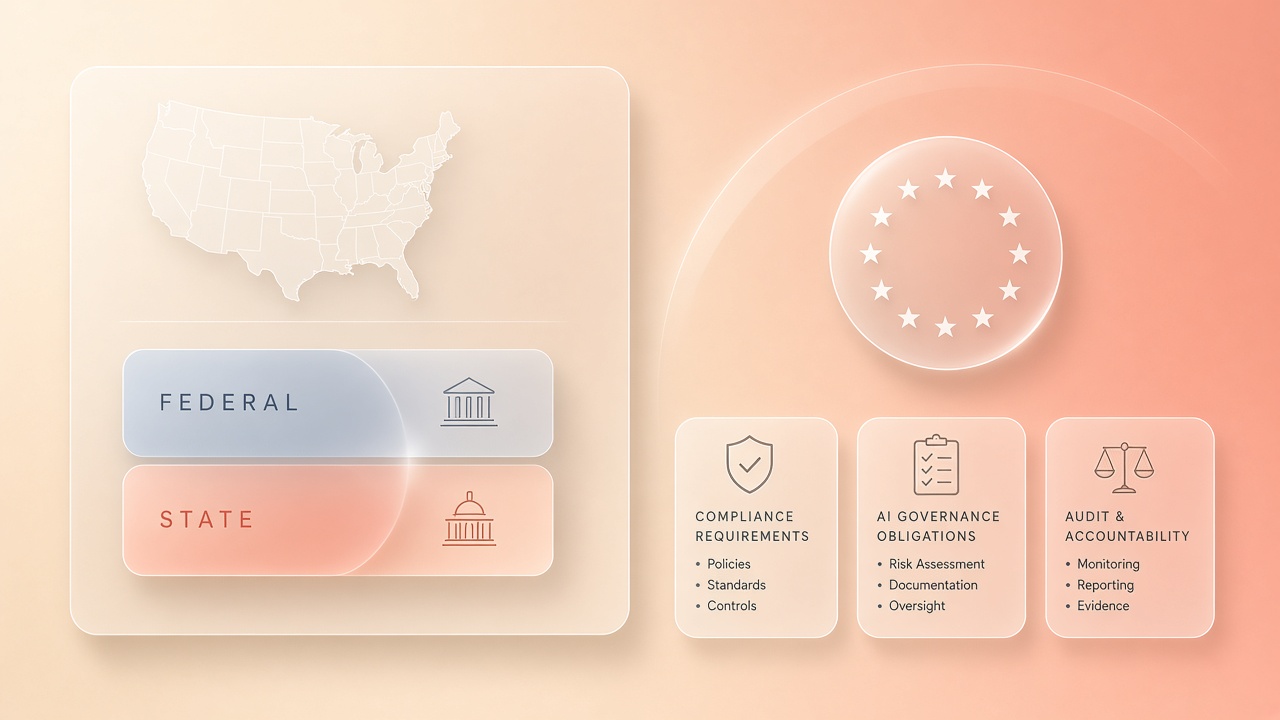
This explainer maps OpenAI federal state AI rules overlap: what OpenAI's proposal would cover, how California and New York frontier laws compare, where EU AI Act duties add global constraints, and how compliance teams should prioritize obligations when federal preemption remains unsettled. Links: AI regulation directory and AI chatbot governance resources.
OpenAI Federal Safety Proposal Summary
OpenAI urges Congress to enact mandatory, capability-based national rules covering testing standards, independent technical assessments, cybersecurity protections, and serious-incident reporting for frontier developers, while continuing to support compatible state legislation until federal text passes. Chris Lehane's September 2026 policy post described four pillars: federal mandates, state momentum, industry standards, and international coordination.
Reported federal elements align with Senate negotiators' duty-of-care framework:
- Thresholds tied to training compute, capability benchmarks, or revenue for frontier developers
- Common testing protocols and qualified independent assessors with secure model access
- Cybersecurity requirements for weights, training clusters, and agent toolchains
- Incident reporting to federal authorities with defined timelines for imminent vs serious risks
- Authority to slow or halt development when catastrophic risks cannot be mitigated
OpenAI labels state support as "reverse federalism": California SB 53, New York RAISE Act, Illinois SB 315, and Massachusetts frontier proposals create a de facto national baseline Congress could codify. The company endorsed four additional California bills on September 9: SB 813 (assessor infrastructure), AB 1405 (auditor standards), SB 1119 (youth protections), and AB 1864 (biological threat safeguards).
State Law Comparison and Preemption Risk
California frontier laws focus on public risk frameworks, independent assessments, and transparency, while Senate and House drafts would preempt some state development rules if enacted with preemption clauses. Baker Botts' January 2026 survey notes federal deregulation signals coexist with aggressive state enactments, creating compliance overlap until courts or Congress resolve conflicts.
| Obligation area | OpenAI federal ask | California (SB 53, SB 813, AB 1405) | Preemption if Senate bill passes |
|---|---|---|---|
| Independent testing | Federal assessor qualifications and secure access | SB 813 designates qualified assessors; AB 1405 sets auditor standards | Likely harmonized or federalized per House draft themes |
| Risk frameworks | Capability-based duty of care and incident reporting | SB 53 requires frontier developer risk disclosures | Disputed; Cantwell opposes weak federal floor |
| Youth safety | Not central to OpenAI federal ask | SB 1119 and companion chatbot laws | May survive if preemption targets development only |
| Transparency / watermarking | Incident-focused, not content labeling | SB 942 portions cited in House preemption docs | Partial preemption proposed in Obernolte-Trahan draft |
| Enforcement | Federal agency plus court blocking | State AG and regulatory actions | Dual track until preemption litigated |
Roll Call reported a bipartisan House discussion draft with three-year preemption of state laws regulating AI model development, not deployment. California AB 2013 training-data summaries and parts of SB 942 watermarking were named as likely preempted, while frontier safety statutes could be "federalized" under that framework.
EU Overlap Map for Global AI Firms
EU AI Act GPAI obligations on systemic risk, documentation, and incident reporting run in parallel with U.S. federal and state proposals, so multinationals cannot assume U.S. preemption reduces global duties. OpenAI's September post explicitly calls for international alignment on testing and incident sharing even if that slows capability releases.
| Compliance theme | U.S. federal proposal (OpenAI-aligned) | EU AI Act (GPAI / systemic risk) | Overlap note |
|---|---|---|---|
| Model evaluation | Independent technical assessments | Evaluations and adversarial testing for systemic risk models | Assessor credentials may differ; evidence can be reused with mapping |
| Incident reporting | Serious safety incidents to federal authorities | Serious incidents to AI Office under Article 55 rules | Timelines and definitions require separate trackers |
| Cybersecurity | Weight and training cluster protections | Cybersecurity for GPAI with systemic risk | Joint security program likely satisfies both if scoped globally |
| Documentation | Risk management and testing records | Technical documentation and summaries | EU public summary rules may exceed U.S. federal draft |
If Congress preempts California development rules but EU duties remain, global labs still need California-class assessor pipelines for EU market access and may voluntarily maintain California compliance for political and customer trust reasons even when federal law supersedes state statutes.
Compliance Prioritization for Enterprises
Until federal text passes, treat California frontier and assessor laws, EU AI Act GPAI timelines, and contractual customer security questionnaires as binding, while monitoring Senate preemption clauses as a planning scenario rather than current law. OpenAI's dual track (federal lobbying plus state endorsements) signals that harmonization will be gradual.
- Map whether your organization meets frontier developer thresholds in California, New York, Illinois, or proposed federal definitions
- Stand up incident reporting playbooks that satisfy the strictest imminent-risk timeline among EU, state, and draft federal rules
- Qualify independent assessors against both SB 813 infrastructure and anticipated federal credentialing
- Separate deployment obligations (consumer protection, youth safety, watermarking) from development duties when evaluating preemption exposure
- Document cybersecurity controls for weights and agents to reuse across U.S. and EU audits
The December 2025 White House order created an AI Litigation Task Force to challenge inconsistent state laws, adding litigation uncertainty. Enterprises should avoid assuming executive orders replace statutory California requirements without court rulings or congressional action.
Frequently Asked Questions
Why does OpenAI support state bills while pushing federal rules?
OpenAI describes "reverse federalism": state laws build assessor infrastructure and safety norms Congress can codify. Until federal passage, state rules fill the vacuum. OpenAI endorsed California bills the same day it urged congressional action.
Does federal law preempt California today?
No comprehensive federal AI safety statute preempts California as of September 2026. Executive branch preemption efforts and litigation may challenge specific state rules, but SB 53 and September 2026 California signings remain enforceable unless struck down or superseded by statute.
What do SB 813 and AB 1405 add beyond SB 53?
SB 813 establishes processes to designate qualified independent organizations for AI risk assessments. AB 1405 sets standards for AI auditors. Together they operationalize independent testing OpenAI wants at the federal level.
If U.S. federal rules pass, can we drop EU AI Act work?
No. EU market access still requires AI Act compliance for GPAI and systemic risk models. U.S. federal rules may reduce duplicate U.S. state paperwork but do not replace EU obligations.
Do API deployers face the same rules as model trainers?
House discussion drafts distinguish development from deployment preemption. Deployers may remain subject to state consumer, employment, and transparency laws even if training rules are federalized. Contractual pass-through duties from frontier labs are likely regardless of preemption outcomes.