M-RADAR (Maritime Reconstruction via Automated Digital Analysis and Restoration) is a computational epigraphy framework that reconstructs damaged inscription segments by comparing the fragmentary Singapore Stone with the better-preserved Karimun Inscription, reporting 78.4 percent morphological correspondence and 89 percent predictive reconstruction accuracy on damaged segments. The pipeline combines noise reduction, vector grapheme analysis, nearest-neighbor classification, and probabilistic syntax modeling. Findings support a Sanskrit-Kawi hybrid reading hypothesis and suggest shared paleographic traditions across the maritime Malay Archipelago. Researchers tracking AI research on digital humanities or AI research infrastructure for low-resource epigraphy should compare M-RADAR with conservative Markov imputation methods that prioritize auditable local hypotheses.
Challenge of Shattered Epigraphic Records
Fragmentary inscriptions resist decipherment because missing graphemes destroy syntactic context, weathering erases diacritics, and single-stele statistics rarely support confident bigram models. The Singapore Stone, blasted in 1843 and now represented by a sole surviving fragment, has puzzled scholars for nearly two centuries. Large gaps between readable characters prevent traditional philological reconstruction. Without cross-inscription evidence, each missing symbol could belong to multiple historically attested words.
Southeast Asian epigraphy adds script mixing: Sanskrit religious formulae written in Kawi-derived characters appear alongside local Malay lexical items. Diacritic loss changes vowel readings and therefore meaning. Physical fragmentation further scatters characters across rubble, so spatial adjacency on the original stele is uncertain. Computational methods must therefore combine shape similarity with linguistic priors rather than treating restoration as pure image inpainting.
A separate 2026 study on the Singapore Stone using smoothed first-order Markov transitions achieved only 46.7 percent top-one accuracy on masked-character recovery, emphasizing transparency over bold completion. M-RADAR pursues higher predictive scores by borrowing morphology from a related inscription, a strategy philologists have used informally but rarely quantified at scale.
Morphological Reference Corpora
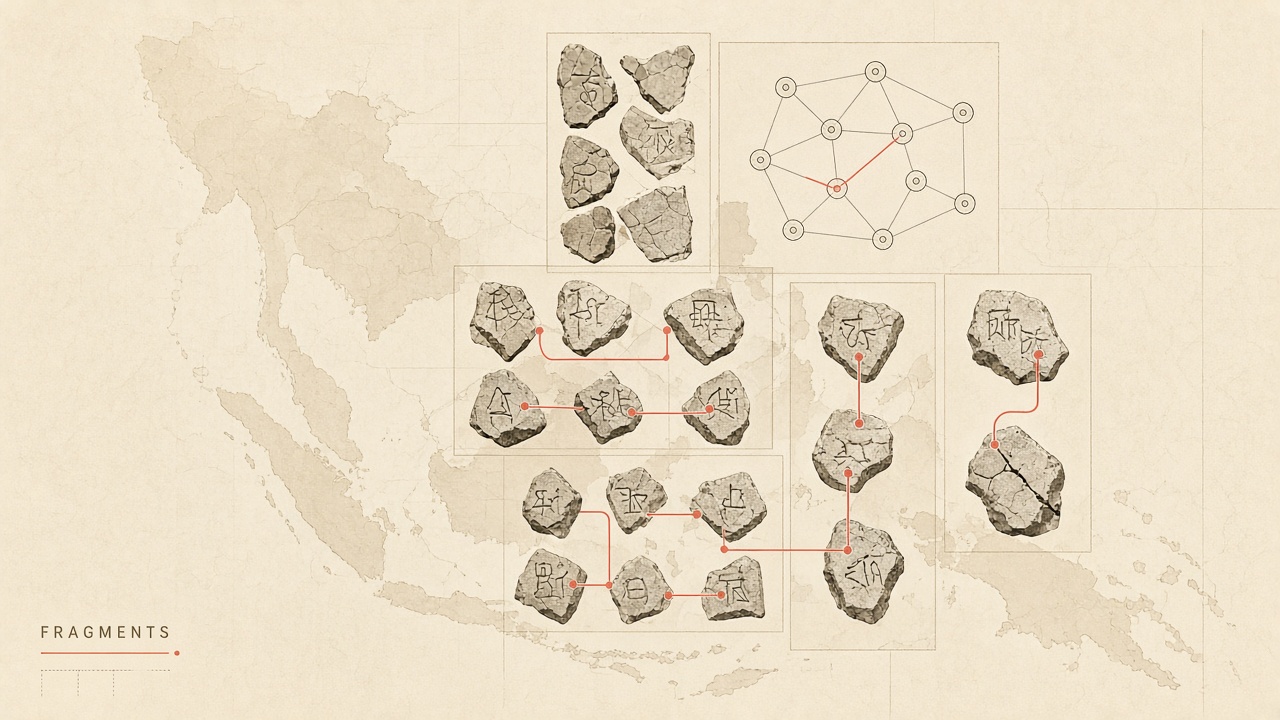
M-RADAR uses the Karimun Inscription as a morphological reference corpus because its graphemes remain more complete and legible than the Singapore Stone fragments. High-resolution imaging after noise reduction yields vector representations of each surviving character on both stones. Researchers align script families, period, and geographic origin before trusting cross-inscription transfer. The 78.4 percent morphological correspondence figure quantifies how often grapheme shapes match between corpora after normalization.
Reference corpus quality dominates outcomes. If the Karimun text diverges in scribal hand or chronology, borrowed shapes mislead reconstruction. M-RADAR authors argue the correspondence rate justifies treating the pair as paleographic siblings within a maritime network stretching across the Strait of Malacca. Additional steles from the same tradition would strengthen or refute that claim.
Building reference corpora for other regions means digitizing rubbings, normalizing scale, and documenting provenance. UNESCO and national heritage agencies increasingly fund 3D scans, but open grapheme-level labels remain scarce. Community epigraphers should retain veto power over which reference texts enter automated pipelines affecting culturally sensitive readings.
Vector Grapheme Nearest Neighbors
Each detected grapheme is embedded as a vector; nearest-neighbor search maps damaged or partial shapes to candidate characters observed in the reference inscription. Vector grapheme analysis captures stroke topology rather than raw pixel similarity, helping match fragments where only part of a character survives. Classification scores rank candidates per missing slot, producing a lattice of alternatives epigraphers can audit instead of a single forced reading.
Nearest-neighbor methods fail gracefully when no close match exists: low similarity scores signal that cross-inscription transfer is unreliable for that position. Combining vector distance with syntactic constraints prunes implausible neighbors even when shape alone looks tempting. This hybrid design mirrors human practice of rejecting paleographically possible but grammatically impossible completions.
The framework also flagged previously unrecognized diacritic markers on Singapore Stone imagery, illustrating how quantitative comparison surfaces features easy to miss in manual inspection. Diacritic recovery changes vocalization and therefore translation hypotheses for Sanskrit loanwords embedded in the text.
| Component | Function | Reported outcome |
|---|---|---|
| Noise reduction | Clarify faint strokes on weathered stone photos | Cleaner grapheme boundaries for embedding |
| Vector grapheme match | Nearest-neighbor shape correspondence | 78.4% morphological correspondence |
| Syntax model | Probabilistic character sequence scoring | 89% segment reconstruction accuracy |
| Markov baseline (separate study) | Local transition statistics only | 46.7% top-one masked recovery |
Probabilistic Syntactic Modeling
After shape candidates are proposed, a probabilistic syntax model scores full sequences, favoring readings that respect attested Sanskrit-Kawi hybrid patterns. Isolated nearest neighbors can produce locally plausible characters that violate grammar when assembled. Joint sequence scoring reduces such errors by evaluating completions in context. The 89 percent predictive reconstruction accuracy applies to damaged textual segments where both shape and syntax constraints apply.
Probabilistic outputs should be presented as ranked hypotheses with confidence intervals, not museum placard translations. Epigraphers remain responsible for final publication. Computational epigraphy succeeds when it accelerates hypothesis generation for expert review, not when it bypasses peer critique.
Syntax models trained on one inscription pair may overfit maritime Malay formulas. Applying M-RADAR templates to Mainland Southeast Asian Khmer or Cham corpora requires retraining transition statistics and validating reference stele relationships independently.
Fragmentary inscription AI also informs disaster response when earthquakes shatter museum steles. Emergency teams can photograph shards in situ, run M-RADAR style alignment against pre-disaster scans, and prioritize conservation glue joins that restore readable sequences. Speed matters when rubble faces secondary looting or weather exposure before crates reach stable storage.
Singapore Stone scholarship benefits when computational outputs sit beside colonial-era transcriptions now known to be speculative. Presenting multiple ranked readings discourages repeating nineteenth-century myths as settled fact. Digital heritage platforms should timestamp each reconstruction release so Wikipedia editors and tour guides cite the correct model generation.
Southeast Asian Paleographic Traditions
M-RADAR findings support viewing Singapore and Karimun inscriptions as products of a shared maritime scribal network rather than isolated anomalies. Sanskrit-Kawi hybrid structure aligns with other coastal epigraphic evidence from trade entrepôts. Digital reconstruction helps connect fragmentary local heritage to broader Indian Ocean cultural exchange narratives without claiming definitive political conclusions from incomplete text alone.
Regional museums can adopt the framework to prioritize which unprovenanced fragments merit new field surveys. If morphological correspondence to a known corpus exceeds a threshold, resources shift from speculative translation to targeted conservation imaging. Conversely, low correspondence flags possible forgeries or unrelated quarry marks misclassified as script.
Public education benefits when reconstructed segments are labeled provisional. Singapore heritage tours referencing the stone should distinguish between surviving physical evidence, colonial destruction history, and computational completions that may change as corpora grow.
Maritime Reconstruction via Automated Digital Analysis and Restoration pipelines should document every hyperparameter affecting the 89 percent segment accuracy claim: train-test splits, fragment length distribution, and how many candidate readings epigraphers rejected post hoc. Reproducibility checklists from computational linguistics apply equally here. Journals publishing M-RADAR inscription reconstruction results should require deposit of grapheme embeddings and anonymized rubbings where community consent allows.
Collaboration between Pakistani, Italian, and Singapore-affiliated authors on the Karimun comparison illustrates how cross-border reference corpora advance regional heritage science. Funding bodies prioritizing decolonized digitization should sponsor imaging trips to lesser-known coastal steles that might become the next morphological anchors, reducing over-reliance on a single famous fragment like the Singapore Stone survivor.
Open-source releases of grapheme embeddings would let independent labs reproduce the 78.4 percent correspondence figure without re-implementing proprietary preprocessing. Until then, cite M-RADAR fragmentary inscription reconstruction metrics as reported in the Journal of Indonesian and Malay World Studies and invite replication studies on held-out Southeast Asian shards held by regional museums willing to share imagery under community agreements.
UNESCO digitization guidelines encourage reversible documentation standards. M-RADAR outputs fit that ethos when stored as layered annotations rather than destructive edits to master rubbings. Epigraphers can accept or reject each predicted grapheme while preserving the original scan for future algorithms trained on larger maritime corpora spanning the Riau Archipelago and beyond. That workflow keeps Singapore Stone research auditable as new Karimun-quality references emerge from ongoing field seasons.
Field teams photographing stele fragments should capture raking light from multiple azimuths before noise reduction. A single flash angle can erase faint diacritic ticks that M-RADAR later needs for vector embedding. Photogrammetry meshes help when fragments are too heavy to transport, letting epigraphers rotate virtual lighting without handling weathered stone. Exporting orthographic tiles at consistent millimeters-per-pixel scale keeps nearest-neighbor grapheme distances comparable across expeditions.
Comparative frameworks like M-RADAR also support education: university seminars can assign students alternative reference corpora and compare how reconstruction rankings shift. That exercise teaches sensitivity analysis more effectively than treating computational epigraphy as a black-box oracle. When two reference inscriptions disagree, reporting both ranked outputs preserves intellectual honesty in publications and museum labels.
Frequently Asked Questions
What does M-RADAR stand for?
Maritime Reconstruction via Automated Digital Analysis and Restoration. The name reflects focus on insular Southeast Asian epigraphic materials linked to maritime trade cultures.
Is 89 percent accuracy a definitive translation?
No. The metric covers predictive reconstruction of damaged segments against held-out validation. Scholarly translation still requires philological debate and additional corpora.
How does M-RADAR handle unprovenanced fragments?
Without trustworthy reference pairings, morphological correspondence drops and the framework should refuse high-confidence completions. Provenance review precedes automated reconstruction.
Can M-RADAR detect fake inscriptions?
Low morphological match to attested corpora plus syntactic anomalies can flag suspicion, but authentication still needs material science and archival provenance checks.
Does UNESCO endorse M-RADAR?
UNESCO publishes digitization guidelines, not specific model endorsements. Align local projects with UNESCO charter principles on community participation and reversible documentation.
Will reconstructions be publicly accessible?
Open access depends on journal and museum policies. Request machine-readable grapheme labels and confidence scores when building public datasets to support reproducibility.
Where should I follow computational epigraphy?
Journal of Indonesian and Malay World Studies published the M-RADAR study in 2026. Broader methods appear in AI research venues covering digital humanities and low-resource script modeling.