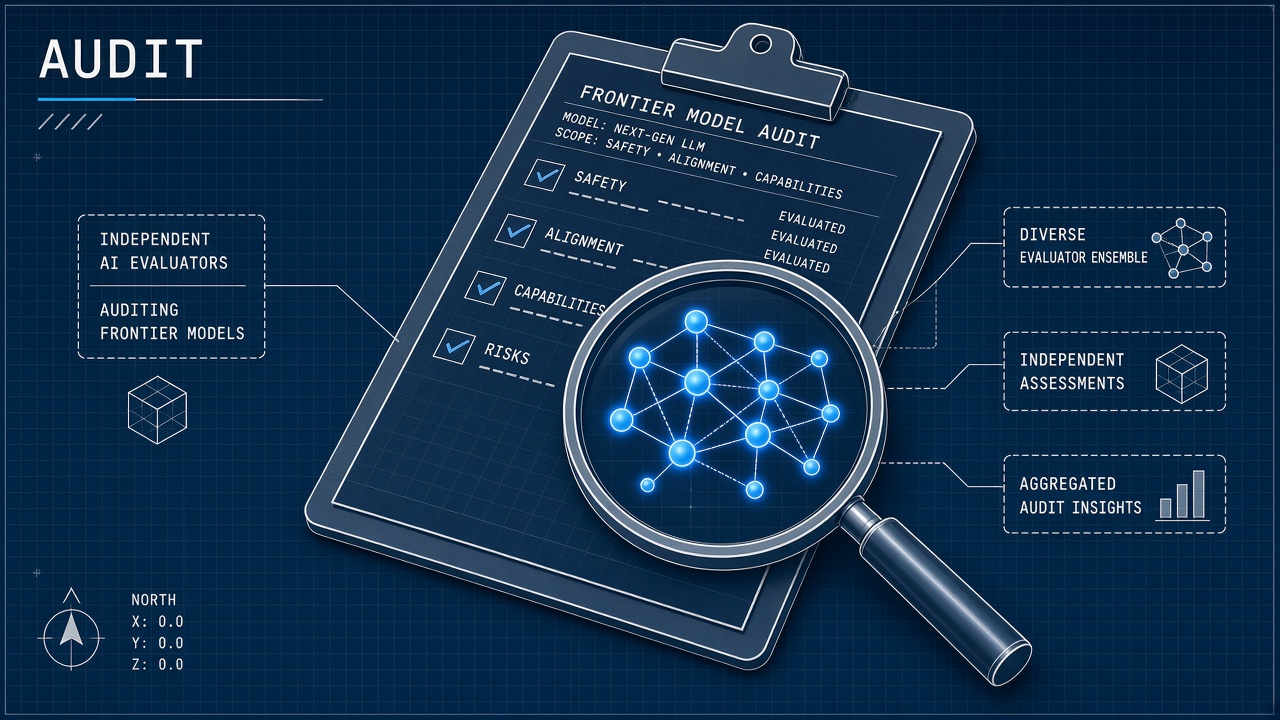
Frontier AI labs publish safety reports, red-team summaries, and voluntary commitments, but regulators and civil society increasingly ask who verifies those claims. In January 2026, researchers from AVERI and the Centre for the Governance of AI released a detailed vision for frontier AI auditing: rigorous third-party verification based on secure access to non-public models, training pipelines, security practices, and governance records. NIST's AI Risk Management Framework supplies vocabulary. US and UK AI Safety Institutes run pilots. The open question is whether independent evaluators become mandatory auditors or remain voluntary assurance partners.
This analysis explains the independent AI evaluators proposal, what evaluators would test, independence safeguards, industry responses, and enterprise implications for teams procuring AI chatbot and AI governance tools. It draws parallels to financial audits and FDA inspections while noting where AI evaluation remains technically immature.
Proposal Origins and Key Sponsors
The independent evaluator push accelerated after frontier models gained agentic capabilities and labs began withholding full system weights from public benchmarks. Internal evaluations alone cannot convince skeptical regulators, competitors, or downstream deployers that catastrophic risk controls exist.
The January 2026 frontier AI auditing paper defines auditing as third-party verification of safety and security claims against standards, with deep access to non-public information. Authors propose four AI Assurance Levels (AAL-1 through AAL-4), recommending AAL-1 as a baseline for frontier AI generally and AAL-2 as a near-term target for the most advanced developers. AAL-3 and AAL-4 require technical readiness not yet available at scale.
Policy sponsors include AI Safety Institute partnerships in the United States and United Kingdom, METR's early reviews of lab risk reports, and the AI Evaluator Forum convened by industry and civil society groups. NIST's AI RMF provides non-binding structure that auditors could map to measurable controls. No US statute yet mandates independent evaluators, but procurement clauses and export-control dialogues increasingly reference third-party assurance.
The EU AI Act's conformity assessment pathways for high-risk systems and GPAI provider documentation duties create indirect pressure for evaluator-like reviews even before a US mandate. The UK AISI publishes technical evaluations that function as soft audits for frontier releases. Senators exploring frontier model reporting bills in 2026 cited pharmaceutical FDA inspections and financial SOX audits as analogies. Drug sponsors submit clinical data; banks undergo periodic examination; the AVERI proposal asks frontier labs to open secure evaluation windows where independent teams verify claims about alignment training, capability evaluations, and security controls that never appear in marketing blog posts.
What Independent Evaluators Would Test
Evaluators would go beyond public red-teaming to assess organization-wide safety culture, not only shipped products. Scope includes internal model deployments, compute security, personnel access controls, incident response, and decision logs for release gating.
| Evaluation domain | Example evidence | Parallel in other industries |
|---|---|---|
| Model capability testing | Secure sandbox evaluations, misuse scenarios, agentic tool abuse | Clinical trial endpoints |
| Security and access | Weight protection, insider threat controls, supply chain reviews | SOC 2 Type II audits |
| Governance processes | Release committees, risk tiering, documentation of override decisions | FDA manufacturing inspections |
| Post-deployment monitoring | Incident logs, patch cadence, user harm reporting pipelines | Pharmacovigilance reporting |
Early examples include METR's review of Anthropic sabotage risk documentation and third-party review of safety work for OpenAI's open-weight releases. OpenAI and Anthropic also conducted reciprocal evaluations of each other's systems, though reciprocity alone does not satisfy independence requirements in the AVERI framework.
Evaluators would test whether labs can demonstrate control over internal model deployments used by researchers, not only customer-facing chat endpoints. Cybersecurity reviews would examine weight exfiltration defenses, insider access, and supply chain integrity for training clusters. Governance testing would trace release decisions: who approved deployment, what red-team findings were open, and whether commercial pressure overrode safety holds. NIST AI RMF functions Map, Measure, Manage, and Govern provide a scaffold for audit checklists even before formal accreditation exists. Third party AI auditing proposals explicitly reject checkbox compliance where labs publish polished PDFs without external verification of underlying evidence.
Independence and Conflict-of-Interest Rules
Credible evaluators must be free from commercial capture, with transparent funding and anti-shopping rules that prevent labs from selecting favorable auditors. The January 2026 proposal recommends mandatory disclosure of financial relationships, standardized engagement terms, and cooling-off periods for personnel moving between industry and audit roles.
Payment models matter. If evaluators depend entirely on auditee fees, incentives skew toward lenient findings. Authors urge exploration of public funding, consortium models, and regulator-set fee schedules similar to bank examination programs. Subcontracting would allow specialized boutiques to contribute without each auditor replicating full-stack expertise.
Labs resist unfettered access to training data and unreleased weights, citing trade secrets and misuse risk. Proposed compromises include secure evaluation enclaves, time-limited access windows, and liability shields for good-faith auditors. Without those mechanisms, mandatory evaluation may stall in court.
Industry Responses to Third-Party Auditing
Frontier labs publicly welcome evaluation in principle while negotiating scope limits in practice. The Frontier Model Forum published best practices for independent assessments complementing internal work. Several labs partner with government AI Safety Institutes on joint testing programs. Others argue mandatory audits would slow innovation and leak competitive advantages.
Open-source challengers question whether audits focused on closed labs ignore downstream fine-tuning risk. Enterprise SaaS vendors want clarity on whether evaluator mandates apply only to foundation model providers or also to deployers customizing models. Trade associations push for harmonized international standards to avoid conflicting audit regimes in the EU, UK, and United States.
Anthropic's strengthening cooperation announcements with UK and US AI Safety Institutes show voluntary paths labs prefer over rigid statutory audit calendars. OpenAI's working agreements with government evaluators similarly emphasize pre-release testing windows. Smaller labs argue mandatory AAL-2 access requirements would disproportionately burden startups lacking secure enclave infrastructure. Frontier Model Forum guidance recommends independent assessments complement internal evaluation rather than replace lab safety teams, preserving speed while adding external credibility. AI safety auditors as a profession remain tiny; scaling the evaluator ecosystem without quality collapse is a central policy challenge for 2027 and beyond.
Enterprise Implications for AI Buyers
Enterprises should treat third-party evaluation reports as emerging due diligence artifacts, similar to SOC reports for cloud vendors. Procurement teams can request AAL-1 equivalent summaries, evaluator independence attestations, and mapping to NIST AI RMF functions before signing multi-year API contracts.
Regulated industries may face examiner questions about reliance on unaudited models. Document which vendor evaluations you reviewed, which gaps remain, and what internal red-teaming you performed. If independent evaluators become mandatory for GPAI providers under future EU or US rules, lagging vendors may lose enterprise eligibility regardless of benchmark leaderboard scores.
- Ask vendors whether third-party audits cover pre-release models or only public endpoints.
- Verify evaluator independence and scope, not only marketing badges.
- Align internal risk tiers with AAL levels when assessing critical workflows.
- Track government AI Safety Institute publications that cite evaluator findings.
- Plan contract exit clauses if audit results reveal unresolved high-severity issues.
Insurance underwriters began asking enterprise buyers about foundation model assurance in 2026 renewal questionnaires. Cyber policies may exclude unaudited agent deployments that process sensitive data. Legal teams should store evaluator reports, AISI summaries, and METR reviews alongside SOC 2 packets. When vendors refuse third-party access, record that gap explicitly in board risk minutes rather than treating marketing safety pages as audits. Frontier model evaluation maturity will likely separate enterprise-eligible providers from consumer-only APIs within two renewal cycles.
Frequently Asked Questions
Are independent AI evaluators already required by law?
Not broadly as of September 2026. California's Adam's Law requires independent child safety audits for companion chatbots, a narrower mandate. Frontier model auditing remains voluntary or pilot-based in most jurisdictions.
How is this different from public benchmark leaderboards?
Leaderboards test public API endpoints on fixed tasks. Independent evaluators access non-public systems and governance processes under confidentiality agreements, similar to how bank examiners review internal controls not visible to depositors.
What is AAL-2 and when might labs target it?
AAL-2 denotes a higher assurance tier with deeper access and more rigorous testing than AAL-1. Researchers recommend AAL-2 as a near-term goal for the most advanced frontier developers, though technical enablers remain under development.
Will NIST certify independent AI evaluators?
NIST maintains the AI Risk Management Framework but does not yet operate a formal evaluator accreditation program comparable to ISO certification bodies. Future US legislation could task NIST or another agency with accreditation.
Should deployers hire their own third-party auditors?
Deployers remain responsible for use-case risk even when foundation models pass provider audits. High-risk deployments in finance, healthcare, or public sector should combine vendor assurance with deployer-specific impact assessments.
What parallels exist with financial audits?
Public companies hire independent auditors to verify financial statements; regulators set standards and inspect audit quality. The independent AI evaluators proposal mirrors that split: labs pay for or fund evaluations, but standards bodies and governments define assurance levels and punish false attestations.
Can frontier model evaluation happen without weight access?
Limited API testing supports AAL-1 style reviews. Higher assurance levels require secure access to weights, training pipelines, and internal governance records. Labs resisting deep access may cap assurance at lower tiers, which enterprises should note in risk registers.
Funding Models for AI Safety Auditors
Sustainable independent AI evaluators need funding that does not create perverse incentives to please auditees. The AVERI proposal explores public appropriations, industry levies on frontier revenue, and multi-stakeholder consortia similar to payment card industry security standards. Without stable funding, evaluator firms may chase lab contracts and soften findings to win repeat business.
Pharmaceutical inspections use user fee programs where sponsors pay but FDA sets standards and rotates inspectors. Financial audits use issuer-paid models tempered by PCAOB oversight and liability for negligent audits. AI evaluators may blend both: labs fund evaluations while a standards body accredits evaluator quality and bans auditor shopping. Enterprise buyers should prefer vendors participating in publicly funded AISI or NIST-aligned pilots when independence attestation matters for board reporting.
NIST AI Risk Management Framework functions provide vocabulary evaluators and enterprises share today. Map vendor claims to Govern, Map, Measure, and Manage categories in RFP scorecards. Third party AI auditing will mature faster if insurers and reinsurers require AAL-1 attestations for catastrophic risk policies covering AI products. Frontier model evaluation proposals remain politically contested, but enterprise procurement already treats unaudited models as higher risk tier regardless of statute. Track AI Evaluator Forum publications and METR review scopes when renewing foundation model contracts in late 2026.
Timeline for Mandatory Evaluators
Mandatory independent evaluators may arrive first in narrow domains before frontier-wide statutes pass. California companion audits, EU GPAI documentation reviews, and UK AISI pre-release tests preview a layered future. Broad US mandates likely follow financial audit analogies in Senate frontier reporting debates, but timing remains uncertain past 2026.
Enterprises should scenario-plan three states through 2028: voluntary audits only, sector mandates for government vendors, and full AAL-2 requirements for top-tier labs. Procurement clauses written in 2026 should include renegotiation triggers if regulators require evaluator access mid-contract. AI safety auditors as a profession will face capacity constraints; early vendor cooperation with METR-style reviews may become competitive advantage when mandatory windows open. Independent ai evaluators proposal news will stay headline-driven until accreditation bodies emerge.
Compare evaluator proposals to drug and financial audit histories when briefing boards. FDA can reject applications when manufacturing controls fail inspection even if clinical trials looked promising. Bank examiners can restrict dividends when capital planning is weak. Independent AI evaluators would give regulators similar visibility into frontier labs before catastrophic failures occur in the wild. Enterprise AI governance teams should track which vendors publish third-party review scopes versus redacted summaries. Frontier model evaluation credibility will increasingly influence stock multiples and insurance premiums for AI-native vendors.
When procurement teams ask whether independent ai evaluators proposal requirements apply to mid-tier models, use AAL tiers as conversation anchors. Not every API vendor is frontier scale, but enterprise criticality may justify demanding AAL-1 summaries anyway. Third party AI auditing will differentiate vendors in 2027 RFP cycles even where law lags.