A stakeholder asks whether you should "train your own model" for a customer support bot. Engineering proposes RAG over the knowledge base. Someone on the team suggests "just write a better prompt." All three might work. All three have different cost, timeline, and maintenance profiles. Picking wrong means months of GPU bills for a problem a system prompt could have solved.
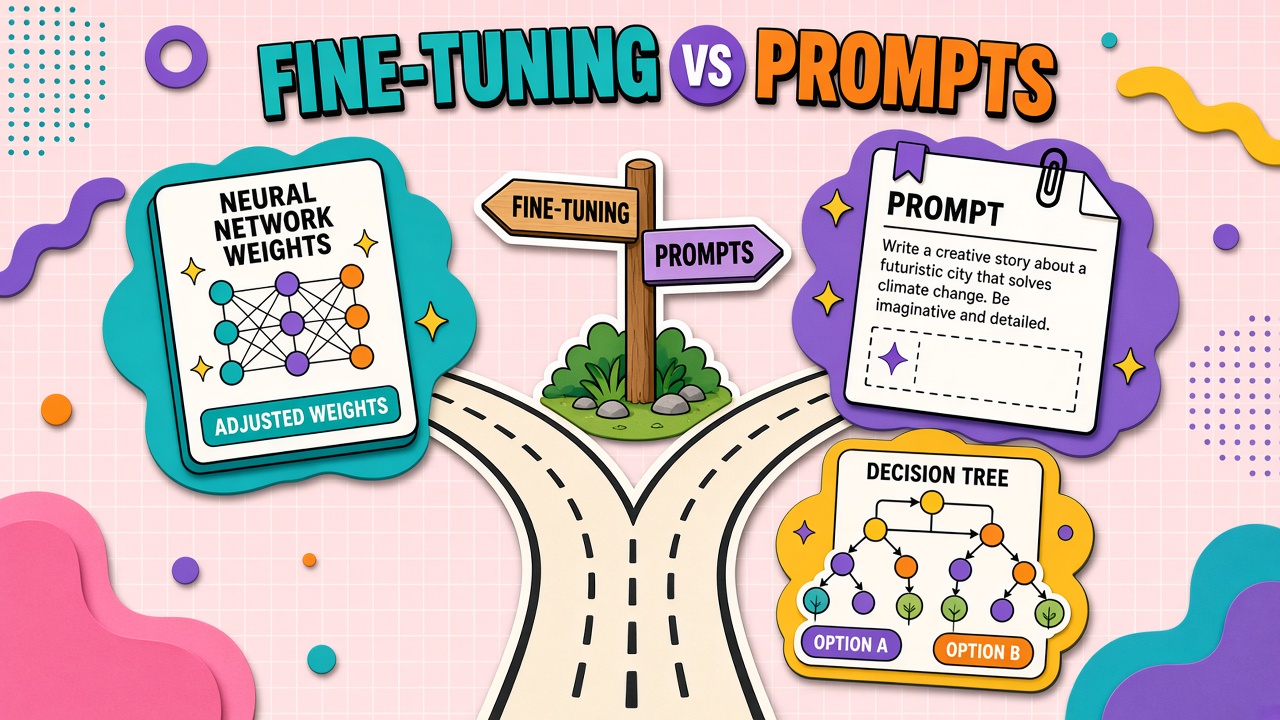
Prompt engineering shapes model behavior through instructions and examples at inference time. RAG (retrieval-augmented generation) adds external knowledge at query time without changing model weights. Fine-tuning updates model weights on labeled examples to bake in behavior or style. This guide compares all three paths, when each fits, data requirements, hybrid patterns in commercial tools, and a decision framework without vendor rankings. Developers evaluating AI APIs should map their gap to technique type before requesting a fine-tuning budget.
Three Ways to Customize: Prompts, RAG, and Fine-Tuning
Customization means closing the gap between default model behavior and what your product needs. The gap type determines the technique. Need current refund policy text? That is a knowledge gap (RAG). Need JSON in your exact schema every time? That may be a behavior gap (prompt engineering first, fine-tuning if prompts plateau). Need a small model to classify support tickets at high volume? That may justify fine-tuning.
| Technique | What changes | Best for | Skip when |
|---|---|---|---|
| Prompt engineering | Instructions and examples in the request | Tone, format, simple task routing, few-shot patterns | Facts change daily and exceed context window |
| RAG | Retrieved documents injected at query time | Private docs, citations, fast-updating knowledge | Task needs new reasoning style, not new facts |
| Fine-tuning | Model weights updated on training examples | Consistent schema, domain register, high-volume narrow tasks | You only need current facts from a wiki |
Cost and Maintenance Comparison
Prompt engineering costs engineer time, not GPU clusters. Iteration cycles are hours to days. RAG adds infrastructure: embedding pipelines, vector stores, chunking logic, and reindex jobs when documents change. Fine-tuning adds dataset curation, training runs, evaluation harnesses, and retraining when base models update.
- Prompt engineering: Lowest upfront cost; ongoing cost is longer prompts (more tokens per call).
- RAG: Moderate build cost; ongoing cost is indexing, storage, and retrieval latency per query.
- Fine-tuning: Highest upfront cost; ongoing cost includes retraining cadence and inference on custom endpoints.
The diagnostic question from production teams: "Would the model answer correctly if I pasted the relevant document into its context?" If yes, you need RAG or better retrieval, not fine-tuning. If no, because the model cannot follow the output format reliably even with examples, consider fine-tuning after exhausting prompts.
Data Requirements for Fine-Tuning
Fine-tuning quality scales with labeled example quality, not just quantity. Vendors often suggest hundreds to thousands of input-output pairs for supervised fine-tuning (SFT). Classification and extraction tasks may need fewer examples than open-ended generation. Every example must represent the behavior you want; noisy labels teach the model your mistakes.
- Define success criteria with a scored evaluation set before training.
- Collect examples from real production failures, not synthetic paraphrases alone.
- Hold out 15 to 20 percent for validation; never tune on the test set.
- Version datasets alongside model checkpoints for auditability.
- Plan retraining triggers: base model upgrades, policy changes, accuracy drift on eval set.
When Prompt Engineering Is Enough
Most business applications never leave prompt engineering plus optional RAG. A clear system message, two to five few-shot examples, explicit output format, and chain-of-thought instructions for complex reasoning solve a surprising share of production requirements. Teams report double-digit accuracy gains from prompt refinement alone on many tasks.
Prompt engineering suffices when the base model already understands your domain vocabulary, when output structure can be specified in natural language or JSON schema, when facts fit in retrieved chunks, and when call volume does not demand a smaller cheaper model. Coding assistants often fall here: the model knows the language; your prompt defines the task. Browse AI coding tools to see how far productized prompts go before custom training enters the picture.
Hybrid Patterns in Commercial Tools
Production systems rarely use one technique in isolation. Common hybrids include RAG plus prompt templates for citation format, fine-tuned classifiers routing queries to specialized prompts, and fine-tuned tone with RAG for factual grounding. Legal and medical assistants often combine fine-tuned register (how to write) with RAG over statutes (what to cite).
Decision tree by gap type
- Knowledge gap, documents update often: RAG first; add prompts for citation style.
- Format gap, consistent JSON or XML: Prompt engineering with structured output; fine-tune if refusal rate stays high.
- Volume gap, need cheaper inference: Fine-tune a small model on a narrow task after prompt-prototyping on a large model.
- Policy gap, strict compliance wording: Fine-tune or constitutional prompts; never rely on RAG alone for behavior.
- Latency gap, long system prompts: Fine-tune to internalize instructions and shorten runtime prompts.
Frequently Asked Questions
Can a small business fine-tune ChatGPT?
OpenAI and other vendors offer fine-tuning APIs on select base models for teams with API access and qualifying datasets. Consumer ChatGPT plans do not expose weight training. Small businesses typically start with custom instructions and RAG via vendor assistants or third-party platforms before pursuing fine-tuning.
Should I use RAG or fine-tuning for company knowledge?
RAG. Fine-tuning cannot reliably inject facts that change after the training run. Updating an index is faster and cheaper than retraining when policies, prices, or product catalogs shift.
How long does fine-tuning take?
Dataset preparation often takes weeks. Training runs may complete in hours on vendor infrastructure. Evaluation, safety review, and deployment add more calendar time. Budget months for a first production fine-tune, not days.
Is prompt engineering a real skill?
Yes. Effective prompting requires understanding model limits, eval design, and iterative testing. It is engineering work even when it does not touch GPU clusters.
Can you combine all three techniques?
Yes, and many enterprise deployments do. Use prompts for runtime control, RAG for knowledge, and fine-tuning for behavior or cost optimization on the highest-volume sub-task.
The Bottom Line
Start with prompt engineering. Add RAG when answers need private or changing knowledge. Reserve fine-tuning for persistent behavior, format, or cost problems that prompts and retrieval cannot solve. Match technique to gap type, measure on a fixed eval set, and avoid fine-tuning as a default badge of sophistication. Compare AI API and AI coding platforms on EliteAI.tools by how far their built-in customization goes before you need custom training.