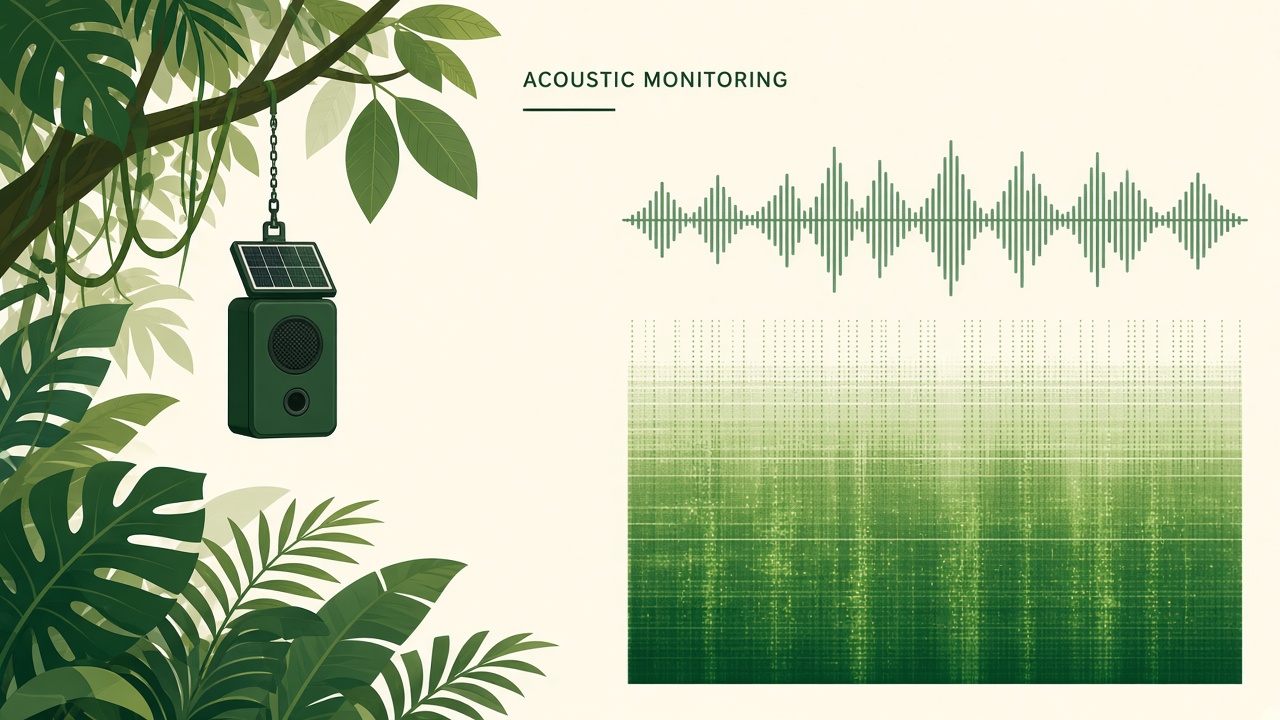
A conservation biologist walks a transect through Ecuadorian cloud forest and counts twelve bird species in an hour. That same hour, a solar-powered recorder mounted ten meters up captures thousands of vocalizations from canopy birds, understory insects, distant howler monkeys, and frogs along a stream. Human surveys scale poorly across vast, inaccessible terrain. Rainforest acoustic monitoring AI converts those continuous audio streams into species detections, biodiversity indices, and restoration trajectories that land managers, carbon credit auditors, and indigenous stewardship programs can act on.
Passive acoustic monitoring (PAM) has matured from niche ecology experiments into operational biodiversity surveillance. Convolutional neural networks, transformer audio models, and community science platforms like BirdNET now process hundreds of thousands of hours of field recordings. Teams building alert dashboards or field reporting tools through AI chatbot interfaces should understand which detection layer supplies species labels and confidence scores. For more research explainers on AI applied to environmental systems, visit the EliteAI.tools blog index.
What Rainforest Acoustic Monitoring AI Means in Plain Language
Rainforest acoustic monitoring AI is the use of machine learning models to classify, count, and track vocalizing species from continuous audio recorded in tropical forests, producing biodiversity metrics without direct visual observation. Recorders capture sound 24 hours a day across wet seasons, night cycles, and canopy layers that camera traps cannot reach. Models trained on labeled spectrograms or raw waveforms assign species labels, estimate abundance proxies, and flag acoustic communities that shift when forests are logged, restored, or fragmented.
The approach complements camera traps and eDNA sampling. Audio travels farther through dense vegetation than line of sight. Many rainforest birds and primates vocalize at dawn choruses, during territorial displays, and in response to weather. A single recorder can sample dozens of hectares if vocalizations carry. The tradeoff is taxonomic coverage: acoustic AI excels for vocal taxa (birds, frogs, bats, some mammals) and struggles with silent insects, plants, and cryptic reptiles.
| Monitoring method | Strength in rainforest | Limitation |
|---|---|---|
| Passive acoustic (AI) | Continuous, canopy-scale, night coverage | Vocal species only; rain and wind noise |
| Camera traps | Visual ID for mammals, ground birds | Limited field of view; theft risk |
| Human transects | Expert validation; habitat notes | Labor intensive; observer bias |
| eDNA (water, soil) | Broad taxonomic signal | Point samples; lab turnaround |
How the Underlying Acoustic AI Pipeline Works
A typical rainforest acoustic AI pipeline chains field recording, cloud or edge storage, spectrogram generation, neural network inference, and ecological aggregation into biodiversity indices or species inventories. Each stage introduces decisions that affect whether a restoration project earns credible acoustic evidence.
Field hardware and deployment
Solar-powered autonomous recorders (AudioMoth, Swift, custom rigs) sample at 16 to 48 kHz, often in lossy compressed formats to extend battery life across weeks of deployment. Mounting height, distance from streams, and proximity to logging roads change the species assemblage captured. Standard operating procedures document recorder GPS, gain settings, and schedule so models trained on one site do not silently fail when gain drifts at another.
BirdNET and large-scale bird classification
BirdNET, developed at the Cornell Lab of Ornithology, has processed more than 152,000 hours of audio with reported precision above 80% for many species, detecting 89 species in large-scale validation campaigns. The model uses a convolutional architecture on mel-spectrogram inputs and ships as a mobile app, desktop client, and API for batch processing. BirdNET generalizes well for North American and European birds; tropical deployments require checking whether target species appear in training metadata and whether subspecies with similar songs confuse the classifier.
DeepForestSound and primate vocalizations
DeepForestSound, evaluated in Kibale National Forest, Uganda, achieved average precision of 0.964 for primate call detection using deep learning on rainforest soundscapes where manual review is prohibitive. Primate monitoring matters for conservation because many species are endangered and vocally active at dawn. Specialized models outperform generic bird classifiers on hoots, grunts, and long-call sequences that differ from passerine song structure.
Restoration metrics from Ecuador CNN studies
A convolutional neural network applied to acoustic indices in Ecuadorian forest restoration sites reported adjusted R-squared of 0.69 when predicting restoration success from soundscape features, published in Nature Communications. The study linked acoustic complexity and species richness proxies to ground-truthed vegetation structure, showing that AI-derived soundscape metrics can track whether replanted areas recover toward reference forest acoustic signatures. Adjusted R-squared of 0.69 indicates meaningful but imperfect prediction: acoustic AI supports restoration monitoring but does not replace plot-based botanical surveys.
| System / study | Reported performance | Primary application |
|---|---|---|
| BirdNET (Cornell) | 152,376+ hours processed; 80%+ precision; 89 species | Global bird detection and citizen science |
| DeepForestSound (Kibale) | AP 0.964 for primate calls | African rainforest primate monitoring |
| Ecuador restoration CNN | adj-R² 0.69 for restoration prediction | Reforestation outcome tracking |
Typical workflow steps
- Define monitoring goals (species inventory, restoration benchmark, illegal logging alert).
- Deploy recorders across stratified habitat gradients with GPS and metadata logs.
- Upload audio to storage; run quality control for corrupted files and gain clipping.
- Generate spectrograms or pass raw audio to pretrained or fine-tuned classifiers.
- Apply confidence thresholds; queue low-confidence segments for expert review.
- Aggregate detections into occupancy, acoustic diversity indices, and trend lines.
- Validate a random subset against expert ornithologists or parallel transect counts.
Acoustic Indices and Biodiversity Metrics
Beyond species-level classifiers, acoustic indices compress soundscapes into numeric features that track forest condition when labeled training data is scarce. Acoustic complexity index (ACI), acoustic diversity index (ADI), and bioacoustic index (BI) summarize energy distribution across frequency bins and temporal bins. The Ecuador restoration CNN used such features as inputs, linking soundscape structure to vegetation recovery without requiring species ID for every vocalization. Indices trade taxonomic precision for robustness: a logging road may reduce ACI before ornithologists confirm which species disappeared.
Teams often run a dual pipeline: BirdNET or custom CNNs for flagship species (parrots, hornbills, howlers) plus index trends for overall soundscape health. Reporting both avoids overclaiming species lists from noisy clips while still giving funders year-over-year charts. Seasonal baselines matter: insect choruses dominate wet season spectra and can mask bird declines if indices are not stratified by month.
Real Deployments and Published Evidence
Acoustic monitoring now supports REDD+ carbon projects, national park boundary enforcement, and long-term ecological research stations across the Amazon, Congo Basin, and Southeast Asian archipelagos. Projects pair local parataxonomists who know dawn chorus species with cloud pipelines that scale review beyond what any field team could listen to manually.
The Ecuador restoration work demonstrates that soundscape AI can correlate with vegetation recovery, giving funders an intermediate metric between planting day and decades-long canopy closure. BirdNET-scale processing proves that community science and research labs can share model weights and label taxonomies, though tropical endemics remain underrepresented in training data compared to temperate species.
Kibale primate results show that taxon-specific models beat one-size-fits-all bird networks when conservation targets narrow to chimpanzees, red colobus, or grey-cheeked mangabeys. Agencies should budget for fine-tuning when generic pretrained weights underdetect focal species.
Limits, Risks, and Ethical Guardrails
Rainforest acoustic AI can overstate certainty when confidence thresholds are tuned on easy clips and deployed on rainy nights, distant aircraft, and chainsaw noise without revalidation. False positives inflate species lists; false negatives hide silent declines. Both distort biodiversity credit claims and enforcement triggers.
- Domain shift: Models trained in Costa Rica may fail in Borneo without local fine-tuning.
- Label scarcity: Rare endemics have few training examples; detectors remain unreliable.
- Acoustic masking: Heavy rain and insect choruses obscure target vocalizations.
- Data sovereignty: Indigenous territories may restrict audio export; pipelines need local governance.
- Surveillance dual use: Continuous audio can capture human activity; consent and purpose limits matter.
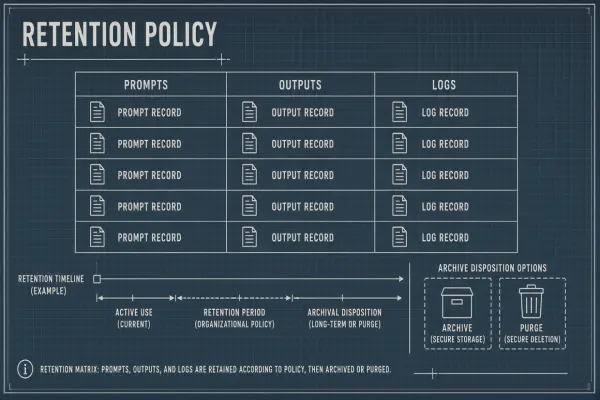
Ethical guardrails include co-design with local communities, clear data retention policies, expert review queues for high-stakes decisions, and publishing detection thresholds alongside biodiversity reports. Acoustic AI informs conservation; it does not replace indigenous knowledge of forest health.
Who Should Use This and Who Should Wait
Restoration NGOs, national park agencies with recurring budgets, and research stations already running camera traps should add acoustic recorders and BirdNET-class pipelines now, with expert validation on focal species. Small projects without ornithological review capacity should wait until they can audit false detection rates on local audio.
| Audience | Recommendation | Caveat |
|---|---|---|
| Carbon / restoration project | Deploy recorders; track acoustic indices over years | Pair with botanical plots; adj-R² is not perfect |
| Primate conservation program | Fine-tune primate-specific detectors | Validate AP claims on your forest |
| Citizen science network | Use BirdNET for outreach and baseline lists | Tropical species gaps remain |
| One-off biodiversity audit | Combine short deployment with expert listening | Single season misses migrants and rare events |
Frequently Asked Questions
How does acoustic monitoring compare to camera traps in rainforest?
Acoustic monitoring covers vocal species continuously including at night and high in canopy; camera traps excel for visual identification of ground mammals but miss many birds and frogs. Combined deployment gives the strongest biodiversity picture.
Can BirdNET work in tropical rainforest?
BirdNET processes tropical recordings but precision varies by species representation in training data; teams should validate detections against local experts and consider fine-tuning for endemic birds. Reported 80%+ precision applies to well-represented taxa, not every regional endemic.
Can acoustic AI track forest restoration success?
Yes. Ecuador CNN research linked soundscape features to restoration outcomes with adj-R² of 0.69, supporting acoustic indices as intermediate recovery metrics alongside vegetation plots. Longitudinal recording strengthens trend detection.
What accuracy can primate call detectors reach?
DeepForestSound reported average precision of 0.964 for primate calls in Kibale forest validation, though performance depends on species, distance, and background noise. Custom training on focal species improves on generic models.
How do teams handle rain and wind noise?
Pipelines use noise classification filters, spectral masking, and scheduling that weights dry-season dawn choruses; some projects discard high-amplitude weather segments before inference. No filter removes all weather artifacts without losing biology.
How much storage does continuous recording require?
Weeks of 24/7 audio at 48 kHz generate terabytes across large arrays; teams use compressed formats, edge triggering, or duty cycling during target vocalization windows. Cloud costs belong in project budgets from day one.
Conclusion
Rainforest acoustic monitoring AI turns soundscapes into scalable biodiversity evidence. BirdNET demonstrates planet-scale bird processing; DeepForestSound shows primate detection at 0.964 AP in Kibale; Ecuador restoration CNN work ties acoustic indices to recovery with adj-R² of 0.69. Success requires local validation, ethical data governance, taxon-specific models when needed, and honest reporting of limits. Teams that document thresholds, expert review rates, and habitat metadata will produce acoustic science that funders and communities can trust.