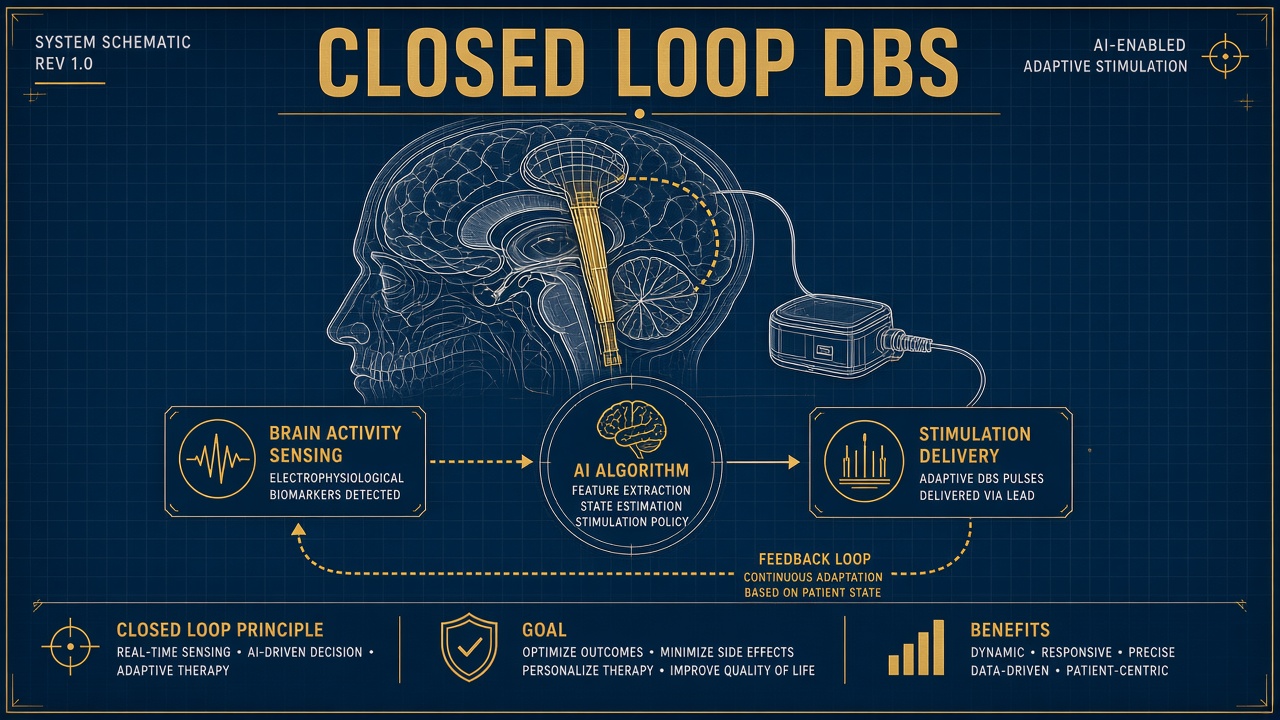
Closed-loop brain stimulation with AI and adaptive control uses implanted electrodes to record local field potentials, detect symptom-linked biomarkers such as beta oscillations, and tune stimulation amplitude automatically instead of delivering constant open-loop pulses. In February 2025 the FDA approved Medtronic BrainSense Adaptive deep brain stimulation for Parkinson's disease, the first commercial closed-loop DBS system. Machine learning research extends biomarker discovery and controller personalization, but approved devices today rely on interpretable threshold rules rather than black-box neural networks. Neurology teams exploring AI healthcare hardware should separate cleared adaptive DBS from experimental psychiatric closed-loop trials.
Open-Loop vs Closed-Loop Stimulation
Open-loop deep brain stimulation delivers continuous or scheduled electrical pulses regardless of momentary brain state; closed-loop systems sense neural activity and modulate stimulation when biomarkers cross thresholds. Conventional DBS programming sets voltage, frequency, and pulse width during clinic visits, then leaves settings static until the next adjustment months later. Parkinson's motor symptoms fluctuate hourly with medication cycles, sleep, and stress, so static stimulation wastes energy during good symptom control and under-treats during "off" periods.
Closed-loop or adaptive DBS (aDBS) records local field potentials (LFPs) through the same implanted leads that deliver stimulation. LFPs reflect summed synaptic activity in local neuronal populations. When pathological beta-band power (roughly 13 to 30 Hz) rises in subthalamic nucleus or globus pallidus internus targets, the stimulator increases output; when beta suppresses during good motor state, stimulation eases, reducing side effects such as dyskinesia and battery drain.
Medtronic's Percept neurostimulators gained FDA sensing capability in 2021 to log LFPs for clinician review. The 2025 BrainSense Adaptive approval adds autonomous real-time adjustment in daily life, not only data recording during programming sessions. More than 40,000 worldwide Percept patients may be eligible for the software update pathway per company announcements.
Biomarkers That Trigger Adaptation
Beta-band oscillatory power in basal ganglia circuits is the primary validated biomarker for Parkinson's adaptive DBS, with research exploring gamma, theta, and kinematic wearable fusion. Excessive beta synchrony correlates with bradykinesia and rigidity in many patients. Adaptive controllers map beta power estimates to stimulation intensity using single-threshold or dual-threshold policies tested in the ADAPT-PD program and long-term follow-up published in JAMA Neurology 2025 (doi:10.1001/jamaneurol.2025.2781).
Dual-threshold aDBS turns stimulation up when beta exceeds an upper bound and down when it falls below a lower bound, creating hysteresis that prevents rapid toggling. Single-threshold modes simplify tuning. Patient-specific threshold calibration occurs during initial programming with clinician oversight using BrainSense Electrode Identifier tools, which Medtronic reports can reduce initial programming time with 85% accuracy improvements in promotional materials reviewed by third-party FDA summaries.
Research frontiers apply machine learning to classify motor states from multimodal streams: LFPs plus accelerometer data from wearables, sleep stage from actigraphy, or speech prosody. These AI-enriched biomarkers remain investigational for closed-loop control because regulators demand explainable safety envelopes before autonomous dosing. Depression closed-loop trials explore cortical evoked potentials and different frequency bands, but approved adaptive indications currently center on Parkinson's motor fluctuations.
| Mode | Sensing | Stimulation rule | Reported outcome (ADAPT-PD long-term) |
|---|---|---|---|
| Continuous DBS (cDBS) | None during therapy | Fixed parameters 24/7 | Baseline comparator |
| Single-threshold aDBS | Beta-band LFP power | Adjust when beta crosses one boundary | 79% met on-time goal vs cDBS |
| Dual-threshold aDBS | Beta-band LFP power | Upper/lower bounds with hysteresis | 91% met on-time goal; exploratory on-time gains |
Controller Algorithms and Safety Limits
Approved adaptive DBS controllers use embedded threshold logic with hard caps on amplitude, duty cycle, and ramp rates; research prototypes test ML classifiers under similar safety interlocks. Latency budgets require biomarker estimation and stimulation updates within hundreds of milliseconds to track motor fluctuations. Implantable pulse generators run firmware-level control loops without cloud dependence, avoiding network failure modes during therapy. Maximum and minimum stimulation floors prevent zero-output periods that could precipitate severe rigidity.
Machine learning enters preclinical and ancillary workflows: clustering patient LFP fingerprints, predicting optimal contacts, and simulating threshold policies before human deployment. Fully learned end-to-end controllers that map raw LFP tensors to stimulation waveforms face verification challenges. Regulators and clinicians prefer transparent beta-power rules whose behavior can be simulated offline on recorded LFP traces.
Stimulation-related adverse events in long-term aDBS follow-up (68 participants, mean age 62.2 years, 70.6% male) largely resolved during setup except one persistent case, with no serious device-related adverse events through extended monitoring in the JAMA Neurology 2025 report. Total electrical energy delivered decreased 15% under single-threshold aDBS versus continuous DBS (nominal P = 0.01), implying battery life benefits alongside symptom control.
Depression and Parkinson's Use Cases
Parkinson's motor fluctuation management is the first FDA-approved adaptive DBS indication; treatment-resistant depression closed-loop trials use different targets and biomarkers still under investigation. Parkinson's patients with persistent "off" time despite medication and conventional DBS candidacy gain from real-time beta-linked adjustment. Primary endpoint definitions in trials emphasize patient-reported motor diaries measuring on-time without troublesome dyskinesias, aligning with how people experience benefit in daily life rather than abstract electrophysiology alone.
Depression adaptive DBS targets subcallosal cingulate or other limbic circuits with biomarkers distinct from beta oscillations. Early closed-loop psychiatric neuromodulation studies explore evoked potential amplitudes and gamma-band features, but no depression adaptive system matched the February 2025 Parkinson's approval at time of writing. Mental health applications raise unique consent and affective state monitoring ethics beyond movement disorders.
Epilepsy responsive neurostimulation (RNS) pioneered closed-loop sensing for seizure detection years earlier, demonstrating regulatory precedents for implantable loops, though algorithms focus on epileptiform activity detection rather than Parkinson beta bands. Cross-indication learning informs AI biomarker pipelines shared across neuromodulation companies.
Open-loop DBS remains appropriate for many patients with stable symptoms and infrequent clinic visits. Adaptive mode adds firmware complexity and requires patients to understand that stimulation intensity will vary automatically. Shared decision-making should review lifestyle factors (exercise, sleep, medication timing) that also modulate motor state independent of biomarker-driven adjustments.
Regulatory Path for Adaptive Devices
Adaptive DBS reached US patients through FDA 510(k) substantial equivalence building on sensing-enabled predicate hardware, with CE Mark availability in Europe preceding US approval. Medtronic announced CE Mark for BrainSense Adaptive in January 2025 and FDA approval February 24, 2025. Existing Percept implantees can receive adaptive features via wireless software updates, reducing surgical barriers. BrainSense Electrode Identifier received parallel clearance to streamline contact selection during programming.
ADAPT-PD trial full results continue to mature; preliminary positive findings supported approval while long-term JAMA Neurology 2025 data reinforce tolerability over ten months. Post-market surveillance will track real-world programming patterns, battery longevity, and rare edge cases when beta biomarkers misclassify non-motor fluctuations.
Future ML-heavy controllers may require de novo or PMA pathways if manufacturers cannot map to predicate threshold devices. Software predetermined change control plans for self-updating biomarker models are under FDA discussion for other device classes and will affect neuromodulation AI roadmaps. Teams tracking AI research should monitor FDA digital health guidance for closed-loop class II neurology devices.
Latency, Battery, and Cybersecurity in Implants
Closed-loop DBS must sense, compute, and stimulate within sub-second windows to track motor fluctuations, imposing firmware constraints that exclude cloud round trips. Beta-power estimation runs continuously on implant batteries already strained by chronic stimulation. Energy savings from adaptive duty cycling (documented as reduced total electrical energy delivered in JAMA Neurology 2025) partially offset sensing overhead. Patients still require surgical battery replacements every few years depending on parameter sets; clinicians should counsel that adaptive modes may extend but not eliminate replacement cycles.
Cybersecurity models treat patient programmers and clinic tablets as trusted endpoints communicating over encrypted short-range links. Researchers publish threat analyses on hypothetical unauthorized reprogramming, motivating firmware signing and anomaly detection. No substitute exists for patients reporting unexpected symptom surges; adaptive systems include clinician-programmed ceilings even when biomarkers spike artifactually from lead migration or electromagnetic interference.
Mental health closed-loop trials raise distinct safety questions: misclassified mood states could trigger stimulation at harmful moments. Movement disorder approvals therefore do not automatically transfer to psychiatric indications. AI biomarker discovery may accelerate candidate frequency bands, but FDA reviewers will likely require interpretable control policies for each new indication before approving autonomous adaptation outside research consortia.
Patients considering upgrade to adaptive mode should discuss whether their symptom pattern includes predictable beta-linked fluctuations. Some individuals stabilized on continuous DBS may see limited incremental benefit, while those with pronounced wearing-off despite optimized open-loop settings are prime candidates. Programming visits still matter: clinicians set biomarker thresholds, verify electrode contacts with BrainSense Electrode Identifier, and monitor for stimulation side effects such as speech changes or paresthesias that biomarkers alone cannot detect.
Frequently Asked Questions
What is closed-loop DBS?
Closed-loop deep brain stimulation senses brain electrical activity through implanted leads and automatically adjusts stimulation when biomarkers such as beta power indicate worsening symptoms, unlike open-loop constant stimulation.
Is adaptive DBS FDA approved?
Yes. Medtronic BrainSense Adaptive DBS for Parkinson's motor fluctuations received FDA approval in February 2025 for patients with Percept neurostimulators meeting labeling criteria.
Does AI run inside the implant?
Cleared adaptive controllers use embedded threshold algorithms on beta-band power, not cloud large language models. Machine learning assists research and clinic programming tools; the therapeutic loop remains on-device firmware.
Will adaptive DBS help depression?
Investigational depression closed-loop studies continue, but the 2025 commercial adaptive approval targets Parkinson's disease motor symptoms. Psychiatric indications require separate trials and biomarker validation.
Does closed-loop extend battery life?
Long-term study data reported 15% reduction in total electrical energy delivered under single-threshold adaptive DBS versus continuous DBS, suggesting potential battery longevity gains when stimulation eases during good symptom periods.
Can hackers control DBS implants?
Implants communicate via short-range wireless protocols with authentication in clinical programmers. No widely reported remote ransomware attacks on DBS have occurred, but cybersecurity remains part of FDA device submissions. Patients should use manufacturer-approved programmers only.
What side effects change with adaptive DBS?
Adaptive therapy aims to reduce stimulation during periods when beta biomarkers are low, potentially lowering dyskinesia and speech side effects linked to excessive continuous stimulation. Individual responses vary; programming still requires specialist oversight.
Medtronic cites more than ten years of BrainSense sensing development culminating in the February 24, 2025 FDA approval announcement. The ADAPT-PD program's dual-threshold and single-threshold modes give clinicians tunable policies rather than a single black-box AI, reflecting how neuromodulation regulation currently balances innovation with interpretable safety cases.